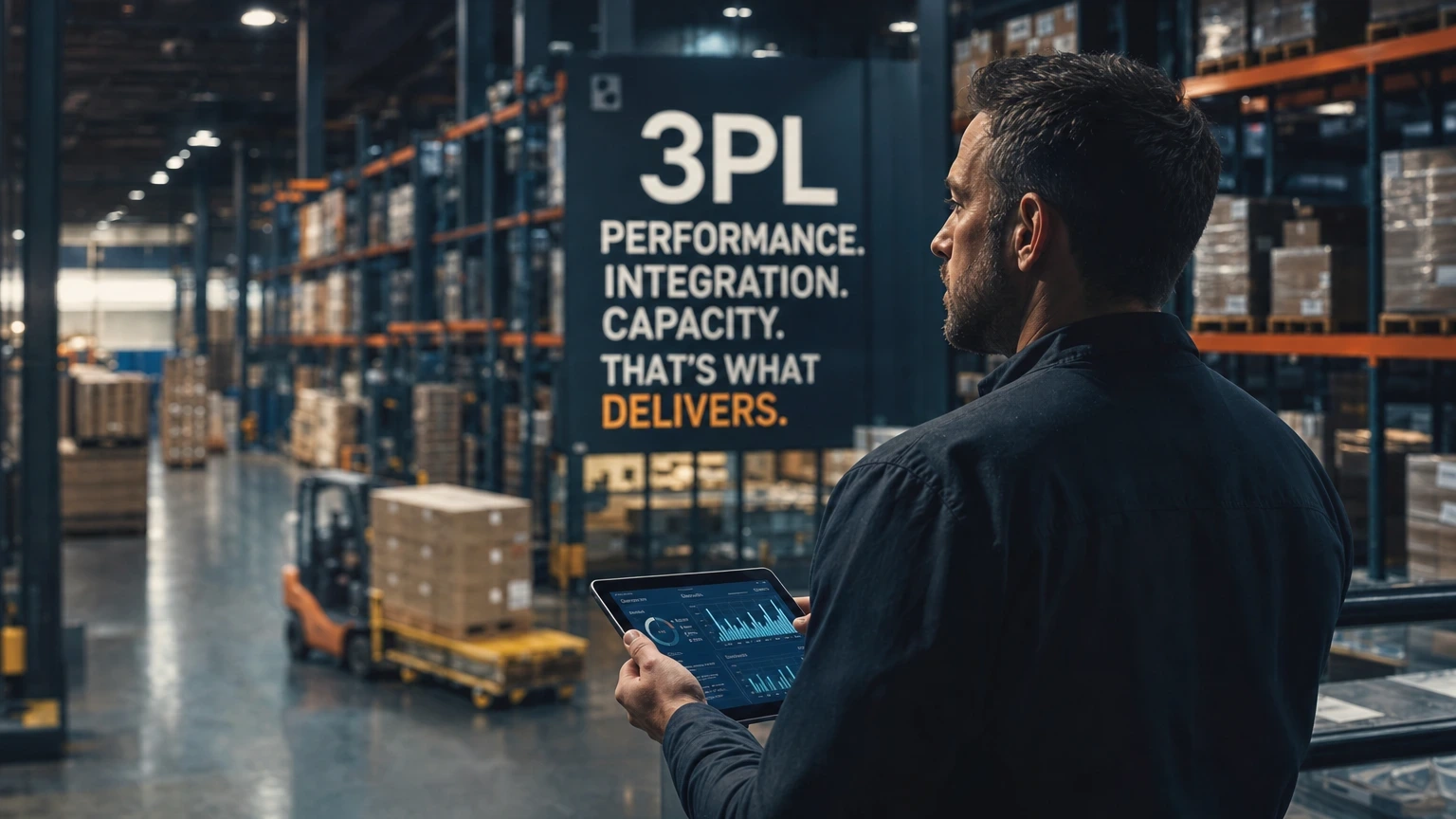
Most shippers pick a 3PL company based on a slick sales deck and a low quoted rate. That’s backwards. The contracts that blow up in year two almost always ignore the stuff that actually runs a warehouse: pick rates, WMS integration depth, and racking capacity for your SKU mix.
The pattern repeats across the industry. The cheapest bid on paper becomes the most expensive relationship by month eight, usually through accessorial charges and rework nobody priced into the original quote. This guide covers what to check before you sign, not what the brochure promises.
What a 3PL Company Actually Does Day to Day
If you are still mapping the basics, start with our explainer on 3PL meaning and what these providers cover.
A 3PL company handles receiving, storage, pick-pack, and outbound shipping so you don’t have to run your own warehouse. That’s the textbook version. The real version is messier.
On a typical mid-size DC floor, a receiving team processes inbound trailers against purchase orders, scans cartons into a WMS like Manhattan Associates or Fishbowl Inventory, and slots product into bins based on velocity. Fast movers go to forward pick locations near the pack stations. Slow movers get pushed to reserve racking, sometimes 30+ feet up.
Definition: A 3PL (third-party logistics) company is an outsourced provider that manages warehousing, inventory, order fulfillment, and shipping on behalf of another business, typically billed through storage fees, pick fees, and per-order fulfillment charges.
Walk a 90,000 square foot facility where inventory accuracy sits at 97.2% and the number sounds fine until you do the arithmetic on units. A 2.8% error rate on 40,000 monthly orders means over 1,100 mis-picks a month. That’s the number that should scare you, not the square footage.
Pick Rates and Fulfillment Accuracy Benchmarks
Pick rate is the single best predictor of whether a 3PL company can scale with you during peak. A solid single-item pick operation should hit 60 to 90 picks per hour per associate using pick-to-light or voice-directed systems. Batch picking for multi-line orders often pushes that to 120-150 lines per hour.
Inventory accuracy is the second number to demand in writing. Anything below 98.5% cycle count accuracy signals a WMS or process gap. Top-tier operators run 99.5%+ using RF scanning at every touchpoint plus daily cycle counts on a subset of SKUs rather than one chaotic annual count.
Consider a subscription-box brand whose 3PL quotes 99% accuracy while its actual cycle count data shows 96.4% over the prior quarter. On that volume the gap is 2,600 wrong shipments a month. The answer is to tie SLA penalties to a rolling 30-day accuracy average rather than a marketing claim.
Order cutoff times matter just as much. If your 3PL company promises same-day shipping but their cutoff is 11am for an operation processing orders until 6pm, you’re not getting same-day for half your volume. Get the cutoff time in the contract, not the sales call.
Warehouse Management Systems That Actually Sync With Your Stack
Comparing the Major WMS Options
Your 3PL’s software is your software, functionally speaking, since you’ll be staring at its dashboards daily.
| WMS Platform | Best For | Typical Pricing | Integration Strength |
|---|---|---|---|
| Manhattan Associates | High-volume enterprise DCs | $150,000+/year licensing | Deep ERP, strong EDI |
| NetSuite WMS | Mid-market brands already on NetSuite ERP | $999-$3,999/month per module | Native NetSuite sync |
| Fishbowl Inventory | Small to mid-size 3PLs | $4,395 one-time plus hosting | Solid QuickBooks tie-in |
| ShipHero | Ecommerce-focused fulfillment | From $1,995/month | Shopify, WooCommerce native |
| Extensiv (3PL Central) | Multi-client 3PL operators | Custom, usually $500-$2,000/month per client | Built for billing complexity |
The pricing above shifts fast, so treat it as a ballpark for budgeting conversations, not a quote.
What matters more than the sticker price is API latency. If your Shopify store fires an order and it takes 45 minutes to appear in the 3PL’s WMS, you’ve already lost the same-day cutoff. Ask for a live API test during your evaluation, not a screenshot.
A 3PL company running a 14-year-old legacy WMS can still hit 99.6% accuracy when the floor team knows the workarounds cold. Software age matters less than whether the team trusts and understands the tool they’re using every shift.
Racking, Storage Density, and Load Capacity Planning
Storage infrastructure decides how much you pay per pallet position, and that fee compounds monthly. A standard selective pallet rack beam typically holds 2,500 to 4,600 pounds per level depending on gauge and span, while a heavy-duty structural rack can carry upward of 6,000 pounds per beam pair.
For fast-moving ecommerce SKUs, most 3PLs use a mix of selective racking near pack stations plus carton flow rack for high-velocity small items. Carton flow lanes sitting on gravity rollers can boost pick density by 25-40% over static shelving because replenishment happens from the back while picking continues from the front.
A furniture brand may need drive-in racking rated for 3,000 pound pallets stacked four deep. Put that product on standard selective racking instead and 35% of usable cube goes to waste, because bulky pallets can’t nest properly. Correcting the racking type alone can cut the per-pallet storage fee by 18%.
Ask any prospective 3PL company for their racking load certification documents. If they can’t produce them on request, that’s a liability red flag, not a paperwork nitpick.
Choosing Between Dedicated and Shared Warehouse Space
Not every brand needs a dedicated facility, and not every 3PL company offers one. Here’s how the two models actually differ on the floor.
- Shared (multi-client) warehousing puts your inventory alongside other brands’ SKUs in the same building, often the same racking aisles. Costs run lower, typically $0.45-$0.75 per cubic foot monthly, because overhead splits across clients.
- Dedicated space gives you your own footprint, sometimes your own dock doors and staff. Expect $0.85-$1.40 per cubic foot, but you get priority during peak season congestion.
- Hybrid models reserve a fixed pallet count for you within a shared facility, giving predictable capacity without full dedicated overhead. This works well for brands doing 5,000-15,000 orders a month.
- Co-packing zones exist inside some 3PLs for kitting and bundling, and these areas need separate racking rated for lighter, higher-turn SKUs versus bulk reserve storage.
- Seasonal overflow space should be negotiated before peak, not during it. A 3PL scrambling for extra racking in November will charge premium rush rates, sometimes 2-3x standard storage fees.
Match your order volume and seasonality pattern to the right model before signing. A brand with a brutal Q4 spike needs overflow guarantees written into the contract, not a verbal promise.
Integration, Onboarding Timelines, and What Delays Go-Live
Onboarding a new 3PL company takes longer than anyone tells you upfront. A clean integration with an existing WMS and a simple SKU catalog can go live in 3-4 weeks. A complex catalog with kitting, lot tracking, or multi-warehouse distribution often runs 8-12 weeks.
The biggest delay isn’t software. It’s data. SKU masters with inconsistent dimensions, missing weights, or duplicate barcodes stall integration testing for days. An apparel catalog of 1,800 SKUs with no verified weight data can push go-live back three weeks on its own, while the 3PL’s receiving team weighs cartons by hand.
Run a parallel testing period before fully cutting over. Ship a small batch, maybe 50-100 orders, through the new 3PL while your old fulfillment process still handles the bulk of volume. Watch the accuracy numbers for two weeks before flipping the switch completely.
Freight and carrier integration also needs testing separately from order integration. A 3PL that generates shipping labels correctly for UPS but throws errors on USPS or regional carriers like OnTrac will cost you real money in manual label corrections during week one.
Finding the Right 3PL Company for Your Fulfillment Model
The right partner depends entirely on your SKU velocity, order complexity, and growth trajectory, not just the quoted per-order fee.
For a brand shipping under 2,000 orders a month with simple single-item packages, a smaller regional 3PL company with shared warehousing usually wins on cost and personal attention. For a brand pushing past 20,000 orders monthly with kitting, subscription boxes, or multi-channel demands, you need an operator running a modern WMS with real-time inventory sync and dedicated account management.
Don’t evaluate on price per order alone. A quote of $2.10 per order sounds better than $2.75 until you factor in the accuracy gap, the slower cutoff time, and the storage fee structure buried in the fine print. Build a total cost model across storage, pick fees, packaging, and return processing before comparing bids side by side.
The operators who last with their 3PL for five-plus years are the ones who audited the floor, tested the API, and checked the racking certs before signing anything. That diligence upfront saves the renegotiation headache later.
Frequently asked questions
What does 3PL stand for and what’s the difference from a 4PL?
3PL stands for third-party logistics, meaning a provider that physically handles your warehousing and fulfillment. A 4PL manages logistics strategy and coordinates multiple 3PLs and carriers on your behalf without necessarily touching inventory directly.
How much does a 3PL company typically charge?
Expect receiving fees around $25-$50 per pallet, storage at $0.45-$1.40 per cubic foot monthly depending on dedicated versus shared space, and pick-and-pack fees of $2-$4 per order for standard single-item shipments. Kitting, returns processing, and custom packaging add separately.
How long does it take to switch 3PL companies?
A straightforward transition with clean SKU data takes 3-4 weeks. Complex catalogs with lot tracking or multi-warehouse distribution can run 8-12 weeks, especially if inventory needs to be physically transferred between facilities.
What inventory accuracy rate should you expect from a 3PL company?
Top operators sustain 99.5% or higher using RF scanning and rolling cycle counts. Anything consistently below 98% signals process or WMS gaps worth investigating before you scale volume with that provider.
Can a small ecommerce brand use the same 3PL as a large enterprise?
Many 3PLs serve both segments, but the service model differs. Small brands typically land in shared warehousing with standard SLAs, while enterprise accounts negotiate dedicated space, custom integrations, and tighter accuracy guarantees backed by financial penalties.