Everyone assumes outsourcing to a 3PL warehouse saves money automatically. It doesn’t, not always. If your SKU count is low and your volume is predictable, an in-house operation can beat a 3PL on cost per order.
But for most growing ecommerce brands, a 3PL warehouse still wins on speed to market and flexibility. The real question isn’t cheaper or not. It’s whether your order profile matches what third-party fulfillment does well.
What a 3PL Warehouse Actually Does Day to Day
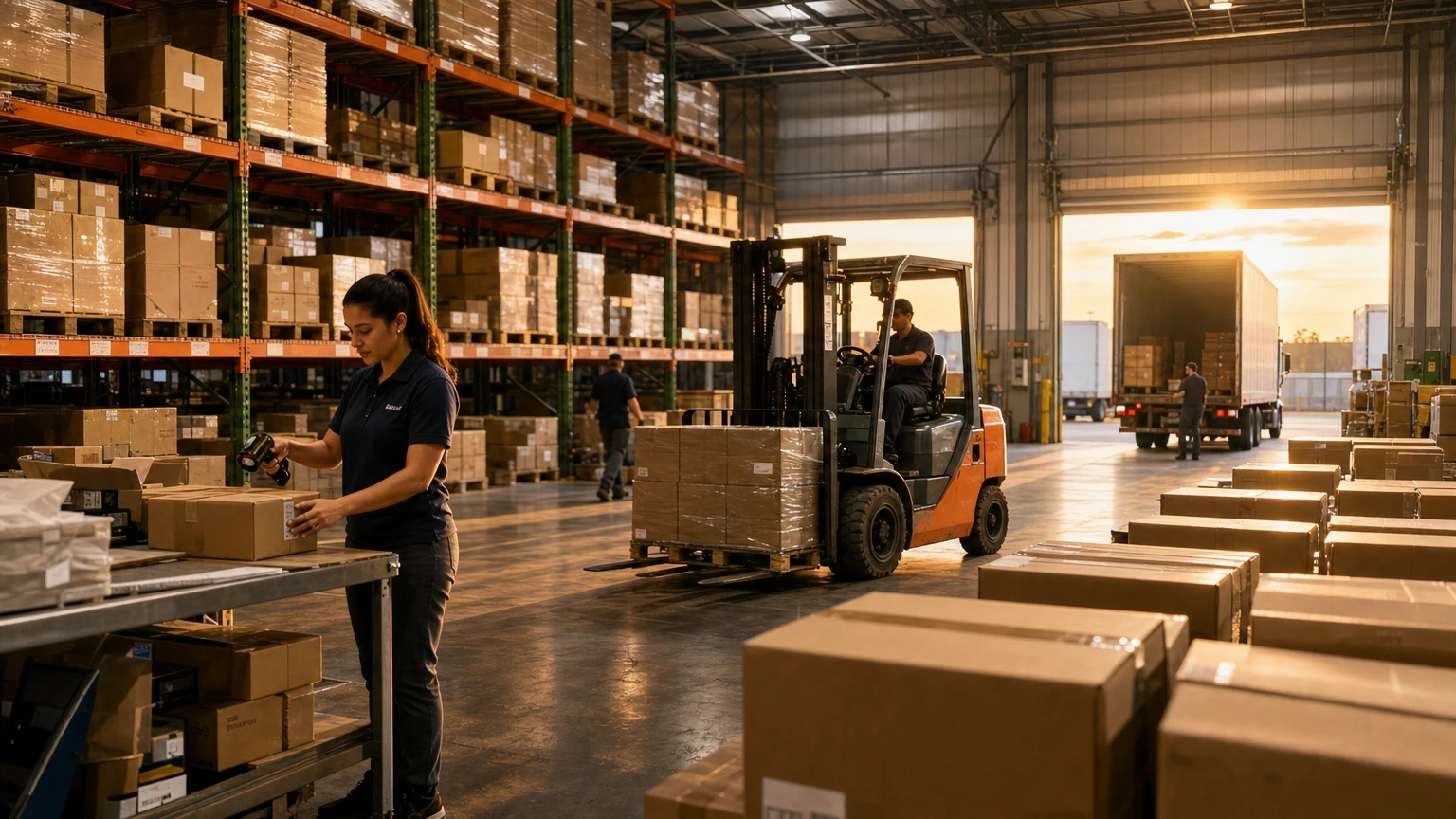
A 3PL warehouse (third-party logistics warehouse) receives your inventory, stores it, picks and packs orders, and ships them under your brand. That’s the short version. The longer version involves a lot of moving parts you don’t see from a dashboard.
On a typical floor, inbound receiving happens at a dock door with a 3-hour appointment window. A receiving clerk scans cartons against your ASN (advance shipping notice), and discrepancies get flagged within that same shift. Where the ASN data is clean, a 40-foot trailer carrying 26 pallets can be checked in, cross-docked, or put away in under 90 minutes. Where it isn’t, the same trailer can tie up a dock door for a full shift.
Storage happens across zones: bulk racking for slow movers, forward pick locations for your top 20% of SKUs, and sometimes climate-controlled rooms for anything temperature-sensitive. Pick rates in a well-run facility run 80 to 140 lines per hour per picker using RF scanners, and inventory accuracy sits at 99.5% or higher when cycle counts happen weekly instead of once a quarter.
Outbound is where the client actually feels the operation. Orders get batched, picked, packed, and handed to carriers like UPS, FedEx, or regional couriers before a cutoff time, usually 3 PM or 5 PM local. Miss that cutoff and your same-day promise turns into next-day.
Choosing Between Dedicated Space and Shared Fulfillment
Not every 3PL model looks the same. Some warehouses give you dedicated racking and staff. Others pool your inventory alongside dozens of other brands in a shared, multi-client facility. Here’s how the two actually compare on the floor.
Option A: Shared Multi-Client Warehouse
This is the standard model for brands shipping 500 to 15,000 orders a month. You rent space by the pallet or by cubic foot, and staff serve multiple clients on the same shift.
Costs run lower because overhead splits across tenants. Expect $25 to $40 per pallet per month for storage and $3 to $6 per order for pick-and-pack, depending on box count and packaging complexity. Onboarding takes 2 to 4 weeks in most cases.
The tradeoff is queue priority. During peak season, a shared facility processes orders in the sequence they hit the WMS (warehouse management system), not by client importance. A client of mine running a supplement brand saw pick times stretch from same-day to 36 hours during a November spike because bigger tenants got batched first.
Option B: Dedicated Facility or Zone
Above roughly 15,000 to 20,000 monthly orders, dedicated space starts making sense. You get your own racking, sometimes your own dock door, and staff trained only on your catalog.
Pricing shifts to a fixed monthly fee plus labor, often $8,000 to $25,000 a month depending on square footage and headcount. You lose some of the per-order flexibility, but you gain control over SLAs (service level agreements) and can negotiate pick-rate guarantees in the contract itself.
Racking in dedicated zones typically runs selective pallet racking rated for 2,500 to 4,600 pounds per beam level, stacked four to five levels high in a 24-foot clear-height building. That’s the standard for mixed-case ecommerce SKUs, not the heavier structural racking you’d see in a beverage distribution center.
How to Vet a 3PL Warehouse Before You Sign
Picking a fulfillment partner isn’t just a pricing conversation. It’s an operations audit. Here’s the sequence to work through before any contract gets signed.
- Request their inventory accuracy rate for the trailing 12 months. Anything below 98% means their cycle counting process is broken, and you’ll inherit that problem.
- Ask which WMS platform they run. Names like Manhattan Associates, Fishbowl, or ShipBob‘s proprietary system tell you a lot about integration depth with Shopify or Amazon FBA feeds.
- Tour the actual floor, not just the sales office. Look for aisle congestion, mislabeled bins, and whether pickers are using handheld scanners or still writing on paper.
- Check their damage and mis-ship rate. Industry benchmark sits around 0.5% to 1% of total orders. Above 2%, expect chargebacks from your own customers.
- Confirm dock-to-stock time. This is how long inventory sits after arrival before it’s scannable and sellable. Good operators hit 24 to 48 hours; slow ones take a week.
- Get their peak season capacity commitment in writing. A verbal promise means nothing on Black Friday when their floor is at 130% capacity.
Skipping any of these six steps is how brands end up locked into a 12-month contract with a warehouse that can’t hit a 99% on-time ship rate.
Warehouse Management Software That 3PLs Actually Run On
The WMS underneath a 3PL warehouse determines almost everything, your inventory visibility, your integration options, your billing accuracy. Here’s how the major platforms stack up.
| Software | Best For | Starting Price | Key Feature |
|---|---|---|---|
| Extensiv | Multi-client 3PLs | ~$400/month | Client billing automation |
| Fishbowl | Small-to-mid warehouses | ~$329/month per user | QuickBooks integration |
| Manhattan Associates | Enterprise distribution | Custom quote, $50K+/year | Labor management modules |
| NetSuite WMS | Brands already on NetSuite ERP | Bundled with ERP, varies | Real-time inventory sync |
| ShipHero | DTC and B2B hybrid | ~$1,850/month | Built-in 3PL billing tools |
Extensiv dominates the multi-client space because it was built specifically for warehouses billing different clients different rates. Fishbowl works fine for single-client operations under 10,000 SKUs but starts straining past that. Manhattan Associates is overkill unless you’re running six-figure daily order volume across multiple facilities.
One thing to check regardless of platform: does it support cycle counting on a rolling schedule, or only full physical inventory counts? Rolling cycle counts, counting a subset of bins daily, are how top-tier warehouses maintain that 99.5% accuracy number without shutting down operations for a full inventory freeze.
Racking, Equipment, and the Physical Layout Behind the Numbers
Software gets the attention, but the steel and concrete underneath it does the actual work. A 3PL warehouse floor plan usually breaks into three zones: fast-pick, bulk reserve, and returns processing.
Fast-pick zones use gravity flow racking or standard shelving at waist-to-shoulder height, optimized for pickers doing 120+ picks an hour. Bulk reserve uses selective pallet racking, and forklifts, often Toyota or Crown models, move pallets rated up to 3,000 pounds per fork in and out of positions three or four levels up.
Conveyor systems show up once order volume crosses roughly 2,000 orders a day. Below that threshold, cart-based picking is usually cheaper to run and easier to reconfigure when your SKU mix shifts.
Returns processing gets ignored by a lot of brands evaluating a 3PL, and that’s a mistake. A facility that takes 5 days to process a return and restock it is bleeding you sellable inventory. Ask for their average return-to-restock time before you sign, not after your first holiday return wave buries them.
Common Mistakes Brands Make Switching to a 3PL Warehouse
Most onboarding failures aren’t about the warehouse itself. They’re about the brand’s own data and expectations going in unprepared.
The biggest one: shipping inventory before your SKU master data is clean. If your product dimensions, weights, and barcodes aren’t accurate in their WMS, receiving slows down and pick accuracy drops immediately. A single mislabeled case size can cause a three-day backlog across an entire SKU family, and the fix has to land in both systems before receiving restarts.
The second mistake is underestimating integration time. Connecting your Shopify or BigCommerce store to a new 3PL’s system typically takes 1 to 3 weeks for order flow, inventory sync, and tracking webhooks to run cleanly. Rushing that window means orders drop or double-ship in week one.
The third: not testing peak capacity before peak season arrives. Ask for a stress test, a simulated volume spike, at least 60 days before Black Friday or your busiest quarter. A warehouse that can’t demonstrate handling 3x normal daily volume in a test run will struggle when it’s real.
Getting the Most Out of Your 3PL Partnership
A 3PL warehouse works best when you treat it as an extension of your own operations team, not a black box you ship boxes into and hope for the best. That means weekly check-ins on accuracy metrics, not just monthly invoices.
The brands that get the best results track three numbers religiously: inventory accuracy, on-time ship rate, and cost per order. When any of those three drift, in either direction, that’s your signal to have a conversation before it becomes a customer complaint.
Whether you land on a shared facility or a dedicated one, the fundamentals stay the same. Clean data in, clear SLAs on paper, and a floor team that actually walks the aisles instead of just watching a dashboard. Get those three right and the 3PL warehouse question answers itself.
Frequently asked questions
What does 3PL warehouse mean exactly?
A 3PL warehouse is a facility operated by a third-party logistics company that handles storage, order picking, packing, and shipping on behalf of another business. The brand owns the inventory; the 3PL owns the operations and labor.
How much does a 3PL warehouse typically cost per order?
Most shared-facility 3PLs charge $3 to $6 per order for standard pick-and-pack, plus separate storage fees per pallet or bin. Dedicated facilities shift to a flat monthly fee, often $8,000 to $25,000, once volume justifies it.
What inventory accuracy rate should a 3PL warehouse guarantee?
Look for 99.5% or higher, verified through weekly cycle counts rather than quarterly full inventory freezes. Anything consistently under 98% signals a counting process that needs fixing before you commit long term.
How long does onboarding with a new 3PL warehouse take?
Expect 2 to 4 weeks for a shared facility and closer to 6 to 8 weeks for a dedicated setup with custom racking or integrations. Data cleanup on your end, SKU dimensions and barcodes especially, is usually what determines whether that timeline holds.
Can a small ecommerce brand use a 3PL warehouse profitably?
Yes, brands shipping as few as 300 to 500 orders a month can work with shared multi-client 3PLs profitably. Below that volume, per-order fees and minimum monthly charges sometimes make in-house fulfillment cheaper until you scale past that threshold.