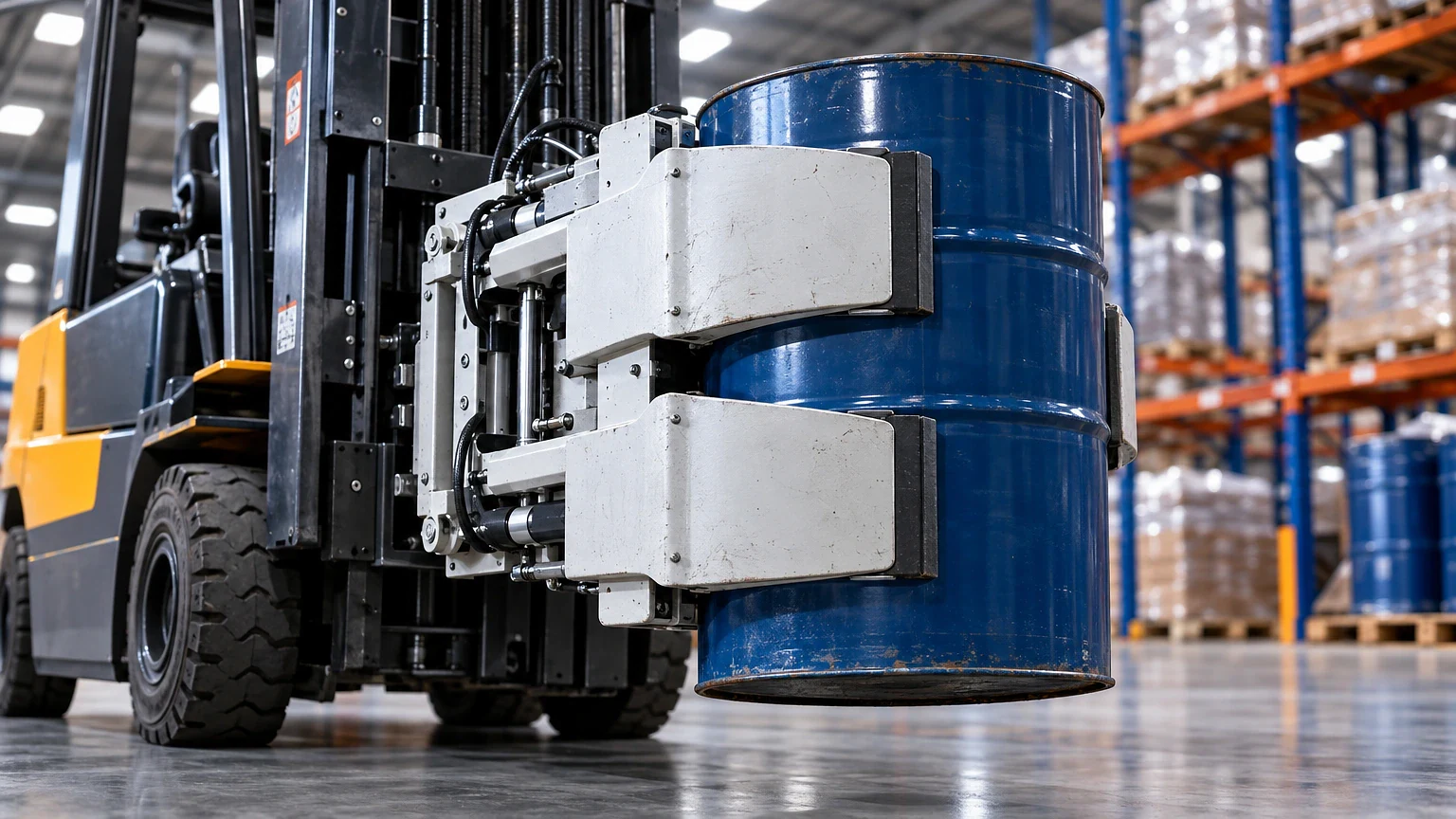
Your standard forks handle pallets fine, but the second a load doesn’t sit on a pallet, you’re stuck. Forklift attachments exist for exactly that gap. Drums, carpet rolls, slip sheets, appliances – all of it needs something your truck wasn’t built to carry.
That’s what forklift attachments solve. They turn one truck into three or four, without buying another lift or hiring another operator.
What Are Forklift Attachments and When Do You Need One
A forklift attachment is any device that mounts to the carriage, replacing or supplementing the standard forks to handle a non-standard load. Think of the carriage as a universal mounting plate – almost anything can bolt onto it with the right class rating.
You need one the moment your SKU mix stops being uniform pallets. A beverage distributor handling kegs, a carpet warehouse moving 500-pound rolls, a paper mill rotating rolls for unwinding – none of these work with bare forks. Forcing it usually means damaged product, a tipped load, or a strained operator improvising with chains and a pallet jack.
Note: Attachments are rated by ITA (Industrial Truck Attachment) class, matched to your forklift’s carriage class – 2, 3, or 4. Mismatching classes is the most common fitment mistake buyers make.
The real signal: if your team is “making it work” with bungee cords, ratchet straps, or two people lifting by hand, that’s a line item for an attachment, not a safety training session.
Common Forklift Attachment Types and What Each One Fixes
Picture a distribution center floor where three trucks each do one job all shift – that’s the inefficiency attachments are built to kill. Here’s where most warehouses start.
A rotating drum handler lets one truck pick, tilt, and pour 55-gallon drums without a second person steadying the load. A fork positioner lets the operator widen or narrow forks hydraulically from the seat, cutting the time spent re-adjusting for different pallet widths. A carton clamp replaces forks entirely, squeezing appliance boxes or stacked cartons from the sides – useful when pallets aren’t involved at all, like in big-box furniture distribution.
A push-pull attachment handles slip sheets instead of pallets, which matters if you’re shipping into retailers like grocery chains that mandate slip-sheet loading to cut pallet costs. A load stabilizer adds a clamping bar over the forks for unstable or loosely stacked loads, common in beverage and canned goods distribution where shrink wrap alone isn’t enough.
Each of these solves one specific failure mode. The mistake is buying the flashiest one instead of matching it to your actual damage and claims data.
Attachment Types Compared by Load and Application
| Attachment | Typical Capacity | Best For | Weight Penalty |
|---|---|---|---|
| Fork positioner | Matches truck rating | Mixed pallet widths, high pick rates | Minimal, 50-150 lbs |
| Carton/paper roll clamp | 1,500-4,500 lbs | Unpalletized cartons, paper rolls | Moderate, 500-1,200 lbs |
| Rotating drum handler | 1,000-2,000 lbs | Drums, barrels, chemical totes | Moderate, 300-800 lbs |
| Push-pull (slip sheet) | 2,500-4,000 lbs | Retail slip-sheet programs | High, 800-1,500 lbs |
| Load stabilizer/bar | Matches truck rating | Loose or mixed-height stacking | Low, 100-300 lbs |
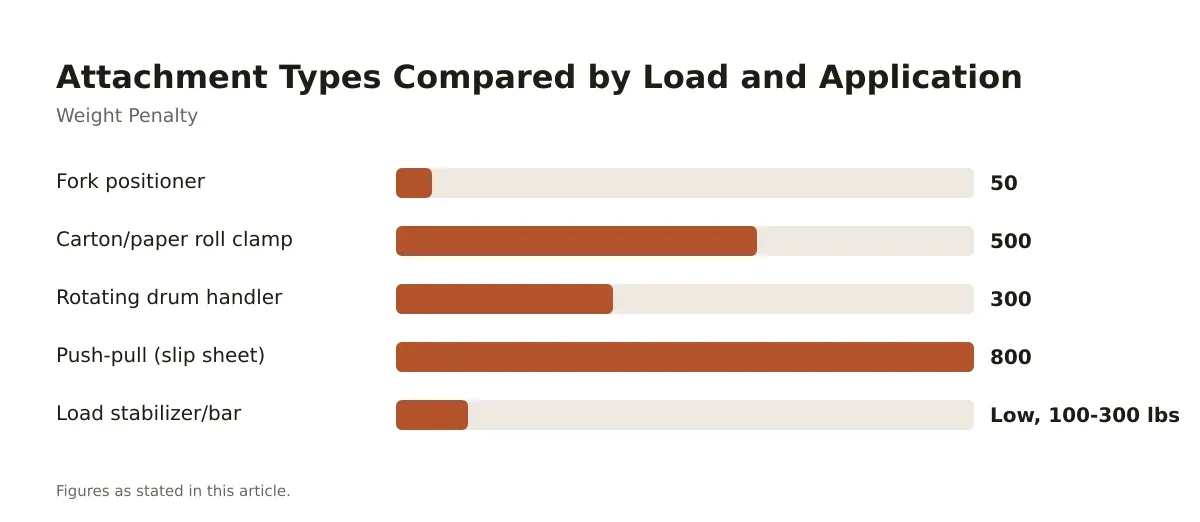
That weight penalty column matters more than buyers think. Every attachment reduces your truck’s actual lift capacity, because it adds dead weight ahead of the load center. A 5,000-pound-rated forklift fitted with an 800-pound clamp doesn’t lift 5,000 pounds anymore – check the derated capacity plate, not the original one, before you load anything close to the limit.
How Forklift Attachments Affect Pick Rates and Inventory Accuracy
Here’s the part sales reps gloss over: attachments change your pick rate, for better or worse, depending on fit.
A fork positioner typically adds picks per hour because operators stop dismounting to manually adjust forks between SKUs. Warehouses running high SKU-width variability – think mixed pallet sizes in a 3PL cross-dock – often see real gains here, since the adjustment that used to take 30-60 seconds happens with a lever.
A clamp attachment, on the other hand, usually slows initial cycle times. Operators need retraining on squeeze pressure, since too much crushes cartons and too little drops them. OSHA requires documented powered industrial truck training whenever an operator moves to a new attachment type – not optional, and worth building into your onboarding checklist from day one.
Inventory accuracy ties in indirectly. Crushed or dropped cartons from a poorly calibrated clamp generate damage write-offs that throw off cycle counts. If your WMS shows a 98% inventory accuracy target and you’re consistently missing it in the clamp-truck zone, check the squeeze pressure settings before you blame the counting process. It’s often the attachment, not the team.
Buying New Versus Retrofitting an Existing Forklift
You’ve got two paths: order a forklift with the attachment factory-installed, or retrofit an attachment onto a truck you already own. Both work. The right call depends on hydraulic capacity and fleet age.
Factory integration gets you matched hydraulics, a single warranty, and a hose routing designed for that specific attachment from day one. Brands like Toyota Material Handling, Hyster, and Crown Equipment all offer attachment-ready configurations at order time, with the auxiliary hydraulic valve pre-installed.
Retrofitting works when your truck already has a third or fourth hydraulic function available. Most trucks built in the last decade have at least a third valve for a positioner or clamp. Older two-function trucks usually need a hydraulic kit added, which runs into additional cost and sometimes voids part of the original truck warranty – confirm with your dealer before committing.
The rule of thumb from fleet managers: if the truck has fewer than 10,000 hours left in its useful life, retrofit. If you’re replacing the truck anyway, spec the attachment at order time and skip the aftermarket install labor entirely.
Attachment Maintenance and Safety Checks That Get Skipped
Attachments fail quietly, usually from neglect, not defect. Here’s the pre-shift and periodic checklist most warehouses should run but often don’t:
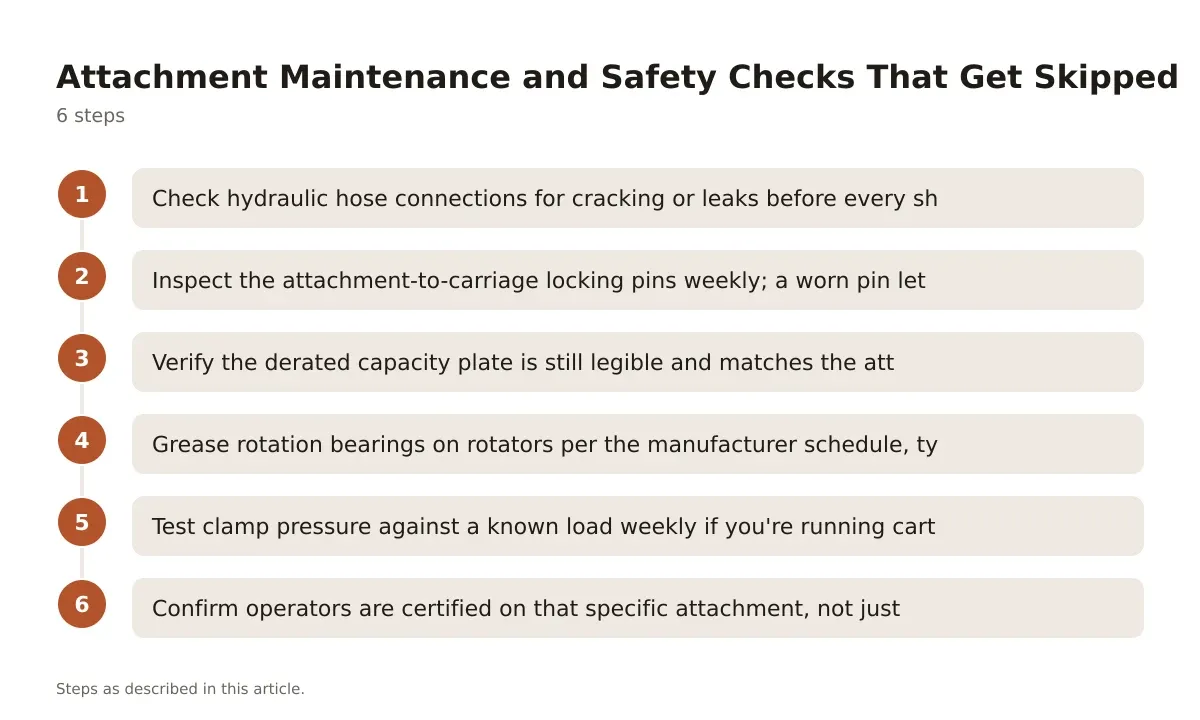
- Check hydraulic hose connections for cracking or leaks before every shift – a slow leak means lost clamp pressure mid-lift.
- Inspect the attachment-to-carriage locking pins weekly; a worn pin lets the attachment shift under load.
- Verify the derated capacity plate is still legible and matches the attachment currently mounted.
- Grease rotation bearings on rotators per the manufacturer schedule, typically every 40-50 operating hours.
- Test clamp pressure against a known load weekly if you’re running cartons or drums, since pressure drifts as seals wear.
- Confirm operators are certified on that specific attachment, not just general forklift certification.
Skipping step 3 is the one that gets facilities cited. An auditor who pulls up and sees a clamp mounted with no updated capacity plate assumes nobody’s tracked the derate – and that’s an OSHA finding waiting to happen, even if the truck itself is in good shape.
Choosing the Right Attachment for Your Operation
Start with your damage log, not a catalog. Pull the last 90 days of damage claims and sort by cause. If “dropped during manual handling” or “pallet jack tip-over” shows up repeatedly for one product type, that’s your attachment candidate.
Next, check your existing hydraulic setup. A single-function truck limits you to passive attachments like a fixed fork extension. A triple or quad hydraulic valve setup opens up clamps, rotators, and positioners that need powered actuation.
Finally, run the math on cycle time against attachment weight penalty. A rotator that saves two minutes per drum but derates your truck below your heaviest SKU isn’t a win – it’s a new bottleneck disguised as an upgrade. Match the attachment to the actual load, not the average one.
Frequently asked questions
What is the most common forklift attachment?
Fork positioners are the most widely used attachment because they fit almost any warehouse handling mixed pallet sizes. They let an operator adjust fork spacing hydraulically instead of manually, which saves time on every pallet swap across a shift.
Do forklift attachments reduce lift capacity?
Yes, every attachment adds weight ahead of the load center, which lowers the truck’s effective capacity below its original rating. Always check the derated capacity plate installed with the attachment rather than relying on the forklift’s factory nameplate.
Can any forklift attachment fit any truck?
No. Attachments are built to ITA class ratings (2, 3, or 4) that must match your forklift’s carriage class, and hydraulic function count limits which powered attachments you can run. A dealer or the attachment manufacturer should confirm fitment before you order.
How much training does a new attachment require?
OSHA requires documented training any time an operator starts using a new attachment type, even if they’re already certified on the base forklift. Training typically covers load capacity changes, attachment-specific controls, and inspection steps before each shift.
Is it cheaper to retrofit an attachment or buy a new truck with one installed?
Retrofitting is usually cheaper upfront if your truck already has a spare hydraulic function and enough remaining service life. Factory-installed attachments cost more initially but avoid aftermarket labor, hose routing issues, and warranty complications down the line.
Attachment choice also depends on the truck underneath it, so check our guide to the counterbalance forklift before you order.