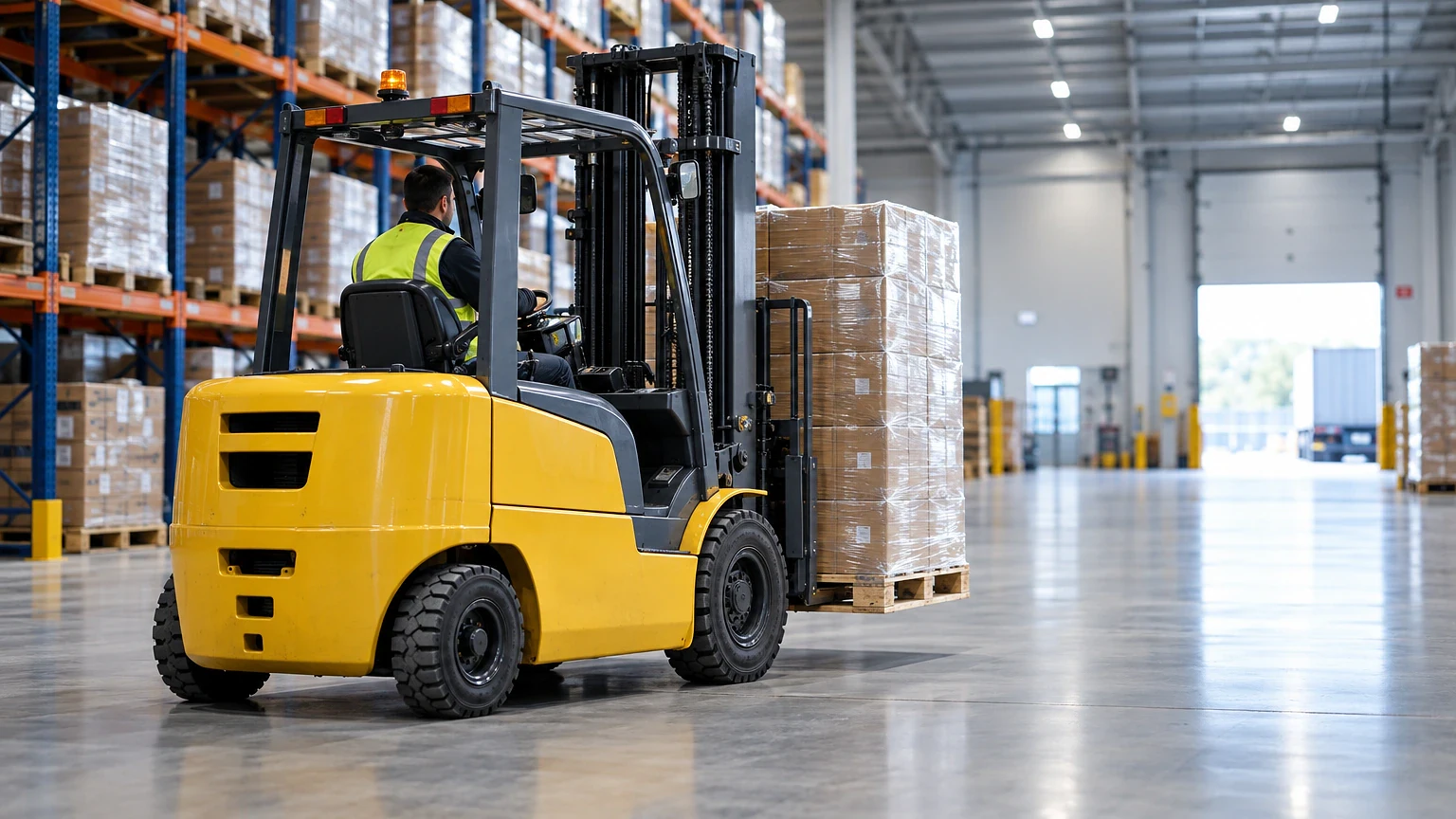
Is a counterbalance forklift really the right default for every warehouse? Not always, but it’s the workhorse most operations reach for first, and for good reason. It handles pallets on open floors without needing outrigger legs or a stabilizing mast system, which is exactly why it dominates yards, docks and general warehousing.
This guide breaks down what a counterbalance forklift actually does well, where it falls short, what it costs to own, and how it stacks up against narrow-aisle alternatives. You’ll get real capacity numbers and the operational tradeoffs that matter when you’re signing a purchase order.
What Is a Counterbalance Forklift
A counterbalance forklift carries its load on forks that extend from the front of the truck, with no outrigger arms underneath. The weight of the rear-mounted counterweight and the engine or battery offsets the load on the forks. That’s the whole mechanical idea: balance, not bracing.
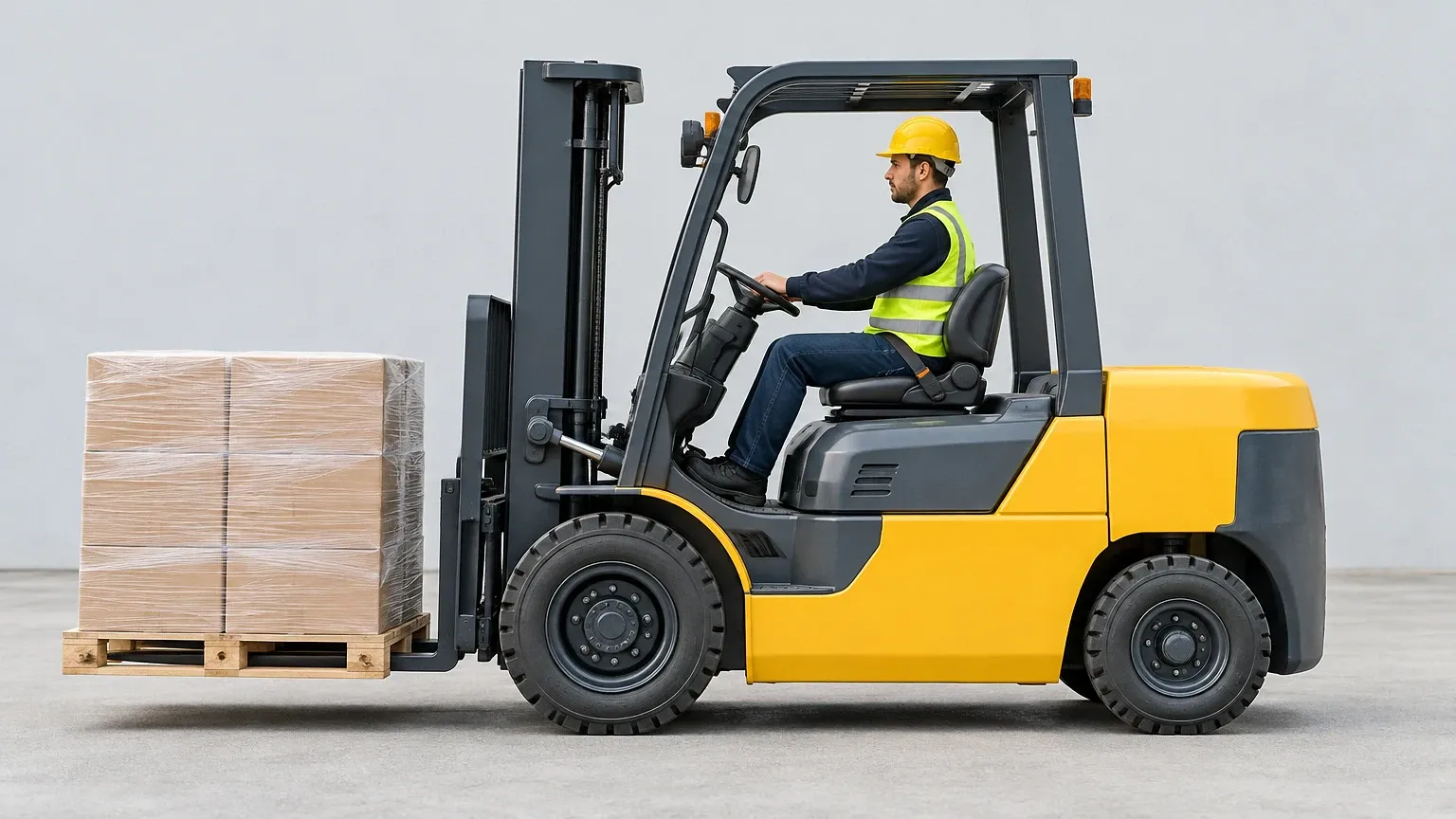
Definition: A counterbalance forklift is a lift truck design where a fixed counterweight at the rear offsets the load carried on the front forks, eliminating the need for front stabilizing legs.
This design lets the truck drive right up to a pallet and lift without any supporting arms reaching under the load. That’s the tradeoff against a reach truck, which uses extending forks and legs to get closer to racking in narrow aisles but can’t handle outdoor ground conditions nearly as well.
Most three-wheel and four-wheel counterbalance models lift 3,000 to 5,000 lbs as a standard class, with heavy-duty versions rated well past 15,000 lbs for container and lumber yards. Aisle widths typically run 10 to 13 feet for a standard sit-down counterbalance, which is why big-box retail backrooms and general distribution centers use them over narrow-aisle trucks.
Capacity Ranges and Load Charts You Need to Check
Every counterbalance forklift ships with a data plate listing rated capacity at a specific load center, usually 24 inches. That number drops as the load center moves forward or the fork height increases. This is the single most misread spec on the floor.
Attachments change that figure again. Our guide to forklift attachments explains how clamps and rotators cut the rated capacity. Always derate the truck before you fit anything to the carriage.
A truck rated for 5,000 lbs at 24 inches might only handle 3,800 lbs if your pallet’s center of gravity sits at 30 inches, which happens constantly with oversized or irregular freight. Warehouse supervisors who skip the load chart and go by the sticker number alone are the ones who tip a mast or snap a fork.
Standard capacity classes break down roughly like this: Class I electric motor rider trucks from 3,000 to 12,000 lbs, Class IV and V internal combustion trucks from 3,000 to 15,500 lbs, and heavy industrial counterbalance units built for ports and steel yards exceeding 20,000 lbs. OSHA requires operators to reference the manufacturer’s nameplate data, not generic published specs, before any lift.
On the floor, this means a receiving team running mixed pallet weights needs a truck sized for the heaviest realistic load, not the average one. If 80% of your pallets run 2,200 lbs but your heaviest incoming SKU hits 4,600 lbs at a 28-inch load center, you’re buying capacity for that outlier, not the average.
Fuel Types: Electric, LPG, and Diesel Compared
Choosing a power type is really choosing a shift pattern. Electric counterbalance trucks run clean and quiet, which matters indoors, but they need charging infrastructure and battery swap routines.
LPG trucks refuel in under five minutes and work both indoors and outdoors, making them the default for multi-shift operations that can’t afford charging downtime. Diesel counterbalance trucks deliver the highest torque for outdoor yard work, heavy container handling, and rough ground, but emissions rules keep them out of enclosed warehouses in most jurisdictions.
A cold storage facility running three shifts typically leans toward electric with opportunity charging or battery swap stations, since LPG combustion in a freezer space creates condensation and visibility problems. A lumber yard or scrap metal operation almost always runs diesel, since the ground conditions and duty cycle favor torque over quiet operation.
Lithium-ion battery packs have changed the electric calculation. They charge faster than lead-acid, don’t need a dedicated battery room, and hold a flatter power curve through the discharge cycle, which matters on a truck doing a thousand cycles a shift. The upfront cost is higher, but fleets running two or three shifts often find the maintenance savings close the gap within a few years.
Counterbalance vs Other Lift Truck Types
A counterbalance forklift isn’t the right pick for every application, and it’s worth being blunt about where it loses to alternatives.
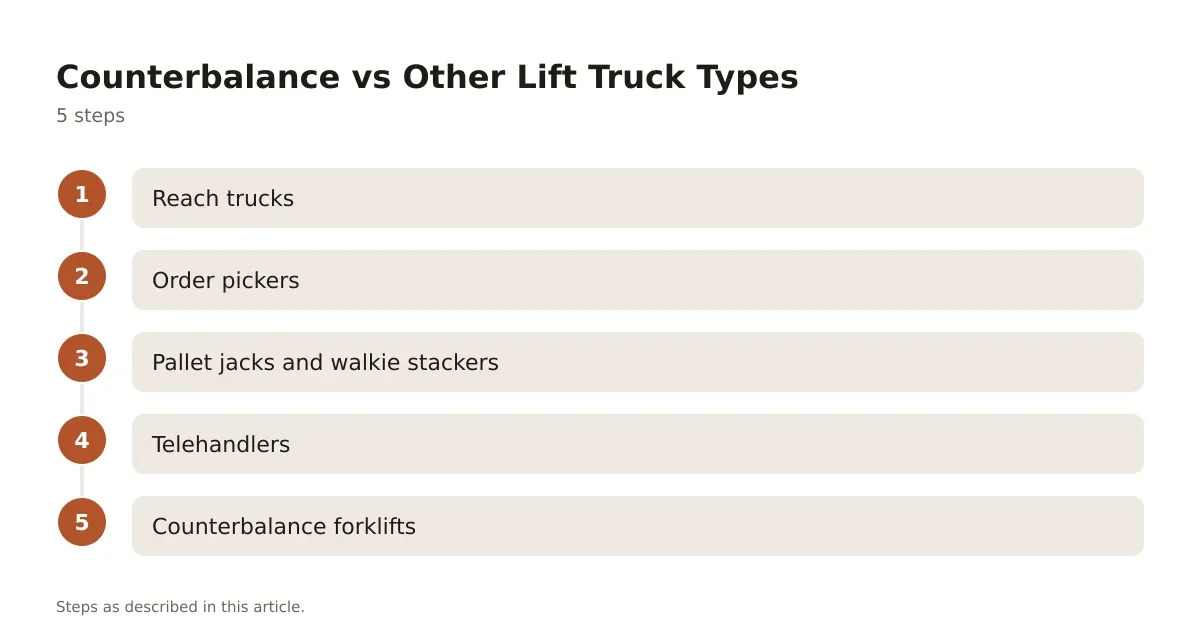
- Reach trucks work narrow aisles down to 8.5 to 10.5 feet and lift considerably higher, often past 30 feet, making them the standard for high-density pallet racking. If your facility runs narrow-aisle racking already, a reach truck forklift will usually out-cube a counterbalance truck on the same footprint.
- Order pickers handle case-level and each-level picking where an operator rides up with the load, suited to split-case fulfillment rather than full pallet moves.
- Pallet jacks and walkie stackers cover light-duty, low-height moves at a fraction of the purchase cost, typically under 3,300 lbs capacity and limited lift height.
- Telehandlers extend reach diagonally and handle uneven outdoor terrain that would stall a standard counterbalance truck’s tires and mast.
- Counterbalance forklifts remain the generalist choice: wide aisles, mixed indoor/outdoor use, and loads that don’t need narrow-aisle precision.
The mistake operations managers make is standardizing on one truck type fleet-wide because it’s familiar. A distribution center running both wide receiving aisles and tight reserve racking usually needs both a counterbalance fleet for dock work and reach trucks for the high-bay zones.
Operator Training, Safety Checks, and Daily Inspections
Every counterbalance forklift operator in the US needs certification under OSHA standard 1910.178, which covers both classroom instruction and a hands-on evaluation specific to the truck type and workplace conditions. Certification doesn’t transfer automatically between a sit-down counterbalance and a stand-up reach truck; the evaluation has to match the equipment.
Daily pre-shift inspections should cover tire condition, hydraulic fluid leaks, horn and backup alarm function, seatbelt operation, and fork condition for cracks or bends. A bent fork heel is one of the most commonly missed defects because it doesn’t affect lift function until the load shifts under stress.
Tip-over incidents are the leading cause of forklift-related fatalities, and counterbalance trucks are more exposed to lateral tip risk than three-wheel narrow-aisle equipment because of how the mast extends forward of the wheelbase. Operators turning too fast with a raised load, or driving with forks elevated across uneven dock plates, create the exact conditions that cause rollover.
Refresher training every three years is the OSHA minimum, but operations running multiple shifts and high pallet volumes often retrain annually, since near-miss patterns tend to surface well before three years pass.
Total Cost of Ownership and Lease vs Buy
The purchase price on a counterbalance forklift is only the entry fee. Maintenance contracts, tires, battery or fuel costs, and operator labor make up the bulk of lifetime spend.
A standard LPG counterbalance truck typically needs tire replacement every 1,500 to 2,000 operating hours in a warehouse environment, less if it’s running on abrasive concrete or outdoor pavement. Planned maintenance intervals usually fall every 250 hours for fluid and filter service, which adds up fast on a truck running two shifts.
Leasing makes sense for operations with seasonal volume swings, since a peak-season spike in receiving doesn’t justify owning idle capacity the other nine months of the year. Buying makes more sense for a steady, predictable duty cycle where the truck runs close to its full depreciation life without sitting idle.
Dealers typically quote maintenance either as a per-hour rate bundled into a lease or as a separate service contract on owned equipment. Whichever route you take, get the hourly maintenance rate in writing before signing, since that number swings wildly between vendors and it’s the figure that determines your real cost per pallet moved.
Buying a Counterbalance Forklift the Right Way
Picking the right counterbalance forklift starts with your actual load profile, not the biggest capacity number on the lot. Match the truck to your heaviest realistic pallet at its real load center, confirm aisle widths against the truck’s turning radius, and choose power type based on your shift pattern and indoor/outdoor mix.
Don’t let a sales rep upsell you into diesel for indoor work or electric for a yard running rough gravel. The power type should follow the duty cycle, not the other way around. And if your facility is splitting between wide dock aisles and dense reserve racking, don’t force one truck type to do both jobs badly.
Run the numbers on lease versus buy against your actual hours-per-shift and seasonal volume, not a generic rule of thumb. A counterbalance forklift bought right will run a decade of service; one bought wrong becomes the truck nobody wants to use.
Frequently asked questions
What is the average lifespan of a counterbalance forklift?
A well-maintained counterbalance forklift typically runs 10,000 to 20,000 hours before major overhaul becomes more expensive than replacement. Electric models with lithium-ion batteries often outlast internal combustion units because there’s less engine wear, though battery replacement cost factors into the long-term math.
Can a counterbalance forklift work outdoors?
Yes, LPG and diesel counterbalance trucks are built for outdoor yard work, with pneumatic tires rated for gravel, asphalt and uneven ground. Electric counterbalance trucks with cushion tires are generally limited to smooth indoor surfaces unless fitted with outdoor-rated tires and sealed components.
How much does a counterbalance forklift cost to maintain per year?
Maintenance cost depends heavily on operating hours, fuel type and duty cycle, but planned service every 250 hours plus tire replacement every 1,500 to 2,000 hours are the two biggest recurring line items. Get a written hourly maintenance rate from your dealer rather than estimating, since it varies significantly by region and contract terms.
What’s the difference between a counterbalance forklift and a reach truck?
A counterbalance forklift lifts loads from the front with no supporting legs, needing wider aisles but working well both indoors and outdoors. A reach truck uses extending forks and outrigger legs to work in narrow aisles and reach greater heights, but it’s generally limited to smooth indoor warehouse floors.
Do I need special certification to operate a counterbalance forklift?
Yes, under OSHA standard 1910.178 every operator needs training and evaluation specific to the truck type and workplace conditions before operating independently. Certification on a counterbalance truck doesn’t automatically qualify someone to run a reach truck or order picker, since each requires its own hands-on evaluation.