Your pallets are stacking up at 24 feet, your sit-down counterbalance trucks can’t touch them, and the picking backlog is growing by the hour. That’s the exact moment most warehouse managers start researching a reach truck forklift.
A reach truck forklift is a narrow-aisle lift truck built for high-bay racking, typically handling aisles as tight as 8.5 to 10.5 feet while lifting 20 to 36 feet. It trades some outdoor versatility for serious vertical reach and tighter footprint efficiency.
What Makes a Reach Truck Different From a Counterbalance Forklift
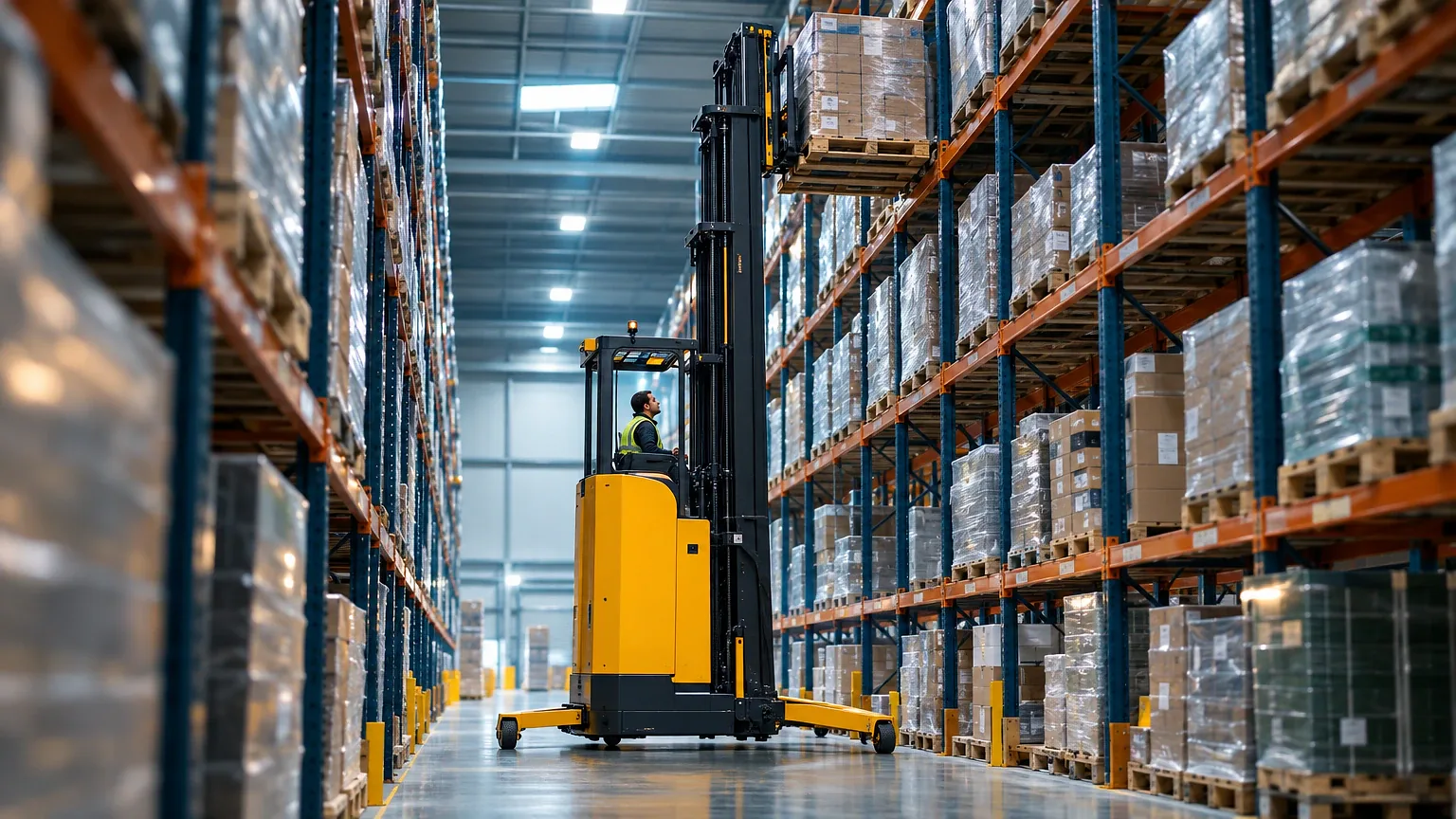
Walk onto any mid-size distribution center floor and you’ll spot the difference immediately. A counterbalance forklift carries its load out front, balanced by weight in the rear. A reach truck forklift uses outrigger legs that straddle the pallet, with a mast that physically extends (reaches) forward to pick or place loads.
That reach mechanism is the whole point. It lets the truck’s wheelbase stay short while the forks travel 12 to 24 inches beyond the outriggers. You get deep rack access without needing the turning radius a counterbalance truck requires.
Operators sit or stand sideways in most models, which takes new hires a shift or two to get comfortable with. Visibility down narrow aisles actually improves once they adjust, since the sideways stance lines up better with the direction of travel.
The tradeoff is surface tolerance. Reach trucks want smooth, level concrete or epoxy-coated floors. Cracked or uneven slabs chew through outrigger wheels and throw off mast alignment faster than most ops managers expect.
Reach Truck Capacity and Lift Height Ranges
Capacity and reach height is where buyers get tripped up, because the numbers shift a lot depending on load center and mast configuration.
Most standard reach trucks carry 3,000 to 5,500 pounds at a 24-inch load center. Push past a 36,000-pound aisle load rating and you’re usually looking at a specialized heavy-duty reach model, which is less common and pricier to source.
Lift height is the real selling point. Standard duplex masts top out around 20 feet. Triplex masts, which are what most warehouses actually spec, reach 30 to 36 feet. A few manufacturers, including Crown Equipment and Raymond, offer models pushing past 40 feet for very high-bay installations.
Here’s the thing people forget: rated capacity drops as you lift higher. A truck rated for 4,500 pounds at ground level might only handle 3,200 pounds at full extension. Always check the load chart at your actual working height, not just the nameplate number.
Battery reach trucks dominate this category now. Lithium-ion packs from suppliers like Enersys have cut opportunity-charging downtime significantly compared to lead-acid, letting multi-shift operations skip battery swap stations entirely.
When a Reach Truck Is the Right Call (And When It Isn’t)
Reach trucks earn their keep in single-deep or double-deep selective racking, running aisles between 8.5 and 10.5 feet wide. If your facility runs standard 42-inch or 48-inch pallets through racking taller than 20 feet, this is probably your equipment.
Very narrow aisles call for something different again. Our guide to the turret forklift covers machines that pick without turning the chassis. Consider one where aisle width matters more than purchase price.
They’re the wrong pick for yard work, trailer loading, or any mixed indoor-outdoor flow. No rough-terrain tires, no real ground clearance, and that narrow stance doesn’t like potholes or dock plates with any slope.
A grocery distribution center running double-deep pallet racking at 28 feet is a textbook reach truck application. Swap that same layout to a cross-dock facility loading 53-foot trailers all day, and a counterbalance or even an electric pallet jack makes more sense.
Throughput matters too. Reach trucks typically move 18 to 25 pallets per hour per operator in steady putaway-and-pick cycles. That’s slower than a counterbalance truck in open space, but faster than anything else once your aisle width drops below 11 feet.
Comparing Reach Trucks to Other Narrow-Aisle Equipment
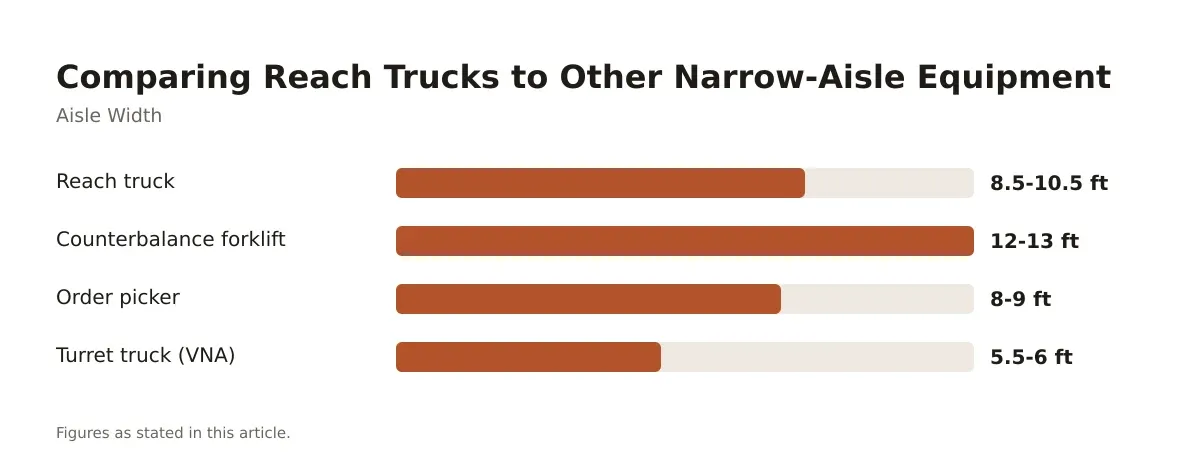
Picking the wrong narrow-aisle truck is an expensive mistake, since most of these machines carry six-figure fleet costs once you multiply across a dozen units. Here’s how the main options stack up.
| Equipment Type | Aisle Width | Max Lift Height | Typical Capacity | Best Fit |
|---|---|---|---|---|
| Reach truck | 8.5-10.5 ft | 30-36 ft | 3,000-5,500 lbs | Single/double-deep selective racking |
| Counterbalance forklift | 12-13 ft | 15-20 ft | 3,000-15,000+ lbs | Open floor, yard, trailer loading |
| Order picker | 8-9 ft | 30+ ft | 2,500-3,500 lbs | Case and each picking at height |
| Turret truck (VNA) | 5.5-6 ft | 40+ ft | 3,000-4,500 lbs | Very narrow aisle, high-density storage |
| Electric pallet jack | Varies, flexible | N/A (floor level) | 4,500-8,000 lbs | Horizontal transport, dock work |
Turret trucks, sometimes called VNA (very narrow aisle) trucks, push density further than reach trucks but need wire-guidance or rail systems installed in the floor. That’s a serious capital commitment most operations only make when land cost forces maximum cube utilization.
Order pickers solve a different problem. They’re built for person-up each-picking at height, not full-pallet movement. Plenty of warehouses run both reach trucks and order pickers side by side, each handling the task it’s built for.
Operator Training, Safety and Daily Inspection Standards
Reach truck incidents cluster around two causes: tip-overs from traveling with a raised load, and pedestrian collisions in blind intersections. Both are preventable with discipline, not luck.
OSHA requires powered industrial truck operators to complete formal training and an evaluation specific to the equipment type, under 29 CFR 1910.178. A counterbalance certification doesn’t automatically cover reach truck operation, and most safety-conscious facilities retest operators on the actual mast-extension controls before turning them loose in racking.
Daily pre-shift inspections should cover outrigger wheel wear, mast chain tension, fork heel wear, and horn and backup alarm function. A warehouse running three shifts will burn through outrigger wheels faster than one running a single shift, simply from accumulated travel hours.
Rack damage is the other silent cost. A reach truck operator misjudging the extension distance by even a few inches can clip an upright, and repeated minor hits weaken the rack’s load rating long before anyone notices a bent frame. Facilities serious about this install rack guards at column bases and run quarterly rack inspections under RMI guidelines.
Pricing, Leasing and Fleet Decisions That Actually Matter
Buying a reach truck forklift outright runs into real capital, and most mid-size operations now lease instead of buy, especially for lithium-ion models where battery technology is still evolving fast enough that a 5-year lease avoids obsolescence risk.
A few decision points separate the operations that get this right from the ones that overspend:
- Match mast height to your actual tallest rack beam, not your tallest possible future rack, since taller masts cost more and reduce visibility.
- Choose lithium-ion over lead-acid if you run more than one shift, because opportunity charging during breaks eliminates battery-swap labor.
- Spec side-shift and fork positioner attachments up front rather than retrofitting, since factory-installed hydraulics cost less than aftermarket kits.
- Negotiate a maintenance contract that includes mast chain lubrication and outrigger wheel replacement, both high-wear items on reach trucks specifically.
- Compare lease terms across at least three dealers, since residual value assumptions on reach trucks vary more than on counterbalance models.
Telematics add-ons from providers like Crown Equipment InfoLink or similar fleet management systems track impact events, utilization hours, and operator ID. Facilities running 10 or more trucks generally find this pays off through reduced unplanned downtime and better warranty claim documentation.
Choosing the Right Reach Truck for Your Facility
The decision mostly comes down to three numbers: your narrowest aisle, your tallest rack beam, and your busiest shift’s pallet-move count per hour. Get those three right and the equipment spec nearly picks itself.
Don’t let a vendor talk you into more mast height than your racking needs. Extra lift height adds cost and reduces visibility for no operational benefit. On the other side, undersizing capacity for “someday” heavier pallets is just as common a mistake, and retrofitting a fleet mid-lease is expensive.
If you’re still deciding between a reach truck and a different narrow-aisle configuration, walk your tightest aisle with a tape measure before you call a dealer. The equipment conversation goes a lot faster once you know whether you’re working with 9 feet or 11.
Frequently asked questions
What is a reach truck forklift used for?
A reach truck forklift is used for putting away and retrieving palletized loads in high-bay selective or double-deep racking, typically in aisles between 8.5 and 10.5 feet wide. It’s the standard choice for distribution centers and 3PL warehouses storing full pallets above 20 feet.
How much weight can a reach truck lift?
Most reach trucks carry 3,000 to 5,500 pounds at a standard 24-inch load center, though capacity drops as lift height increases. Always check the truck’s load chart at your actual working height rather than relying on the nameplate rating alone.
Do reach trucks need special floors?
Yes. Reach trucks perform best on smooth, level concrete or epoxy-coated floors, since the outrigger wheels and extending mast are sensitive to cracks and uneven surfaces. Rough or uneven flooring accelerates wheel wear and can throw off mast alignment over time.
Is a reach truck harder to operate than a counterbalance forklift?
It takes different skills rather than being strictly harder. Operators sit or stand sideways and must judge extension distance precisely when placing loads in racking, which usually takes a shift or two to get comfortable with, plus separate training under OSHA’s powered industrial truck standard.
Should I buy or lease a reach truck forklift?
Leasing is common for mid-size fleets, particularly with lithium-ion models, since battery technology keeps improving and a shorter lease term avoids locking in older equipment. Buying outright can make sense for smaller, stable operations that plan to run the same truck for eight to ten years with predictable usage.