Most warehouses don’t need a turret forklift. They think they do, because the racking looks tight and the ceiling looks tall. But a turret forklift only earns its keep in true very narrow aisle (VNA) layouts. Buy one for a standard reach-truck building and you waste six figures fast.
Are you weighing narrow-aisle storage against your current setup? This guide breaks down what a turret forklift actually does and what it costs. It also covers when a reach truck or order picker will beat it every time.
What Is a Turret Forklift
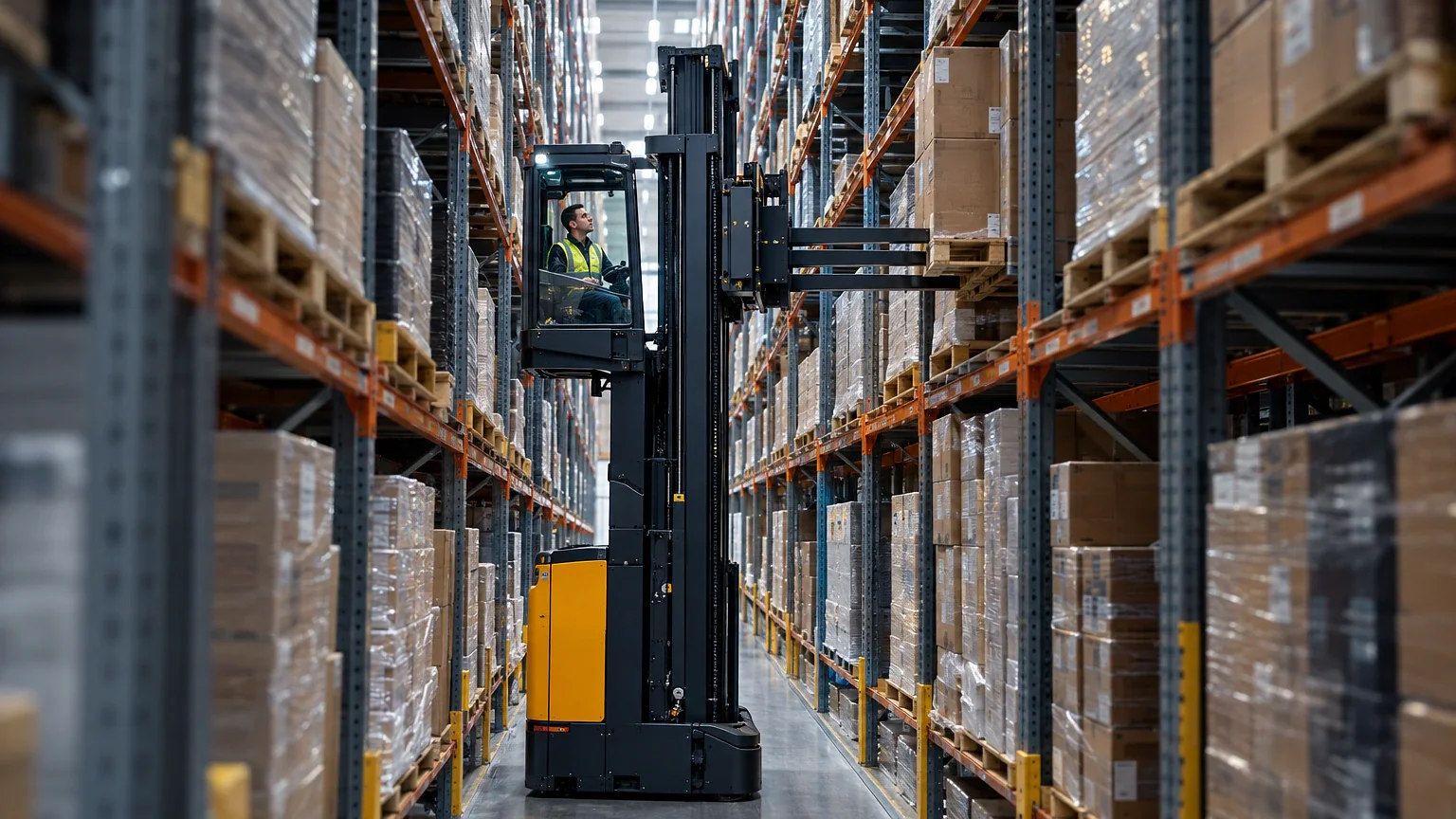
A turret forklift is a VNA lift truck with a rotating fork carriage. The carriage swings 90 degrees left or right without turning the chassis. The truck drives straight down an aisle as narrow as 60 to 72 inches. Then the mast rotates the forks into the rack, instead of the whole machine turning.
Turret forklift (definition): A very narrow aisle lift truck whose fork carriage pivots independently of the chassis, allowing pick and put operations in aisles too tight for a standard reach truck to turn into.
Brands like Crown Equipment and Combilift build turret models that lift loads 30 to 40 feet. Some push past 45 feet in high-bay cold storage. Wire guidance or rail guidance keeps the truck centered in the aisle at speed, which matters once you’re moving at height.
Picture a 50,000-square-foot facility running 8-foot-wide aisles with reach trucks today. Switch to turret trucks in 66-inch aisles and you typically add 20 to 30 percent more pallet positions. That gain comes from narrower aisles and taller stacking alone.
Turret Forklift Capacities and Height Ranges
Capacity and lift height drive the whole buying decision here. Most turret trucks carry rated loads between 2,500 and 4,500 pounds. That covers the vast majority of palletized dry goods and mixed-case picking.
Lift height is where turret trucks separate from everything else on your floor. Standard reach trucks top out around 30 feet in practical use. Turret trucks routinely work 35 to 40 feet. Man-up models put the operator cab on the forks and climb even higher for dense, high-bay storage.
Aisle width is the other number that matters as much as capacity. A reach truck needs roughly 10 to 11 feet of clear aisle to turn and stack. A turret truck needs 60 to 72 inches, sometimes less with tight-tolerance guidance.
That difference compounds. Drop your aisle width by 4 feet across a 40-aisle warehouse and you’ve recovered enough floor space for several additional racking runs. Run the math on your own slot count before you assume the gain, but it’s rarely small.
Load capacity does drop at extreme heights on some models. Check the lift chart at your actual working height, not just the nameplate rating. A truck rated for 3,500 pounds at 20 feet may derate closer to 3,000 pounds at 40 feet depending on mast configuration.
Man-Up vs Man-Down Turret Trucks
This is the decision point most buyers get wrong. Man-up turret trucks lift the operator in a cab alongside the forks, so the picker can visually confirm slot and pallet position at height. Man-down models keep the operator at floor level and rely on cameras or sensors for high picks.
Man-up trucks are the standard choice for case-pick and each-pick operations where accuracy at height matters more than raw throughput. The operator can read labels, check lot codes, and catch a mis-slotted pallet before it becomes a cycle count headache.
Man-down (or “stock picker”) turret trucks move faster for full-pallet put-away and retrieval because there’s no cab to raise and lower on every cycle. They’re common in automated or semi-automated high-bay freezer storage where humans minimize time at height anyway.
A grocery distribution center running full-pallet in, full-pallet out at 42 feet will likely choose man-down for speed. A parts distributor doing split-case picking at the same height needs man-up, because someone has to physically grab the right box off the shelf.
Turret Forklift vs Reach Truck vs Order Picker
Here’s where the equipment choice actually gets made, and it’s rarely just about one truck type.
- Reach truck: Best for aisles 10 to 12 feet wide, lift heights up to 30 feet, and facilities that still need forklift flexibility for yard work or mixed pallet/floor storage. Lower upfront cost, easier to train new operators, and no wire or rail guidance infrastructure needed.
- Order picker: Built for each-pick and case-pick in standard pallet racking, with the operator riding up with the load. Works in 8 to 9 foot aisles, typically caps around 30 feet of lift, and handles split-case fulfillment better than any VNA truck.
- Turret truck: The choice when you need both narrow aisles (under 72 inches) and tall storage (35+ feet) in the same move. Requires wire-in-floor or rail guidance, a dedicated VNA racking layout, and operators certified specifically on turret equipment.
- Swing-reach / articulated truck: A middle option that handles narrower aisles than a reach truck without full VNA guidance infrastructure, trading some throughput for lower install cost.
Most facilities that ask about turret trucks are really asking whether they should rebuild their racking layout. If your current racking runs standard 42-inch beam spacing with 10-foot aisles, moving to turret means a full re-rack, not just a new truck purchase.
Turret Forklift Cost and WMS Integration
A new turret forklift typically starts in the mid-$60,000s for a basic man-down model. A man-up unit with camera systems, wire guidance, and a high-bay mast package runs well over $120,000. Used and refurbished units from dealers can cut that substantially, though guidance system compatibility with your existing floor wire needs checking before you buy.
Guidance infrastructure adds its own line item. Wire guidance means cutting a slot in the concrete and embedding wire down every VNA aisle, plus the antenna package on the truck itself. Rail guidance skips the concrete work but adds steel rail along the aisle floor or rack base.
None of this works without a warehouse management system that actually supports directed put-away and pick-path optimization for narrow aisle. Manhattan Associates and Blue Yonder both offer VNA-aware slotting logic in their WMS platforms, and both are quote-based enterprise pricing rather than published rate cards.
On the mid-market side, Fishbowl and Cin7 handle basic inventory tracking. Neither offers true VNA slotting intelligence. Go that route and you will need a warehouse execution module or custom slotting rules. Expect any enterprise WMS deal here to be negotiated per facility, not off a price list.
Inventory accuracy is the real payoff once the system is tuned. Facilities running cycle counting discipline alongside a VNA-integrated WMS commonly report accuracy in the high 90s, often 98 to 99.5 percent, versus the low-to-mid 90s common in loosely slotted standard racking.
Operator Training and Daily Safety Checks
Turret operation is its own certification track under OSHA powered industrial truck rules, and it is not interchangeable with standard sit-down forklift certification. An operator trained only on a counterbalance truck should not be put on a turret truck without dedicated classroom and hands-on hours.
Daily pre-shift checks matter more here than on a standard forklift. A turret truck working at 40 feet in a 66-inch aisle has far less room for mechanical error.
- Check wire guidance antenna alignment and rail wheel wear before the first shift.
- Test the mast rotation stop limits to confirm the carriage locks square to the rack face.
- Inspect operator cab restraint systems on man-up units, including the gate interlock.
- Verify horn, strobe, and end-of-aisle photo-eye sensors are functioning, since turret trucks rely on these more than open-floor trucks.
- Confirm load backrest and anti-tip mast guarding show no cracks or loose bolts from the previous shift’s high-bay cycles.
⚠️ Warning: Never operate a man-up turret truck with a disabled cab gate interlock. A fall from 35 feet at full extension is catastrophic, and OSHA cites facilities for bypassed safety interlocks regularly.
Skipping these checks is how a bent fork at floor level turns into a stuck cab at height. That stops the entire aisle until a technician or crane gets involved.
Choosing the Right Narrow Aisle Strategy
A turret forklift is a commitment, not just a truck purchase. You’re committing to a racking layout, a guidance system embedded in your floor, a specific operator certification track, and a WMS configured for VNA slotting logic. Reverse that decision later and you’re re-racking a warehouse, not just trading in equipment.
That said, for facilities genuinely constrained on square footage, the math usually works. Recovering 20 to 30 percent more pallet positions often justifies the guidance infrastructure and training cost within a few years. That math gets stronger in high-rent urban distribution markets. Expanding the building simply isn’t an option there.
Start by mapping your actual SKU velocity and case-pick versus full-pallet mix before you call a dealer. A warehouse doing heavy each-picking belongs on order pickers or man-up turret trucks, not man-down units built for pallet-in, pallet-out speed. Get that fit wrong and no amount of WMS tuning fixes it.
Frequently asked questions
What is a turret forklift used for?
A turret forklift stores and retrieves pallets or cases in very narrow aisle warehouses. Those aisles typically run 60 to 72 inches wide. Working heights range from 30 to 45 feet. It’s the standard equipment choice when a facility needs both tight aisle spacing and tall racking in the same building.
How much does a turret forklift cost?
Pricing ranges widely depending on configuration. A basic man-down model starts around the mid-$60,000s. A man-up unit with camera guidance and a high-bay mast tops $120,000. Guidance infrastructure, wire-in-floor or rail systems, adds a separate installation cost on top of the truck itself.
Do I need wire guidance for a turret forklift?
Most true turret trucks require either wire guidance embedded in the concrete floor or rail guidance along the aisle to stay centered at height. A few lower-height models operate with laser or optical guidance instead, but height and speed both drop compared to wire or rail systems.
What’s the difference between a turret forklift and a reach truck?
A reach truck turns its whole chassis to face the rack. It needs roughly 10 to 11 feet of aisle clearance. A turret forklift drives straight down a 60 to 72 inch aisle and rotates only the fork carriage. Turret trucks also lift considerably higher, often 35 to 40 feet versus 30 feet for a typical reach truck.
Can one operator run both man-up and man-down turret trucks?
Not without separate training on each configuration, even though both fall under the same general VNA certification category. Man-up operation adds cab restraint systems, gate interlocks, and at-height visual picking skills that man-down certification doesn’t cover.