
Your peak-season pick queue backs up by noon. Carrier cutoffs slip, and your team is stacking pallets in the aisles. That is usually the moment managers start pricing out 3PL shipping.
This guide covers what a third-party logistics partner does with your freight, how the pricing works, and where the handoff breaks. You will also find a comparison table and a short checklist for choosing a provider.
What 3PL shipping covers day to day
A 3PL takes your inventory into its building. It then picks, packs, labels and ships orders on your behalf. Some also handle returns, kitting and inbound receiving.
Paperwork names everyone in that chain. Our explainer on consignee meaning sets out who legally receives the goods and who pays on arrival. Getting the field wrong delays customs more often than anything else.

Picture a Tuesday at a mid-size ecommerce 3PL. Your inbound pallet arrives and gets scanned against the ASN. Putaway sends cartons to forward pick locations. When an order drops in from Shopify, the warehouse management system (WMS) generates a pick task. Pickers batch it with other orders.
A decent operation hits 80 to 120 lines picked per labour hour on a cart-based batch process. Goods-to-person setups push that well past 200. Ask any provider for their actual numbers, not a brochure range.
Shipping is the last step. Your 3PL buys postage through its carrier contracts, and those rates are often better than yours because they pool volume across clients. If you want the plain-language definition first, our guide explains what a 3PL is and who it suits.
3PL shipping, defined: Outsourcing storage, order picking, packing and carrier handoff to a third-party logistics provider, which ships your orders from its own warehouse network.
How 3PL shipping pricing is built
Quotes look simple until you read the rate card. Most providers stack several fee types, and the headline number rarely tells the full story.
Expect these line items on a typical proposal:
- Onboarding or setup fee: often a one-off charge for integration and SKU loading.
- Receiving: charged per pallet, per carton or per hour of labour.
- Storage: billed per pallet position per month, or per cubic foot for small parts.
- Pick and pack: a base fee for the first item, then a smaller fee for each additional unit.
- Packaging materials: boxes, mailers, dunnage and tape, usually marked up.
- Shipping: carrier postage plus a handling surcharge on some contracts.
- Account minimums: a monthly floor that applies even in a slow month.
Run your own numbers before signing. Take last month’s order count, average lines per order and units on hand, then price each fee type separately. A low pick fee can hide a steep storage charge on slow-moving SKUs.
Where 3PL shipping saves money and where it does not
The savings are real, but they depend on your order profile. A brand shipping 400 parcels a day from a rented unit often gains from a 3PL’s carrier discounts. A brand shipping 40 oversized items a day may not.
Consider a floor example. A homewares seller runs two full-time packers plus a part-timer. Labour, rent, utilities and a basic WMS add up quickly. Once a 3PL takes over, those fixed costs become variable costs tied to order volume.
That shift matters most for seasonal sellers. You stop paying for empty racking in February.
The weak spot is control. Your inventory now sits in a building you do not run. Cycle count accuracy, damage rates and dock-to-stock time all become things you monitor rather than fix directly. Aim for inventory accuracy of 99.5 percent or better, and put it in the service agreement.
Comparing the main 3PL models
Not every provider works the same way. The right model depends on your volume, your product and how much visibility you need.
Traditional single-site 3PL
One warehouse, usually near a major carrier hub. Pricing is straightforward and onboarding is quick. The trade-off is zone distance: a single East Coast site means longer, costlier ground transit to the West Coast.
Multi-node fulfilment networks
Providers like ShipBob and Radial operate several warehouses and split your stock between them. Orders ship from the closest node, which cuts transit days. You pay for it in inbound freight, since each location needs its own replenishment.
Specialist and niche 3PLs
Cold chain, hazmat, apparel with heavy returns, and heavy-bulky freight all need specific handling. A generalist cannot always meet those requirements. Check certifications and ask to see the relevant zone on a tour.
3PL provider comparison table
The figures below are typical structures, not quotes. Exact rates change by contract and volume, so treat this as a framework for your own request for proposal.
| Model | Best for | Typical pricing model | Main trade-off |
|---|---|---|---|
| Single-site 3PL | Regional sellers, steady volume | Per-order pick fees plus pallet storage | Longer transit to distant zones |
| Multi-node network | National sellers needing 2-day ground | Per-order fees plus inbound split freight | Higher inventory spread and safety stock |
| Specialist 3PL | Cold chain, hazmat, heavy-bulky | Quote-based, often with minimums | Fewer providers, higher rates |
| Hybrid (in-house plus 3PL) | Seasonal peaks or new markets | Variable, project-based | Two systems to reconcile |
What to check before you sign a 3PL shipping contract
A good proposal can still hide a poor operation. Do your homework on the floor, not just the contract.
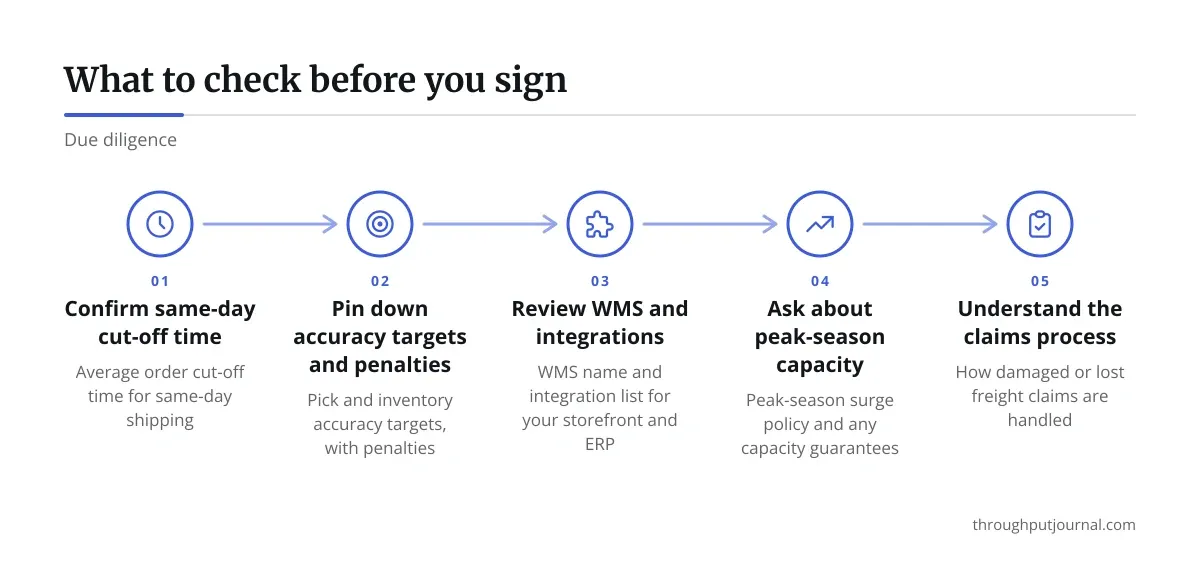
Visit the building during a busy shift. Look at how aisles are labelled, how fast the dock turns around and whether racking looks damaged. Beam labels should show load capacity, and bent uprights should be tagged out.
Ask for these specifics in writing:
- Average order cut-off time for same-day shipping.
- Pick accuracy and inventory accuracy targets, with penalties.
- WMS name and integration list for your storefront and ERP.
- Peak-season surge policy and any capacity guarantees.
- Claims process for damaged or lost freight.
Then test the integration with a pilot. Send 200 to 500 orders through before moving your full catalogue, and compare their reported accuracy against your own audit.
Moving to 3PL shipping without disrupting orders
Switching providers is a project, not a flip of a switch. Plan 6 to 10 weeks for a clean transition if you are moving an established catalogue.
Start with a SKU master clean-up. Dimensions, weights and barcodes must match what the WMS holds, or your freight charges will drift. Send a first inbound shipment of your fastest movers, then phase in the long tail.
Keep a small safety buffer at your old location until the new flow is stable. Track on-time ship rate and dock-to-stock time daily for the first month. When both hold steady, release the rest.
Good 3PL shipping should feel boring. Orders leave on time, counts match and your team spends its day on growth work instead of firefighting.
Start with an honest look at your volume, your product profile and the transit zones you need to reach. Request quotes from three providers, price every fee line, and tour the building before you commit. A careful selection process costs a few weeks and saves a lot of rework later.
Frequently asked questions
How much does 3PL shipping cost?
It depends on volume, product size and service level. Expect separate charges for receiving, storage, pick and pack, materials and postage. Request a full rate card and model last month’s orders against it rather than relying on a headline per-order fee.
What is the difference between 3PL shipping and dropshipping?
With a 3PL, you own the inventory and store it in the provider’s warehouse. With dropshipping, the supplier holds stock and ships directly to your customer. A 3PL gives you more control over speed and packaging, but you carry the inventory risk.
How long does it take to onboard a 3PL?
Most onboarding runs 4 to 10 weeks. Integration, SKU data clean-up and the first inbound shipment take the most time. A pilot batch of a few hundred orders helps surface problems before full launch.
Do I need a minimum order volume to use a 3PL?
Many providers set monthly minimums, often tied to order count or a flat fee. Smaller sellers can look at shared-space or startup-focused fulfilment providers with lower thresholds. Always confirm the minimum before you commit.
Can a 3PL handle returns?
Most can. Ask whether they inspect, regrade and restock items or simply ship them back to you. Returns handling fees and turnaround times vary, so check both in the contract.