Think a 3PL is just “a warehouse you rent”? That’s how most people describe it, and it’s wrong enough to cause real problems during vendor selection.
A 3PL, or third-party logistics provider, is a company that handles warehousing, fulfillment, and shipping on behalf of another business. It owns the building, the racking, the labor, and often the software. You own the inventory and the customer relationship. That split is the whole model.
Definition: A third-party logistics (3PL) provider is an outsourced partner that manages storage, order fulfillment, and transportation for a shipper, using its own facilities, staff, and technology instead of the shipper’s.
What a 3PL Actually Does Day to Day
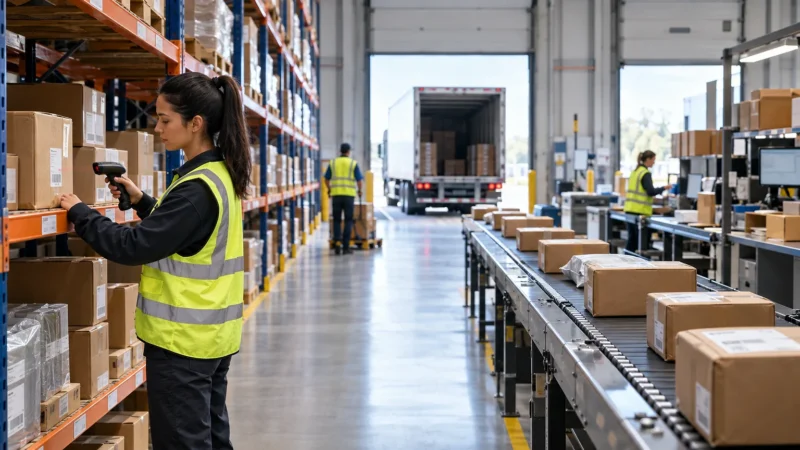
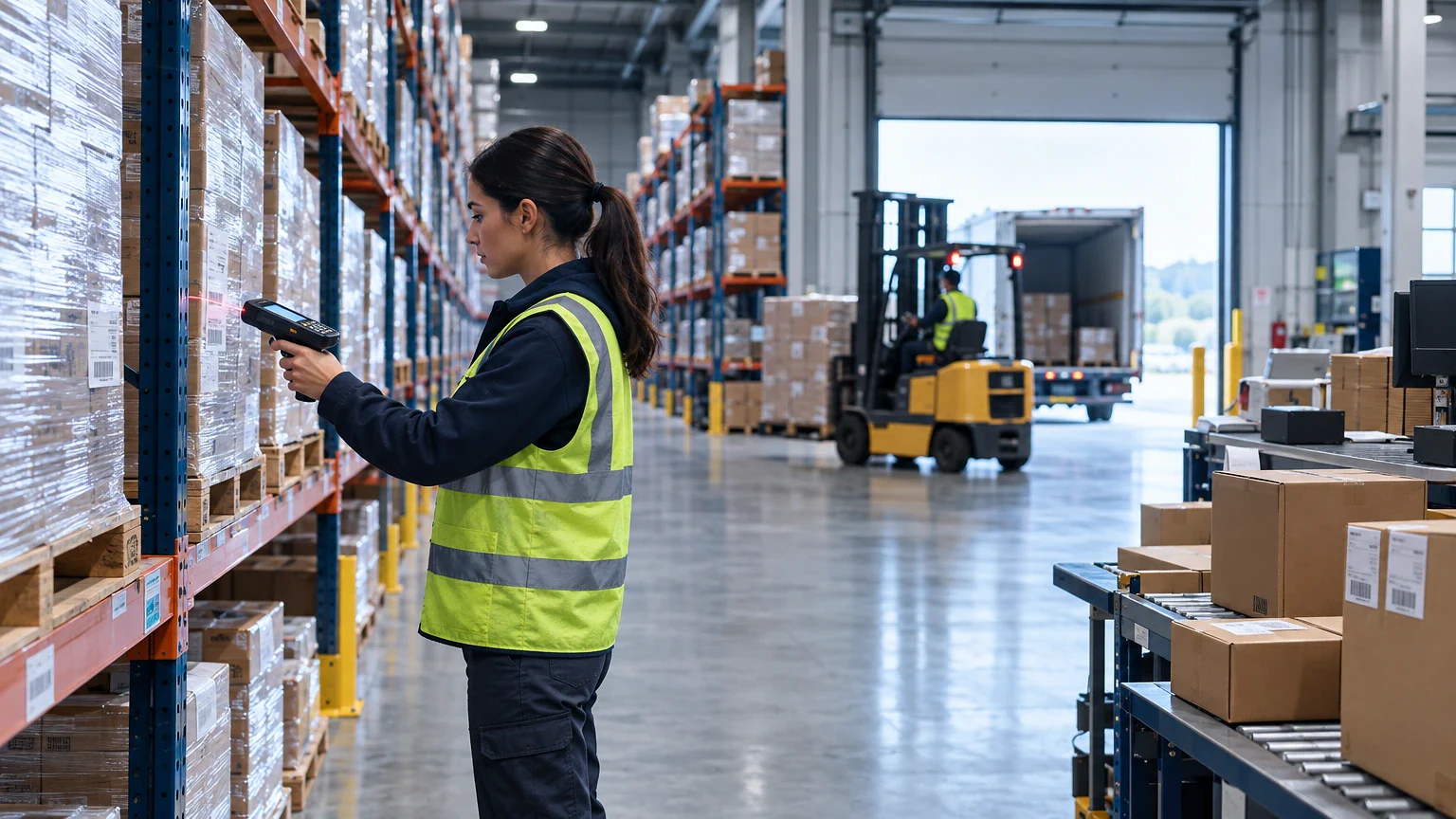
Walk into a working 3PL facility and you’ll see receiving docks running ASN checks against purchase orders. Pickers walk the zones with RF scanners. Packing stations weigh boxes against dimensional data before a label prints. None of that happens in isolation. It’s tied to a warehouse management system (WMS), usually something like Deposco, Extensiv, or a custom build running on top of NetSuite.
The core job breaks into four buckets: inbound receiving, storage, outbound fulfillment, and returns processing. Receiving means verifying piece counts against the ASN, flagging damage, and putting stock away within a slotting plan, not just shoving pallets into the nearest open bay. Storage means managing bin locations, cycle counting, and keeping inventory accuracy above 98%, which is the baseline most shippers expect before they’ll trust a provider with peak-season volume.
Outbound is where speed gets measured. A mid-size 3PL running a decent pick-to-light or voice-pick setup should hit 60 to 100 lines per hour per picker for single-item orders, less for multi-SKU batch picks. If a provider quotes numbers way above that without explaining automation behind it, ask hard questions.
Some providers sit a layer above all this. Our comparison of 3PL vs 4PL explains who actually holds the contracts in each model. Knowing which one you are buying changes who you call when a shipment stalls.
7 Services Bundled Into a Typical 3PL Contract
Most shippers assume 3PL means “pick, pack, ship.” That’s only part of it. Here’s what’s usually on the table:
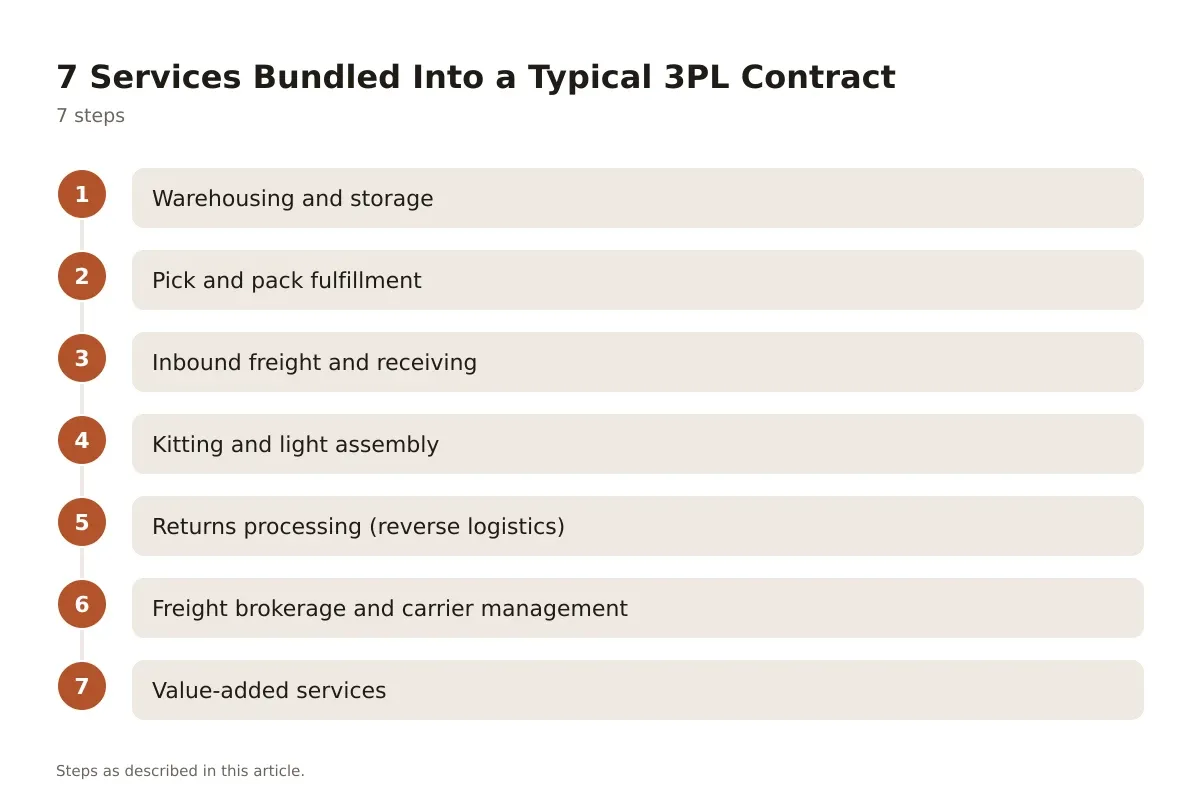
- Warehousing and storage – palletized, shelf, or bin storage billed by pallet position or cubic footage per month.
- Pick and pack fulfillment – order picking, kitting, and packaging to carrier or brand spec.
- Inbound freight and receiving – container unloading, floor-loaded truck receiving, cross-docking for fast-turn SKUs.
- Kitting and light assembly – bundling multi-SKU promo packs or assembling simple product sets.
- Returns processing (reverse logistics) – inspection, restocking, refurbishing, or disposal of returned goods.
- Freight brokerage and carrier management – negotiating LTL and parcel rates across UPS, FedEx, and regional carriers.
- Value-added services – labeling, FDA lot tracking, gift wrapping, or compliance labeling for big-box retailers like Walmart or Target.
Not every 3PL offers all seven. Some specialize narrowly, like cold storage or hazmat-certified facilities. Always ask which of these are in-house versus subcontracted, because subcontracted kitting or freight brokerage adds a markup layer you won’t see until the invoice.
How 3PL Pricing Actually Works
Pricing confuses more shippers than anything else in this industry. It’s not one number. It’s a stack of line items that only make sense once you’ve seen an actual invoice.
Storage is billed per pallet position per month, with rates varying depending on market and whether it’s ambient, climate-controlled, or cold storage. Receiving is billed per pallet or per carton, often $3 to $8 per pallet for standard floor-loaded receiving. Pick and pack runs per order plus per additional unit, commonly $2.50 to $4.50 for the first item and $0.30 to $0.75 for each additional item in that order.
Then there’s the WMS or technology fee. Some 3PLs bundle it into per-order pricing, while others bill it separately. Expect anywhere from $0 to a few hundred dollars monthly, depending on integration complexity. Freight is passed through at carrier rates, sometimes with a small markup. A real quote should itemize all of this, not hand you a blended “per order” number that hides where the margin sits.
⚠️ Warning: Never sign a 3PL contract that bundles storage, pick/pack, and freight into one flat per-order rate without a breakdown. You lose the ability to audit invoices or renegotiate individual line items later.
Why Companies Outsource to a 3PL Instead of Running Their Own Warehouse
Running your own distribution center means leasing space, buying racking rated for your SKU mix, hiring and training a floor crew, and licensing a WMS. That’s a six-figure commitment before you’ve shipped a single order. A 3PL converts that into a variable cost tied to volume.
The real advantage shows up during demand swings. A direct-to-consumer brand that does 800 orders a day in March and 4,000 a day in December can’t efficiently staff for both scenarios in-house. A 3PL spreads that peak labor cost across dozens of clients sharing the same floor. That is exactly why a 3PL warehouse can come out cheaper than running your own. Headcount, benefits, and idle capacity during slow months all tip the math that way.
There’s a tradeoff, though. You give up direct floor control. If a picker mispacks an order or a receiving clerk miscounts a pallet, you’re relying on the 3PL’s quality process, not your own supervisor walking the aisle. That’s the real cost of outsourcing, and it’s why due diligence on a provider’s error rate and chargeback policy matters more than the per-order rate on the quote sheet.
5 Red Flags That Signal a Bad 3PL Fit
Not every provider that looks good on a sales call performs the same way on the warehouse floor. Watch for these signals during evaluation:
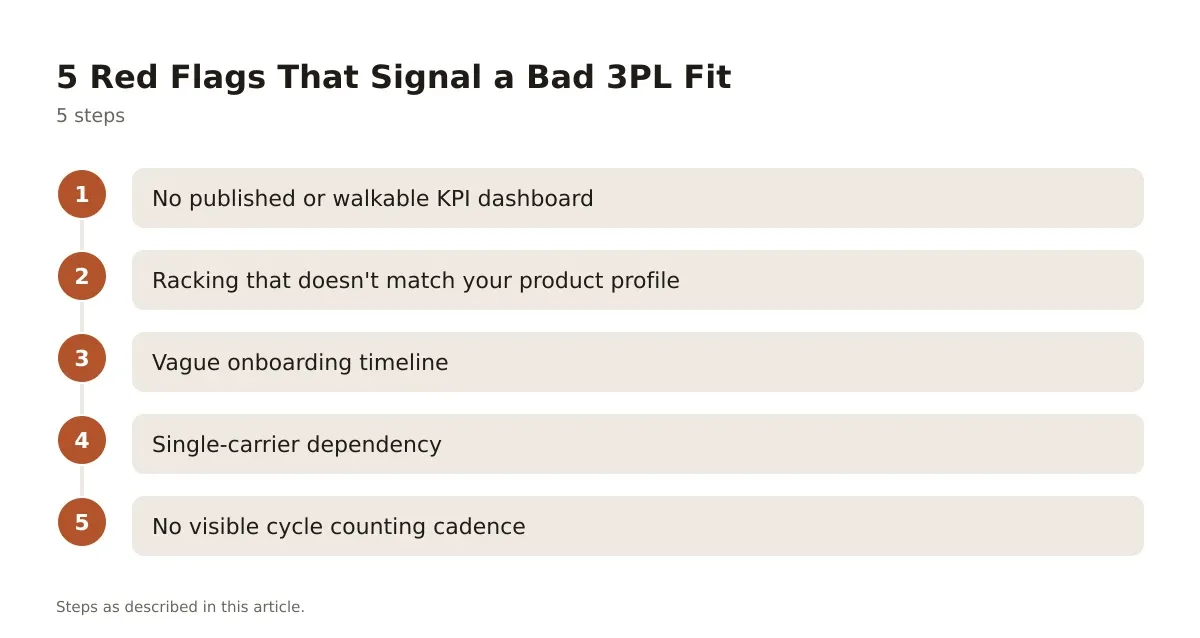
- No published or walkable KPI dashboard – if they can’t show you real-time order accuracy or on-time ship rate, they’re not tracking it closely enough.
- Racking that doesn’t match your product profile – a provider running standard selective racking rated for 2,500 lbs per pallet position won’t work for heavy industrial SKUs needing drive-in or push-back systems.
- Vague onboarding timeline – “a few weeks” with no milestone plan usually means integration problems later.
- Single-carrier dependency – a 3PL that only ships UPS has no use during a carrier’s peak surcharge season.
- No visible cycle counting cadence – ask whether counts happen weekly, monthly, or only during annual physical inventory. Infrequent counts let shrink and location errors pile up unnoticed.
Any one of these alone isn’t disqualifying. Two or three together usually means the partnership will cost you more in firefighting than it saves in outsourced labor.
Getting the Fit Right From the Start
A 3PL isn’t a commodity purchase, even though pricing sheets make it look that way. The same per-order rate can represent a well-run facility with modern WMS integration and tight cycle counts, or a cluttered floor running on spreadsheets and hope. The rate card tells you almost nothing about which one you’re getting.
What actually matters is operational transparency: can they show you real pick rates, real accuracy numbers, real onboarding timelines? If a provider dodges those questions, that’s your answer before you’ve even discussed storage fees. Benchmarks from the Warehousing Education and Research Council give you a yardstick for the numbers they do share. For shippers evaluating multiple providers side by side, it helps to walk through what actually matters when choosing a 3PL company rather than comparing quotes in isolation.
Outsourcing fulfillment isn’t a one-way door, but switching 3PLs mid-contract is expensive and disruptive to customers. Getting the evaluation right up front, with real questions and real floor-level scrutiny, saves you from learning these lessons the hard way during your first peak season.
Common Questions Ops Managers Ask Before Signing
Before any contract gets signed, a handful of practical questions come up again and again on calls with prospective 3PL partners.
Does the 3PL integrate with my existing systems?
Check whether their WMS connects natively to Shopify, Amazon, or your ERP, or whether it requires a middleware tool like Cin7 or ShipStation to bridge the gap. A manual CSV upload process is a red flag for anything beyond a handful of orders a day.
Ask what runs underneath that process. Our overview of 3PL software explains which systems a provider needs to bill and ship accurately. Weak billing logic shows up on your invoice long before it shows up on the floor.
What happens during peak season?
Ask how they handle Black Friday through Cyber Monday volume spikes specifically, including whether they bring in temp labor and how that affects turnaround time. A facility running at 95% capacity in October has no room left for a December surge.
What’s their actual inventory accuracy, measured, not claimed?
Anything below 98% cycle count accuracy should raise concerns, especially for apparel or multi-variant SKUs where mispicks compound quickly.