To begin with, your peak season is eight weeks out. Meanwhile, your 3PL keeps missing cut-off times, and a consultant just pitched a “fourth-party” fix. Before you sign anything, you need to know what 3PL vs 4PL actually changes.
In short, a 3PL runs your physical work: storage, picking, packing, shipping. Conversely, a 4PL manages your whole supply chain, including the 3PLs and carriers. Specifically, this guide compares both models with real operating examples and named providers worth shortlisting.
What this 3PL vs 4PL guide covers
- 3PL vs 4PL at a glance
- 1. GXO Logistics: the automation-heavy 3PL
- Standout features
- Limitations
- Pricing and plans
- 2. ShipBob: the ecommerce-first 3PL
- Standout features
- Limitations
- Pricing and plans
- 3. DHL Supply Chain: the global 3PL
- Standout features
- Limitations
- Pricing and plans
- 4. Accenture: the consulting-led 4PL model
- Standout features
- Limitations
- Pricing and plans
- 5. Geodis: the hybrid answer to 3PL vs 4PL
- Standout features
- Limitations
- Pricing and plans
- 3PL vs 4PL: how they compare
- Choosing between 3PL vs 4PL by team size and budget
- Option A: Choose a 3PL
- Option B: Choose a 4PL
- 3PL vs 4PL: where the line really falls
- 3PL vs 4PL: frequently asked questions
- What is the main difference between 3PL vs 4PL?
- In 3PL vs 4PL, is the 4PL always more expensive?
- Can a company use both sides of 3PL vs 4PL?
- When does 3PL vs 4PL favor a 4PL for a small brand?
- Does a 4PL own warehouses or trucks?
3PL vs 4PL at a glance
First, we judged each provider on four things: scope of service, technology depth, contract structure, and who it suits. Notably, pricing for all five is quote-based or negotiated.
| Rank | Provider | Best for | Price |
|---|---|---|---|
| 1 | GXO Logistics (3PL) | Automated, high-volume contract warehousing | Pricing on request |
| 2 | ShipBob (3PL) | Growing DTC and ecommerce brands | Pricing on request |
| 3 | DHL Supply Chain (3PL) | Multi-site, multi-country operations | Pricing on request |
| 4 | Accenture (4PL-style) | Enterprise supply chain redesign | Pricing on request |
| 5 | Geodis (3PL plus 4PL) | Hybrid: one provider, both layers | Pricing on request |
Definition: A 3PL (third-party logistics provider) performs physical logistics tasks such as warehousing and shipping. By contrast, a 4PL (fourth-party logistics provider) is a single integrator that manages your entire supply chain, including multiple 3PLs, carriers and systems. For the basics, see what a 3PL covers.
1. GXO Logistics: the automation-heavy 3PL
For example, picture a warehouse manager whose manual pickers hit 80 lines an hour. Meanwhile, competitors run goods-to-person cells at several times that rate. Consequently, GXO Logistics sells that gap.

Editor’s pick: GXO leads because it shows what a pure 3PL does best. In practice, it runs the floor at high throughput with proven automation.
In other words, GXO is a contract logistics specialist. In practice, you hand over the building, the labor and the process. Then they return pick accuracy and a cost per order.
Standout features
- Robotics and goods-to-person systems across large sites
- Dedicated site teams with named operations managers
- Mature WMS integrations with major ERPs
- Multi-year contracts that help fund automation spend
- Reporting on pick rate, dock-to-stock time and inventory accuracy
- In-house returns and reverse logistics
- Proven peak-season labor planning
Limitations
However, minimum volumes are high. As a result, small brands will not get much attention. Contracts run long, so exit costs matter.
Pricing and plans
Quote-based. Typically, expect fixed management fees plus per-unit charges. Premium tier.
2. ShipBob: the ecommerce-first 3PL
Then ask a founder shipping 400 orders a day what they need. Usually, it is not a bespoke warehouse. Instead, it is two-day delivery and a dashboard that syncs with Shopify.
Instead, ShipBob runs a network of fulfillment centers on its own software platform. In addition, your stock splits across locations to cut shipping zones.
Standout features
- Multi-node inventory placement to shorten delivery times
- Native storefront and marketplace integrations
- Lot tracking and kitting options
- Returns handled in the same dashboard
Limitations
Of course, you get less customization than a dedicated-site 3PL. Furthermore, complex SKU profiles such as oversize or hazmat can strain the model.
Pricing and plans
Quote-based, with per-order, storage and receiving charges. Mid-range.
3. DHL Supply Chain: the global 3PL
Similarly, a manager running four countries does not want four vendors. By contrast, DHL Supply Chain offers one contract across many sites.
Specifically, DHL covers warehousing, transport and value-added services at scale. Moreover, it often fields industry-specific teams.
Standout features
- Footprint across most major markets
- Specialist teams for retail, healthcare and technology
- Transport and warehousing under one agreement
- Established compliance and safety programs
Limitations
Even so, DHL favors large accounts. Consequently, decision cycles are slow. Similarly, local flexibility varies by site.
Pricing and plans
Negotiated per contract. Premium tier, scaled to volume.
4. Accenture: the consulting-led 4PL model
Finally, here is the scenario that changes the math. For instance, you run six 3PLs, three carriers and two planning systems. Yet nobody owns the end-to-end picture.
Therefore, Accenture and similar integrators design the network. Specifically, they select providers, track performance and run the control tower. However, they rarely touch product.
Standout features
- Vendor selection and ongoing performance governance
- Network design and scenario modeling
- Technology integration across planning, transport and warehouse systems
- One accountability layer above multiple 3PLs
Limitations
Rather, you pay for expertise and management, not capacity. Nevertheless, gains take quarters to appear. Moreover, weak data inside your own business caps the results.
Pricing and plans
Project or retainer-based, often with gain-share terms. Premium tier.
5. Geodis: the hybrid answer to 3PL vs 4PL
Meanwhile, some operators want one provider without a separate integrator. Geodis runs warehouses and also offers supply chain orchestration.
It pairs contract logistics with network management, so one contract spans both layers.
Standout features
- Physical operations plus planning and optimization services
- Freight forwarding and contract logistics under one roof
- Control-tower visibility for multi-leg shipments
Limitations
Still, the conflict of interest is real. After all, a provider that runs the warehouse and audits it is grading its own homework.
Pricing and plans
Quote-based. Mid-range to premium, depending on scope.
3PL vs 4PL: how they compare
| Provider | Price | Best for | Standout feature |
|---|---|---|---|
| GXO Logistics | Quote-based, premium | High-volume contract warehousing | Automation at scale |
| ShipBob | Quote-based, mid-range | Growing DTC brands | Multi-node network |
| DHL Supply Chain | Negotiated, premium | Multi-country operations | Global footprint |
| Accenture | Retainer or project | Enterprise network redesign | Governance layer |
| Geodis | Quote-based, mid to premium | Hybrid single-provider model | Both layers in one contract |
Choosing between 3PL vs 4PL by team size and budget
Use this framework instead of guessing.
Option A: Choose a 3PL
Pick a 3PL if you have one or two warehouses’ worth of work. It fits when you need labor, space or speed. A brand growing from 200 to 2,000 orders a day needs pickers and racking, not a strategy layer.
Option B: Choose a 4PL
Pick a 4PL if you already use several providers and lack end-to-end visibility. If transport, warehouse and technology spend sit in separate silos, a 4PL pulls them together.
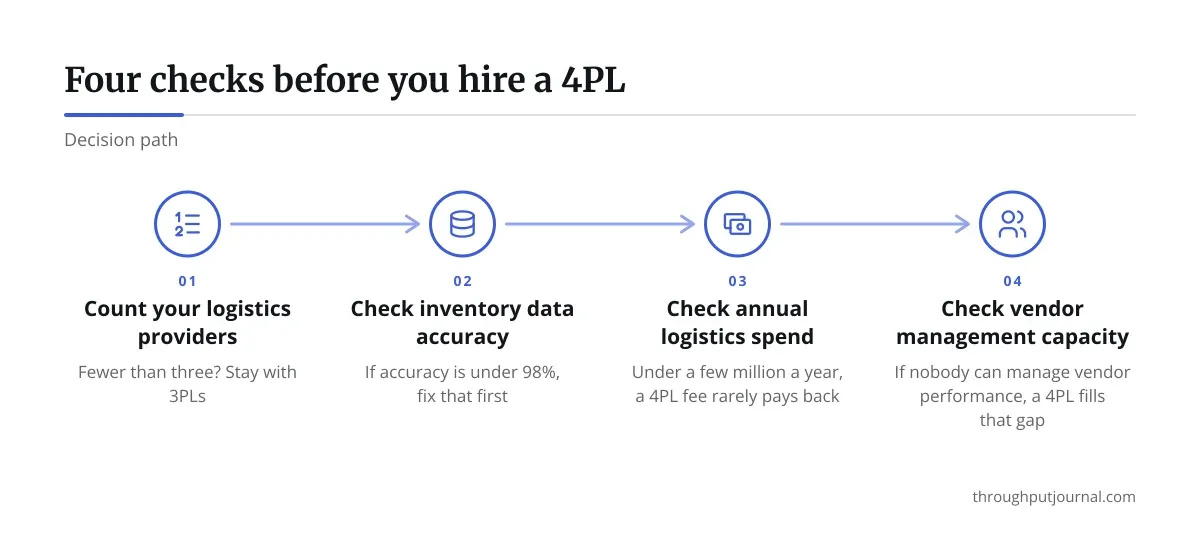
In practice, run this test in order:
- Count your logistics providers. Fewer than three? Stay with 3PLs.
- Check your data. If inventory accuracy is under 98%, fix that first. No 4PL can orchestrate bad data.
- Check your spend. If logistics costs are under a few million a year, a 4PL fee rarely pays back.
- Check your team. If nobody can manage vendor performance, a 4PL fills that gap.
Read what 3PL means in practice before you compare proposals.
3PL vs 4PL: where the line really falls
Ultimately, the practical difference is accountability. In practice, a 3PL answers for pick accuracy and dock-to-stock time. By comparison, a 4PL answers for total landed cost and service levels across every provider.
Overall, most small and mid-size operations never need a 4PL. Indeed, the ones that do often find out after a bad peak, when three vendors blame each other.
So start with a strong 3PL. Then add orchestration only when your network outgrows your bandwidth. Prices for every provider above are quote-based, so confirm figures directly with each vendor. For the handoff itself, our guide to 3PL shipping explains how outsourced fulfilment runs day to day, while order fulfillment covers the steps inside your own four walls.
3PL vs 4PL: frequently asked questions
What is the main difference between 3PL vs 4PL?
In short, a 3PL performs physical tasks: storing, picking, packing and shipping. Conversely, a 4PL manages the whole supply chain, including your 3PLs and carriers. In other words, one runs the floor. The other, meanwhile, runs the network.
In 3PL vs 4PL, is the 4PL always more expensive?
Usually yes in management fees, but the models are not like for like. A 3PL charges for activity, such as storage and orders. A 4PL charges for governance, often with gain-share tied to the savings it delivers.
Can a company use both sides of 3PL vs 4PL?
Yes, and that is the normal setup. The 4PL sits above and manages several 3PLs. Your physical work still happens in the 3PLs’ buildings.
When does 3PL vs 4PL favor a 4PL for a small brand?
Rarely. If you ship a few thousand orders a month from one or two nodes, a 3PL covers what you need. A 4PL fee is hard to justify at that scale.
Does a 4PL own warehouses or trucks?
Traditionally no. A pure 4PL is asset-light and works through partners. Hybrid providers, like Geodis, blur that line by owning assets and offering orchestration too.