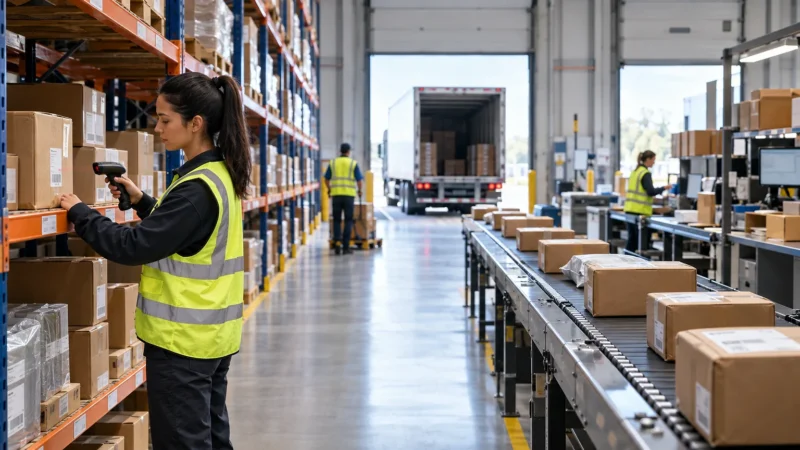
Most brands that move to 3PL ecommerce fulfillment expect lower costs. However, the first invoice often says otherwise. Storage, pick fees, packaging and returns handling add up fast once volume swings.
3PL ecommerce fulfillment means handing storage, picking, packing and shipping to a specialist warehouse operator. Specifically, this guide shows how the model works, what drives the bill, and how to pick a partner without nasty surprises.
Definition: 3PL ecommerce fulfillment. A third-party logistics provider stores your inventory in its warehouse, picks and packs each online order, and hands parcels to carriers. You pay per unit, per order and per pallet instead of running your own building.
How 3PL Ecommerce Fulfillment Actually Runs
Walk the floor of a typical mid-size 3PL and you see four zones. Receiving, putaway, pick-and-pack, and outbound staging.
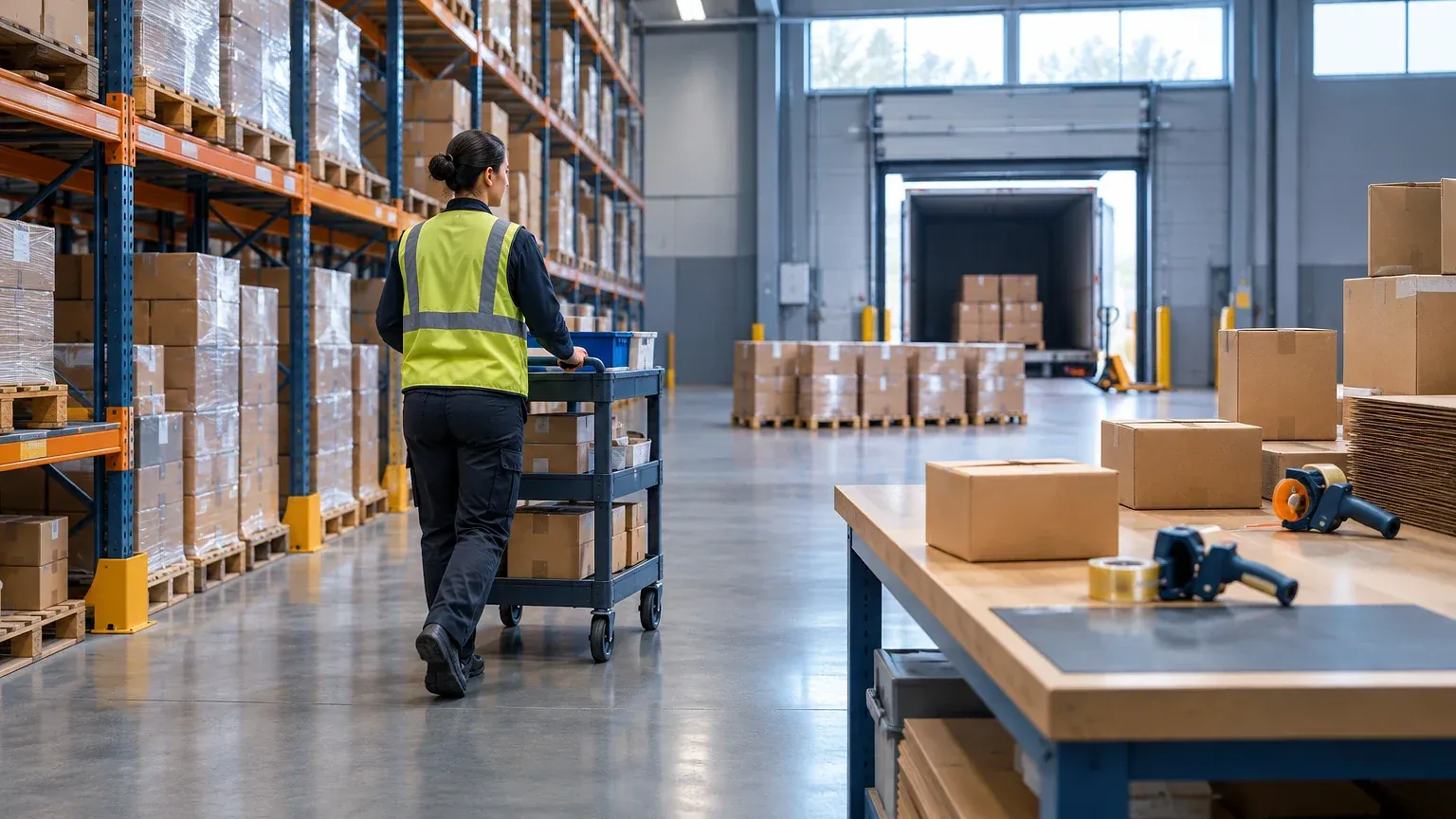
Your goods arrive on pallets or in floor-loaded cartons. First, receiving staff scan each carton against your advance shipping notice. Mismatches get flagged before anything enters stock.
Putaway comes next. Typically, fast movers go into forward pick locations near the packing benches. Conversely, slow movers sit in pallet racking above. A standard selective rack bay often carries around 2,000 to 3,000 lb per pallet position, so the operator slots heavy items low.
On one floor we ran, a batch-pick cart moved four orders at once. Consequently, pickers averaged 90 to 120 lines per hour. By comparison, single-order walking picks managed about half that.
Orders then flow to pack stations. Next, staff scan items, the system picks the carton size, and a label prints. Parcels leave on the carrier’s trailer the same day if the cutoff is met.
What Drives the Cost of 3PL Ecommerce Fulfillment
Your invoice is rarely one number. Instead, it is a stack of line items, and each scales differently with your business.
Most 3PLs bill these categories:
- Onboarding or setup: often a one-time fee for integration and SKU creation.
- Receiving: charged per pallet, per carton or per hour.
- Storage: billed per pallet, per bin or per cubic foot, monthly.
- Pick and pack: a base fee for the first item, then a smaller fee per extra unit.
- Packaging materials: cartons, mailers, dunnage and tape, usually passed through.
- Shipping: carrier rates, sometimes with a markup or a discounted rate card.
- Returns processing: a per-unit inspection and restock fee.
- Minimums: monthly spend floors that punish seasonal brands.
Ask for a sample invoice built from your own order profile. Quotes based on a generic “average order” hide the real cost of oversized items or multi-line orders.
Watch storage in particular. Dead stock sitting for 180 days can cost more in rent than it earns in margin. Moreover, many operators add long-term storage surcharges after 6 or 12 months.
Picking Between Warehouse Models and Networks
Not every brand needs the same setup. Rather, your order volume, SKU count and delivery promise decide the fit.
Single-site 3PL
One warehouse is simplest. Indeed, you get one inventory pool and one set of reports. However, the downside is shipping distance. A West Coast building serving East Coast customers adds zone 7 or 8 parcel rates and extra transit days.
Multi-node 3PL network
Splitting stock across two or three sites cuts average zone and transit time. You carry more total inventory, though, because safety stock is held in each node. Overall, brands under a few thousand orders a month rarely justify it.
Specialist or niche 3PL
Some operators focus on cold chain, hazmat, apparel with heavy returns, or subscription boxes. Therefore, they invest in the right equipment and compliance. Expect higher per-unit rates in exchange for fewer errors in your category.
Comparing Leading 3PL Ecommerce Fulfillment Providers
Here is an honest snapshot of well-known options. Pricing varies by volume, so treat the models below as a starting point for quotes.
| Provider | Best for | Network | Pricing model |
|---|---|---|---|
| ShipBob | Growing DTC brands | Multi-node, North America, Europe, Australia | Per-order and storage fees, quote-based |
| ShipMonk | Mid-size merchants | Several US sites plus international | Per-order and storage fees, quote-based |
| Amazon MCF | Sellers already on Amazon | Amazon’s fulfillment network | Per-unit fees by size and weight, published rate card |
| Red Stag Fulfillment | Heavy and bulky goods | Single large Tennessee site | Quote-based, built around oversized items |
| Flexport | Importers needing freight plus fulfillment | Global freight, US warehouses | Quote-based |
Amazon MCF publishes its rates, which makes budgeting easy. The trade-off is plain packaging, so it suits brands that do not care about unboxing. By contrast, most others quote after reviewing your SKU profile.
Technology and Inventory Accuracy You Should Demand
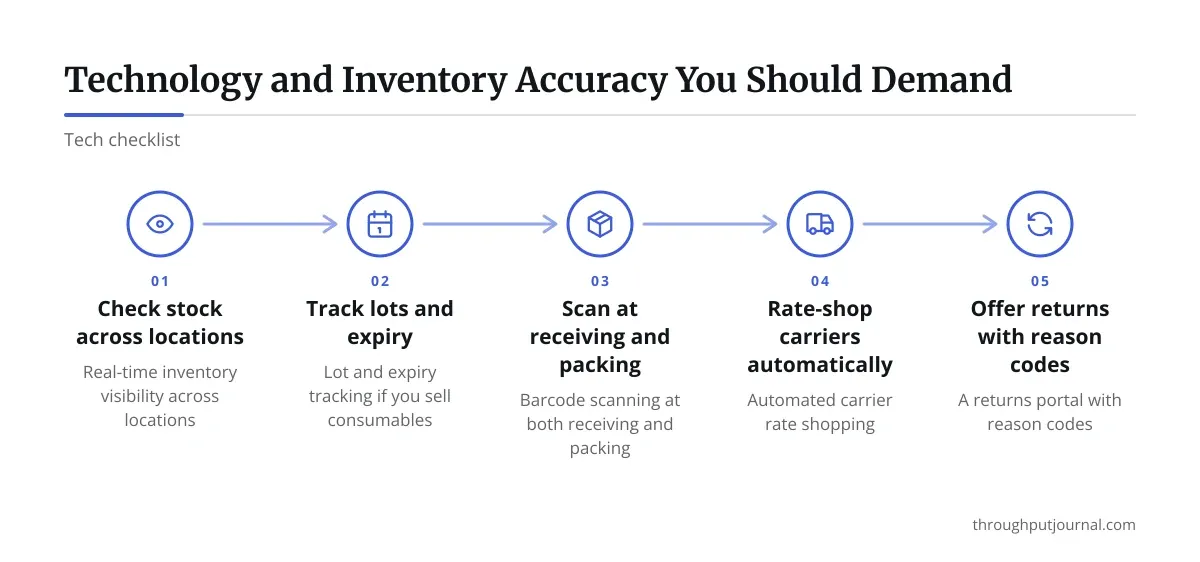
A 3PL is only as good as its warehouse management system. Specifically, the WMS drives pick paths, lot control and your live stock counts.
Ask what accuracy they hold. Strong operators report very high inventory accuracy, backed by regular cycle counts rather than a single annual stocktake. Notably, anything near 95% means oversells, and every oversell is a cancelled order and an angry customer.
Check the integration list too. You want a native connector to your storefront, whether that is Shopify, BigCommerce or WooCommerce. Usually, native connectors sync orders and stock in minutes. In contrast, custom API work adds cost and delay.
Look for these features:
- Real-time inventory visibility across locations.
- Lot and expiry tracking if you sell consumables.
- Barcode scanning at both receiving and packing.
- Automated carrier rate shopping.
- A returns portal with reason codes.
During a demo, ask them to show a mis-pick being caught at the pack station. Good systems force a scan match before a label prints. As a result, that single control removes most wrong-item shipments.
3PL Ecommerce Fulfillment Questions to Ask Before You Sign
Contracts lock you in, so push hard before signing. Start with service levels. Ask for the order cutoff time, the standard dock-to-stock window, and the error rate they guarantee.
Next, ask about peak season. Many 3PLs cap volume or add surcharges from October to December. Get the surge rules in writing.
Then look at the exit. How do you retrieve inventory if you leave? Some providers charge heavy pallet-out fees or hold stock until invoices clear. A fair contract lets you leave with 30 to 90 days’ notice.
Finally, ask for references from brands that ship a similar order profile. Call two. Ask what went wrong in the first 90 days and how the account team handled it. Of course, every operator has bad weeks. What matters is the response.
Choosing a 3PL Ecommerce Fulfillment Partner
The right 3PL ecommerce fulfillment partner matches your volume, product profile and delivery promise, not the lowest quote on the page. Therefore, model your real order mix, compare total landed cost per order, and test accuracy claims in a demo.
Start small if you can. Move a handful of SKUs first, watch pick accuracy and dock-to-stock time for a month, then scale. A phased move exposes integration gaps while the stakes are still low.
Treat the relationship like a partnership with measurable service levels. Specifically, review a scorecard monthly covering on-time ship rate, inventory accuracy and cost per order. Certainly, operators that know you are watching perform better. For the wider picture, our guide to order fulfillment maps every step from cart to doorstep.
Frequently asked questions
What does 3PL ecommerce fulfillment cost per order?
It depends on your product and volume. Expect separate charges for pick and pack, packaging, storage and shipping. Request a quote built from your actual order profile rather than a generic average, since oversized or multi-item orders raise the total.
How much inventory do I need to use a 3PL?
There is no universal minimum, but many providers set monthly spend or order floors. Smaller brands often start with a few hundred orders a month. If a provider’s minimum exceeds your volume, look at smaller operators or marketplace programs.
How long does it take to onboard with a 3PL?
Most onboarding takes a few weeks. You need to integrate your storefront, create SKUs, label products and ship the first inbound stock. Plan extra time if your goods need kitting or custom packaging.
Can a 3PL handle returns?
Yes, most do. The provider inspects returned items, restocks sellable units and disposes of damaged ones. Ask for a per-unit returns fee and a stated turnaround, because slow restocking ties up sellable inventory.
Is a 3PL better than fulfilling orders in-house?
It depends on scale and control. A 3PL removes lease, labor and equipment costs and gives you carrier discounts. In-house gives tighter control over packaging and brand experience. Many brands switch once order volume outgrows a spare room or garage.