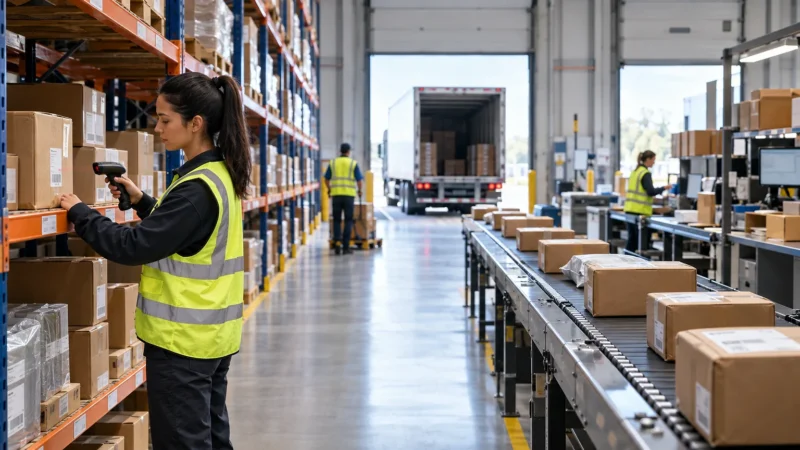
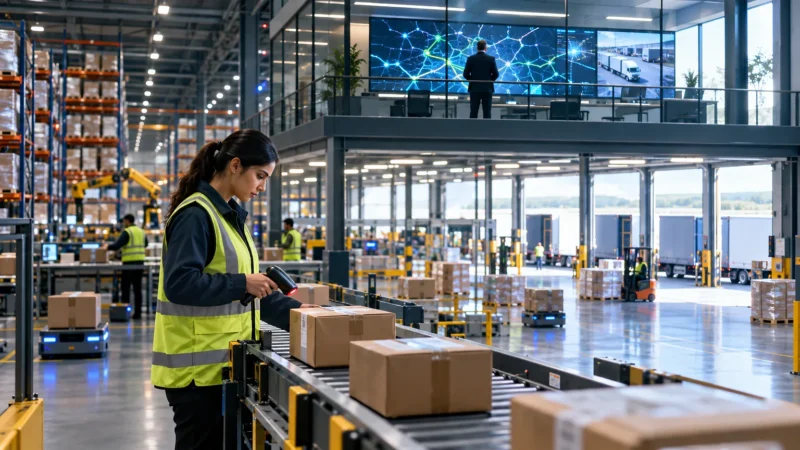
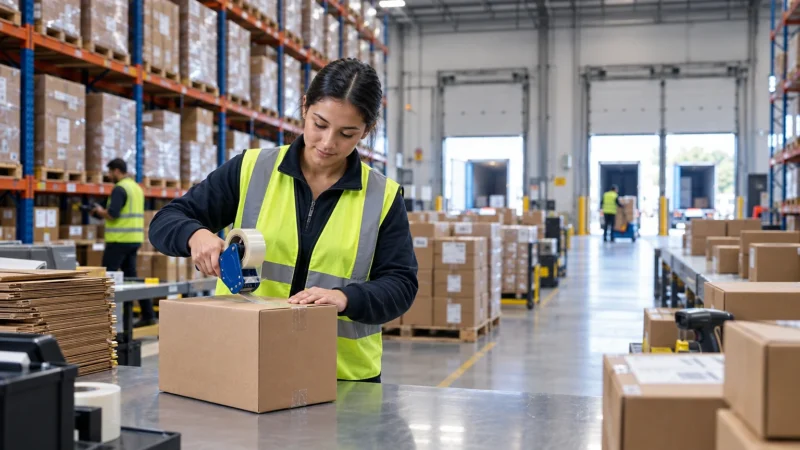
Pick and pack is the part of fulfilment where a customer order becomes a physical parcel. Someone collects the items from storage, verifies them, puts them in a box with the right protection, and labels it for the carrier.
It sounds mechanical, but it is usually the single largest labour cost in a warehouse. It is also where most despatch errors originate, which makes it the most profitable place to spend improvement effort.
Understanding where the minutes actually go is the first step. The answer surprises people: the bulk of the time is not picking or packing, it is walking.

What happens during pick and pack
An order is released to the floor, often grouped with others into a batch. The system generates a pick list sequenced by location, and a picker works through it collecting each line.
Once complete, the items are checked against the order, packed into suitable packaging, and labelled. The parcel then joins the despatch lane for its carrier.
Where the time actually goes
Across most operations, travel accounts for roughly half of total picking time. The physical act of taking an item from a shelf is a small fraction, and searching for a badly slotted item adds more than people expect.
This changes where you should focus. Buying a faster scanner shaves seconds from the smallest part of the cycle. Reorganising your slotting so popular items sit near despatch attacks the largest part.
Picking methods and when each fits
Discrete picking means one picker completes one order at a time. It is simple and keeps errors contained, but it means the most walking per line, so it suits low volumes or large orders.
Batch picking collects the same item for many orders in one pass, then splits the quantities at a sorting station. It cuts travel sharply when many orders share items.
Zone picking assigns each picker a fixed area, with orders passing between zones. It works well in large buildings, though it needs careful balancing so one zone does not hold up the rest.
Wave picking combines these ideas, releasing groups of orders timed around carrier collections. Most mature operations end up using a blend rather than one pure method.
What pick and pack costs per order
Third-party providers commonly charge a base fee of roughly two to four dollars for the first item, then a smaller per-item fee of around twenty to fifty cents for each additional line. Packaging is usually billed separately.
In-house costs are easier to underestimate. Add picker wages, packing labour, materials, the equipment, and the floor space itself. Many operations that benchmark honestly find their internal cost lands close to what a provider would charge.
Reducing errors without slowing down
Scan verification at the pack bench is the highest-value control available. Scanning each item against the order catches the wrong-item error before the parcel leaves, and it costs seconds rather than minutes.
Weight checking adds a second layer. If the packed parcel does not match the expected weight within tolerance, the station flags it, which reliably catches missing or duplicated items.
Packaging decisions that affect cost
Carton size drives shipping cost through dimensional weight, so oversized boxes mean paying to ship air. A small range of right-sized cartons usually beats a single universal box.
Void fill matters too, but more material is not better protection. Correct box selection with modest fill protects goods more reliably than a large box packed with paper.
Staffing for uneven demand
Order volume rarely arrives evenly. Carrier cut-off times create a daily peak, and seasonal spikes can multiply volume several times over.
Cross-training is the cheapest buffer. When packers can pick and pickers can pack, you can shift people toward whichever stage is the bottleneck that hour instead of watching one queue grow.
How pick and pack fits the wider operation
Picking performance depends on decisions made upstream. Slotting, stock accuracy and system support all set the ceiling on how fast the floor can run. Reviewing your picking methods alongside the wider fulfilment process usually reveals more than optimising either alone.
If volumes are growing faster than your space, compare your true internal cost against outsourced fulfilment before committing to a bigger building. Repetitive lifting and reaching also carry a genuine injury risk, and OSHA publishes practical ergonomics guidance for exactly this kind of work, while GS1 barcode standards keep scan verification reliable.
Frequently asked questions about pick and pack
How many orders should one picker handle per hour?
It varies enormously with order profile and layout. Sixty to a hundred lines an hour is a common range for small-item picking, but batch picking in a dense area can push well beyond that.
Is it cheaper to outsource pick and pack?
It depends on volume and how fully you cost your own operation. Outsourcing often wins at low volume or during sharp seasonal peaks, while steady high volume tends to favour running it in house.
What is the most common pick and pack error?
Picking the wrong variant of a similar item, such as the wrong size or colour. Scan verification at the bench catches almost all of these.
The practical takeaway
Attack travel time first through better slotting and batch picking, then add scan verification to control errors. Right-size your cartons, cross-train your team for peaks, and measure your true internal cost per order before deciding whether to outsource.