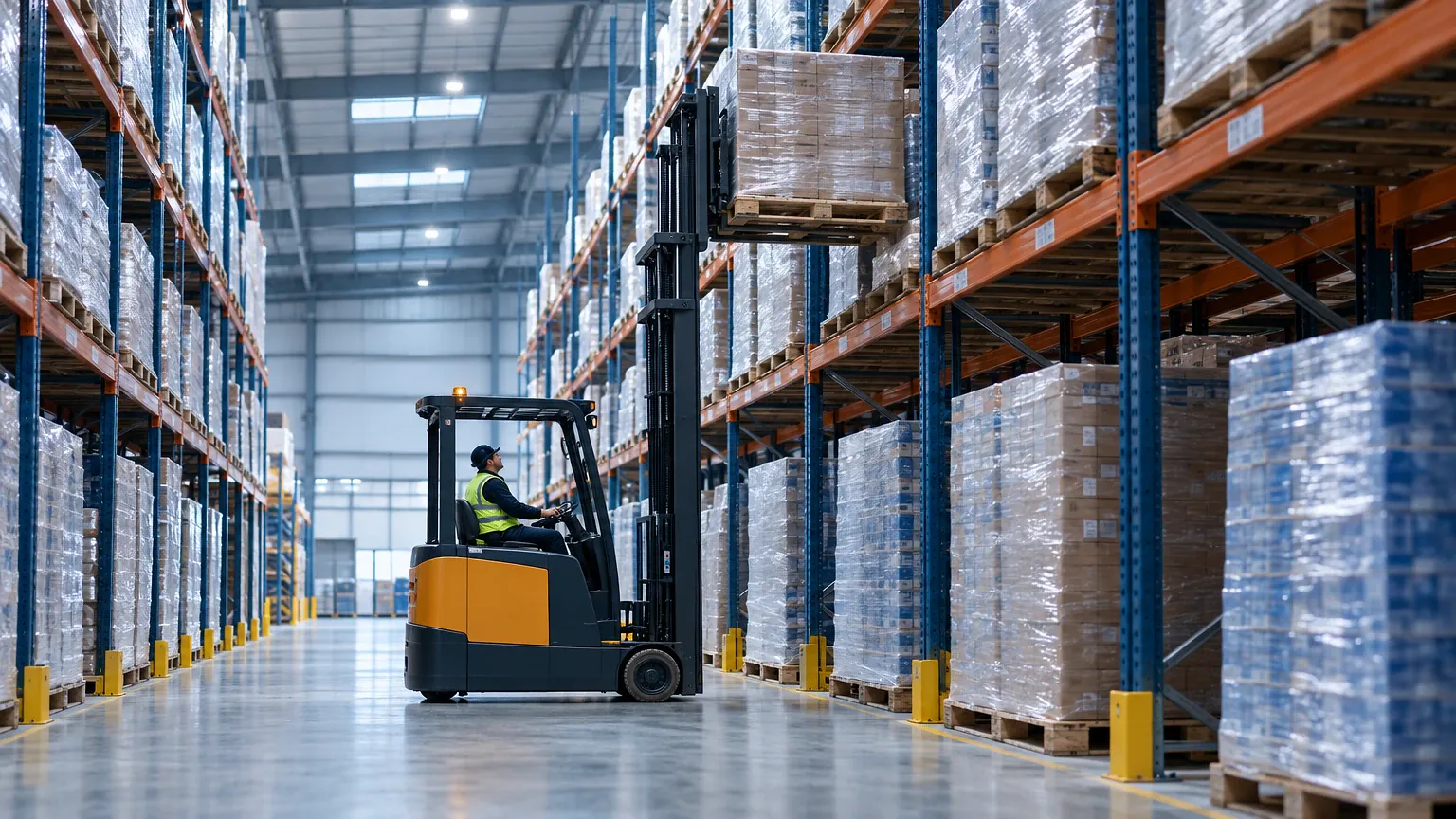
Think every pallet racking system is basically the same steel with a different coat of paint? It isn’t. The frame gauge, beam capacity, and aisle width you choose decide your pick rates, your damage claims, and whether your forklift drivers curse your name every shift.
This guide breaks down the real types, the load numbers that matter, and how to size a system against your actual SKU mix, not a catalog photo.
What Pallet Racking Actually Means in a Warehouse
Pallet racking is a steel storage structure built to hold palletized loads above floor level, stacked in vertical bays accessed by forklift or reach truck. It’s the backbone of nearly every distribution center, 3PL, and manufacturing stockroom you’ll walk into.
Definition: pallet racking means upright frames plus horizontal beams forming bays. Each bay carries a rated load capacity per level. Manufacturers quote ratings in pounds per beam pair and per frame.
The frames are the vertical ladders bolted or anchored to the floor. The beams connect frame to frame, creating the shelf level where pallets sit. Capacity isn’t one number. A beam pair might carry 5,000 lbs evenly distributed, while the frame itself (the upright) might carry 20,000+ lbs total across all levels combined. Mix those up and you’ll overload a bay that looks fine on paper.
Manufacturers like Interlake Mecalux and Ridg-U-Rak publish load tables for every frame gauge and beam profile. You need those tables before you load a single pallet, not after a beam starts bowing.
Selective Racking vs High-Density Systems
Selective pallet racking is the default for a reason. Every pallet has direct forklift access, no digging, no shuffling. You lose some cube efficiency, around 85-90% of floor space goes to aisles and clearance rather than storage, but you gain speed. Pick rates in a selective-rack DC with a reach truck typically run 18-25 pallets per hour per operator, depending on travel distance.
Drive-in and drive-through racking flip that trade-off. Forklifts drive into the rack lane itself, stacking pallets 3-6 deep. You get 60-70% more storage density in the same footprint, but you’re now running LIFO (last in, first out) unless it’s drive-through with access from both ends. That kills FIFO rotation for anything with shelf life.
Push-back racking sits in between. Pallets load onto nested carts on an incline; each new pallet pushes the row back. You get 4-pallet-deep storage per lane with single-aisle access, and it still works LIFO per lane.
A frozen food 3PL running mixed SKU velocity usually splits the difference. Selective racking handles A-items near the dock, and drive-in for slow-moving bulk stock in the back. One system rarely covers the whole floor.
Pallet Flow and Pushback Systems for High-Volume Picking
Pallet flow racking (also called gravity flow) uses roller or wheel tracks on a slight incline, so pallets glide forward by gravity as the front one is picked. You load from the back, pick from the front. That’s true FIFO, which matters enormously for food, pharma, and anything with lot-code tracking requirements.
Flow lanes typically hold 6-10 pallets deep and need a slightly larger footprint than push-back because you’re loading and picking from opposite ends simultaneously. Throughput climbs because replenishment and picking never block each other on the same aisle.
Where this breaks down is slow movers. If a SKU doesn’t turn fast enough to keep the lane flowing, you’ve built an expensive static shelf. Flow racking earns its cost on your top 15-20% of SKUs by velocity, not your long tail.
Reputable suppliers rate flow rail systems by both static load and rolling load, since the dynamic force of a moving pallet differs from a parked one. Always ask for both numbers. Check that the brake/speed controller suits your average pallet weight, not just your lightest case.
What sits on the pallet matters as well. Our explainer on dunnage covers the packing material that stops loads shifting in transit. Rack design and load stability are the same problem at different scales.
Reading Load Capacities and Beam Ratings Correctly
This is where warehouses get hurt, literally. A beam capacity rating assumes uniformly distributed load (UDL) across the full beam length. Stack an unevenly loaded pallet, or a drum load with weight concentrated in the center, and the real-world capacity drops below the rated number.
Capacity labels (required under RMI/ANSI MH16.1 standards in the US) should list:
- Maximum load per beam level, distributed evenly
- Maximum load per upright frame, summed across all levels
- The specific beam and frame combination the rating applies to
Mismatch a beam from one manufacturer with a frame from another, and your rating is void even if both look compatible. This happens more than people admit, usually when a facility expands and buys “compatible” used racking from a liquidator without checking hole spacing or step-beam connector type.
Annual racking inspections should check for bent columns, cracked welds, and missing safety pins on beam connectors. OSHA doesn’t set a specific racking inspection interval by regulation. Most insurers and RMI guidance expect documented inspections at least annually. You either repair damaged components to spec or red-tag them out of service.
Choosing the Right Racking Type for Your Operation
There’s no single “best” racking system. Match the type to your SKU velocity, pallet count per SKU, and how often you need to rotate stock. Here’s a quick-reference rundown of the main options and where each one actually earns its keep.
- Selective racking – best for high-SKU-count operations needing direct access to every pallet; lowest density but fastest pick rates and simplest to reconfigure.
- Drive-in/drive-through racking – best for bulk storage of a few SKUs with many pallets each, like seasonal inventory or raw materials; sacrifices FIFO unless drive-through.
- Push-back racking – best for medium-velocity SKUs needing 2-5 pallets deep storage with single-aisle access; LIFO rotation per lane.
- Pallet flow (gravity flow) racking – best for high-velocity, lot-tracked SKUs needing strict FIFO; highest throughput per lane but costliest per position.
- Cantilever racking – best for long, awkward loads like lumber, pipe, or bar stock that don’t sit on standard pallets at all.
- Mobile (compactor) racking – best for cold storage or archive-heavy facilities where floor space costs more than slower retrieval speed; can hit 80%+ space utilization.
Most multi-SKU distribution centers run two or three of these side by side. A single-type facility usually means the operation hasn’t scaled past its first racking order yet.
Sizing Your Racking Layout to Match Inventory Flow
Layout decisions come down to three numbers: aisle width, bay depth, and clear height. Get any one wrong and you’re either wasting cube or strangling your truck traffic.
Reach trucks typically need 8-9 feet of aisle clearance; counterbalance forklifts need 12-13 feet; and narrow-aisle order pickers or turret trucks can work in 6-7 feet. Going narrow-aisle isn’t free. You need wire-guided or rail-guided trucks and a flatter floor. The tightest VNA (very narrow aisle) setups want tolerance within 1/8 inch over 10 feet.
Bay depth should match your pallet footprint plus clearance. A 42-48 inch standard pallet typically needs a 44-46 inch beam-to-beam depth per level. Most RMI-compliant designs also cap safety overhang.
A growing ecommerce fulfillment operation moving from 3PL space into its own facility often underestimates clear height. Racking vendors will happily spec a system that uses every inch to the sprinkler deflector line. Local fire code and your sprinkler design may force a lower top beam level. The usual constraint is (per NFPA 13 in-rack sprinkler requirements) rather than the building shell. Get the fire marshal’s sign-off before you finalize bay heights, not after the steel is bolted down.
Getting Racking Right Before You Scale
Pallet racking isn’t a one-time purchase you set and forget. It’s infrastructure that locks in your pick rates, your damage rate, and your ceiling on throughput for years. The cheapest racking quote almost never accounts for the aisle width your trucks actually need or the FIFO requirements your product category demands.
Start with your SKU velocity data, not a rack catalog. Know which 20% of SKUs move 80% of your volume, and build flow or push-back lanes around those. Let the long tail sit in selective racking where reconfiguration is cheap and fast.
Before you sign off on any layout, walk it with your safety team and your fire marshal. Confirm beam and frame ratings match the actual manufacturer pairing. Then put that first annual inspection on the calendar the day the racking goes live.
Racking is only one line on that checklist. Our guide to warehouse safety covers pedestrian routes, load handling and the audits that catch problems early. Book both reviews in the same quarter.
Specify racking and trucks together, or not at all. Once you have a pallet racking layout, check it against the machine that works the aisle. Our guide to the stand up forklift covers the aisle widths and capacities these systems assume.
Frequently asked questions
What is the difference between pallet racking and shelving?
Manufacturers engineer pallet racking for forklift-loaded palletized goods. They test beam and frame ratings for heavy, concentrated loads at height. Shelving is typically hand-stocked, lighter-duty, and rated in hundreds of pounds per shelf rather than thousands. You wouldn’t put a 2,000-lb pallet on steel shelving rated for case-pick totes.
How much weight can pallet racking hold?
It depends entirely on the beam and frame specification, not a universal number. Standard structural selective racking often rates beams between 3,000 and 6,000 lbs per level (uniformly distributed), with frame totals reaching 20,000-30,000 lbs across all levels. Always check the manufacturer’s load tag on the actual installed rack, since mixed components void factory ratings.
How often should pallet racking be inspected?
Most RMI and insurer guidance points to a formal documented inspection at least once a year, with informal visual checks happening far more often during daily forklift operations. Red-tag damaged beams, bent columns, or missing safety clips immediately, rather than waiting for the scheduled audit.
Is drive-in racking better than selective racking for a growing warehouse?
Not necessarily. Drive-in racking gives you more storage density for bulk SKUs but trades away FIFO rotation and slows pick rates since trucks drive into the lane itself. Most growing operations keep selective racking for fast-moving, high-SKU-count inventory and add drive-in or push-back only for specific bulk or seasonal items.
Can I mix different racking types in the same warehouse?
Yes, and most well-run distribution centers do exactly that. Selective racking near the dock handles fast pickers, while drive-in, push-back, or pallet flow lanes in the back handle bulk or FIFO-sensitive stock. The key is matching each racking type to the actual velocity and rotation needs of the SKUs stored there, not standardizing on one system for convenience.