Most warehouses that buy sit-down counterbalance trucks for narrow-aisle work are wasting floor space. A stand up forklift gives you a tighter turning radius, faster in-and-out cycles, and better sightlines in aisles under 11 feet wide. It costs more upfront than a basic sit-down unit, but in high-cycle picking operations it earns that back in throughput.
This guide breaks down capacities, aisle widths, pricing ranges, and the exact situations where a stand up rider beats a sit-down counterbalance or a reach truck. You’ll also get a model comparison and buying checklist built for operations managers, not equipment catalogs.
What Is a Stand Up Forklift
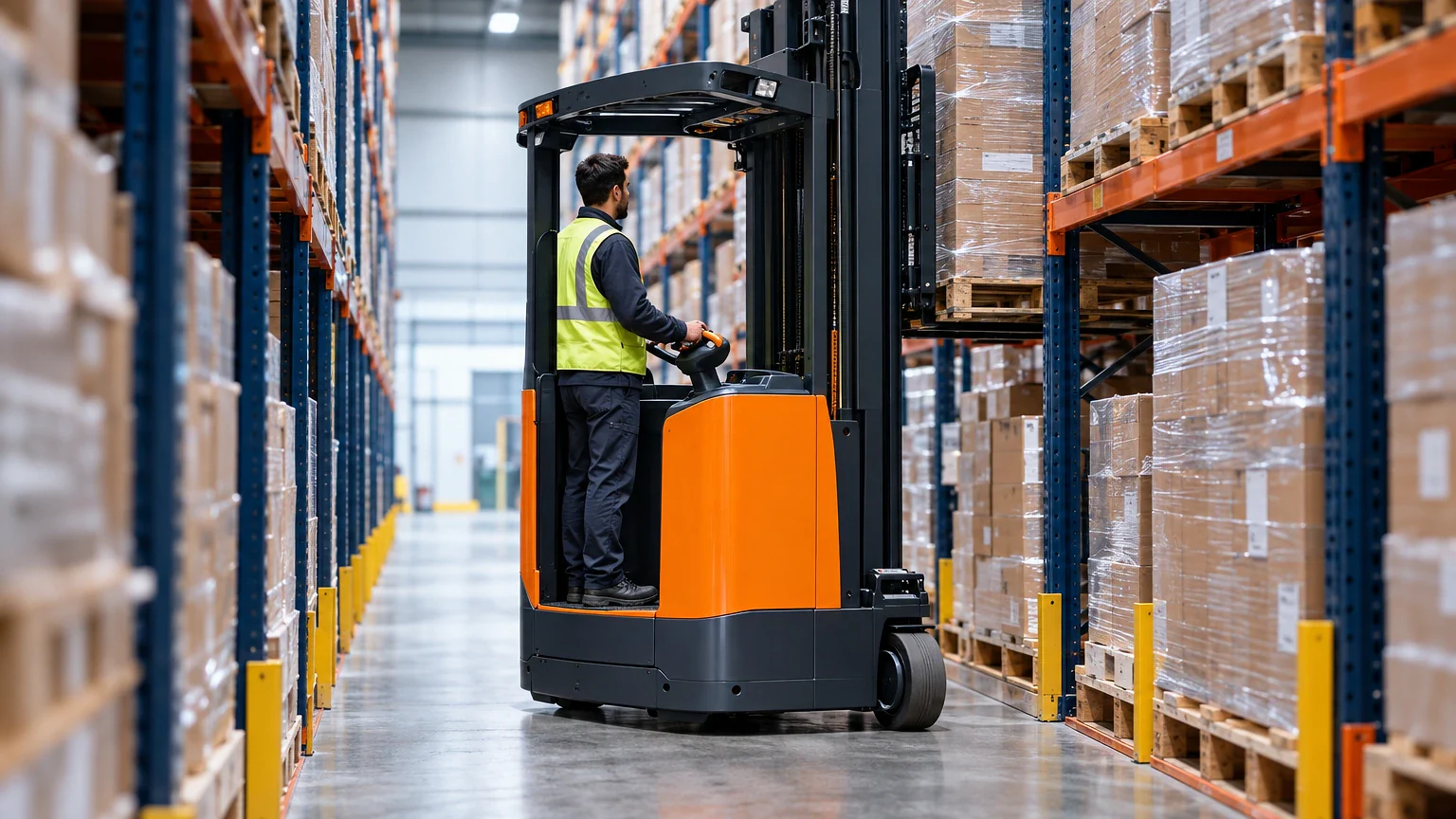
A stand up forklift is an electric lift truck operated from a standing position inside a compartment, rather than a seated cab. The operator steps in sideways, faces the load, and controls travel with a multi-function handle instead of a steering wheel and pedals.
Definition: a stand up forklift is an electric warehouse lift truck. You may also see it called a stand up rider or stand up counterbalance truck. It is built for quick-entry, quick-exit cycles in narrow to standard aisles. Capacity typically runs 3,000 to 6,500 lbs.
The design exists for one reason: dwell time. In a sit-down truck, getting in and out to check a pallet or grab a scanner costs seconds every cycle. Multiply that across 400 picks a shift and it adds up fast. Stand up models let the operator hop off one side, glance at a label, and hop back on without buckling a seatbelt or repositioning a seat.
Take a typical e-commerce fulfillment floor running case-pick replenishment. Operators using a stand up counterbalance truck can complete 15-20% more putaway cycles per hour. The same task on a sit-down unit runs slower, mainly from mount and dismount time.
Capacity Ranges and Aisle Width Requirements
Capacity is where buyers get surprised. Stand up forklifts aren’t all the same class of machine, and picking the wrong capacity class is the most common spec error on a floor plan.
Standard stand up counterbalance trucks run from 3,000 lbs up to about 6,500 lbs, covering most palletized dry goods and mixed-case loads. Above that, you’re looking at sit-down counterbalance or a specialty heavy-capacity rider, since stand up frames aren’t built to stabilize loads much past 6,500 lbs safely.
Aisle width is the real differentiator versus sit-down trucks:
- Standard stand up counterbalance: needs roughly 10’6″ to 12′ of aisle clearance for a 90-degree stack.
- Reach trucks (also stand up style): operate in aisles as narrow as 8’6″ to 9′, since the mast reaches forward instead of the whole truck turning.
- Sit-down counterbalance: typically needs 12′ to 13′ minimum for the same pallet.
- Very narrow aisle (VNA) turret trucks: work in 6′ aisles but cost roughly double a standard reach truck.
If your racking is already set at 11 feet center-to-center, a standard stand up counterbalance fits. Drop below 10 feet and you need a reach truck instead, not a tighter-turning counterbalance model.
When to Choose a Stand Up Forklift Over a Sit-Down Unit
The decision usually comes down to cycle frequency, not just aisle width. If operators are getting on and off constantly, pick stand up. If they’re driving long distances outdoors or crossing dock plates all shift, pick sit-down.
Warehouses running high SKU counts with frequent order picking benefit most. A fulfillment center picking 200+ orders per shift per operator, with frequent stops to verify pick slips, sees real time savings from the no-seatbelt, side-entry design. A single distribution yard moving full truckloads across a lot all day doesn’t gain much. It actually loses operator comfort, since stand up trucks aren’t built for rough pavement.
Battery and charging setup matters too. Most stand up models run on 36V or 48V lead-acid or lithium-ion battery packs. Lithium options from brands like Toyota Material Handling and Crown now support opportunity charging between shifts. That matters if you’re running two or three shifts back to back without swapping batteries.
One more factor: operator fatigue. Standing all shift is harder on some operators than sitting, especially on 10-hour shifts. Some operations rotate staff between stand up and sit-down tasks every few hours specifically to manage this.
Common Models and How They Compare
Here’s how the major stand up categories stack up against each other on the specs that actually matter for a floor plan.
Standard Stand Up Counterbalance
Capacity: 3,000 to 6,500 lbs. Aisle width: 10’6″ to 12′. Best for general palletized putaway and order picking in standard racking. Brands like Hyster, Crown, and Toyota all build this class, usually priced new in the $25,000 to $38,000 range depending on mast height and battery spec.
Stand Up Reach Truck
Capacity: 3,000 to 4,500 lbs. Aisle width: 8’6″ to 9′. Best for high-density selective racking where you need to stack beyond 20 feet. Reach trucks trade some travel speed for mast reach and narrower aisle capability.
Very Narrow Aisle (VNA) Turret Truck
Capacity: 2,500 to 3,500 lbs. Aisle width: as low as 6′. Best for warehouses that have already invested in wire-guided or rail-guided VNA racking systems. These require dedicated infrastructure, so they’re not a drop-in replacement for standard racking.
Order Picker (Stand Up Style)
Capacity: 2,000 to 3,000 lbs, operator rides with the forks. Best for split-case picking where the operator needs to reach shelf levels directly rather than staying on the ground floor.
Pricing, Leasing, and Total Cost of Ownership
New stand up forklifts typically run $24,000 to $45,000 depending on capacity, mast height, and battery type. Lithium-ion packages add $3,000 to $6,000 over comparable lead-acid setups but cut charging downtime significantly.
Leasing is the more common path for growing operations. A standard 3-year lease on a mid-capacity stand up counterbalance truck runs roughly $450 to $700 a month. That is through dealers tied to Hyster, Crown, or Raymond. The figure moves with usage hours included and maintenance terms.
Used equipment is worth considering if your aisles and volume are stable. A 5-year-old reach truck with under 8,000 hours can run 40-50% below new pricing. Battery replacement often costs $3,000-$5,000 for a full pack. Factor that into the math before you sign.
Don’t forget charging infrastructure. A dedicated battery room with ventilation and a 3-phase charger setup can add $8,000 to $15,000 to a first-time electric fleet conversion if you’re not already wired for it.
Operator Training and Daily Safety Checks
OSHA requires powered industrial truck certification for every operator, and stand up trucks have their own quirks worth covering in training beyond the general forklift course.
- Check the deadman pedal or presence sensor before every shift. Stand up trucks cut power the moment the operator’s weight leaves the platform, and a sticky sensor is a common failure point.
- Inspect the side door or guard rail latch. Operators who skip this step risk a limb exposure incident if the truck tips or brushes a rack upright.
- Test the horn and travel alarm at the start of shift, especially in blind-corner aisles.
- Verify tire wear on the load wheels. Uneven wear here throws off stability more than people expect, especially with narrow-stance stand up frames.
- Confirm battery connector and charge indicator are reading correctly, since a partial charge mid-shift on a lithium pack behaves differently than lead-acid running low.
A distribution center running two shifts should budget for a 15-20 minute pre-shift inspection per operator, logged daily. Skipping this is the single most common root cause investigators find after a tip-over incident.
Choosing the Right Fit for Your Floor Plan
Start with your racking layout, not the equipment catalog. Measure actual aisle clearance, not the number on the original rack design drawing, since add-on guards and wire mesh panels eat inches over time.
Next, map your pick frequency. If operators are mounting and dismounting more than 20 times an hour, the stand up design pays off in hours saved per week. If they’re driving long, continuous routes with few stops, a sit-down unit holds up better on operator comfort and won’t cost you much in cycle time.
Finally, match battery strategy to your shift pattern. Single-shift operations do fine with lead-acid and an overnight charge. Multi-shift fulfillment centers running lithium with opportunity charging avoid the battery-swap labor cost entirely, which matters more as headcount grows.
Aisle width is only half the equation. The racking either side of that aisle decides how much of the stand up forklift’s turning advantage you keep. Read our guide to choosing the right pallet racking system before you commit to a layout.
Frequently asked questions
What is the difference between a stand up forklift and a sit down forklift?
A stand up forklift has the operator standing in a side-entry compartment with a multi-function control handle. A sit-down forklift uses a seated cab with a steering wheel. Stand up models allow faster mount and dismount, which helps in high-frequency picking tasks, while sit-down trucks suit longer travel distances and rougher surfaces.
How much weight can a stand up forklift lift?
Standard stand up counterbalance trucks handle 3,000 to 6,500 lbs, while reach trucks and order pickers in the stand up category typically max out around 3,000 to 4,500 lbs. Capacity drops as mast height increases, so always check the load chart at your actual lift height, not just the rated capacity on the nameplate.
What aisle width does a stand up forklift need?
A standard stand up counterbalance truck needs roughly 10’6″ to 12′ of clear aisle width for a 90-degree stack. Stand up reach trucks narrow that down to 8’6″ to 9′, and VNA turret trucks can work in aisles as tight as 6′ with guided racking infrastructure.
Is a stand up forklift harder to operate than a sit down model?
It takes slightly longer to train an operator on multi-function handle controls versus a steering wheel, usually an extra day or two of supervised practice. Once operators are comfortable, most report faster cycle times, though standing for a full 8 to 10 hour shift can be more tiring than sitting.
How much does a stand up forklift cost to lease versus buy?
New units typically cost $24,000 to $45,000 to purchase outright depending on capacity and battery type. A 3-year lease on a mid-capacity model generally runs $450 to $700 a month through major dealers. That is the more common route for operations scaling up headcount or testing a new layout.