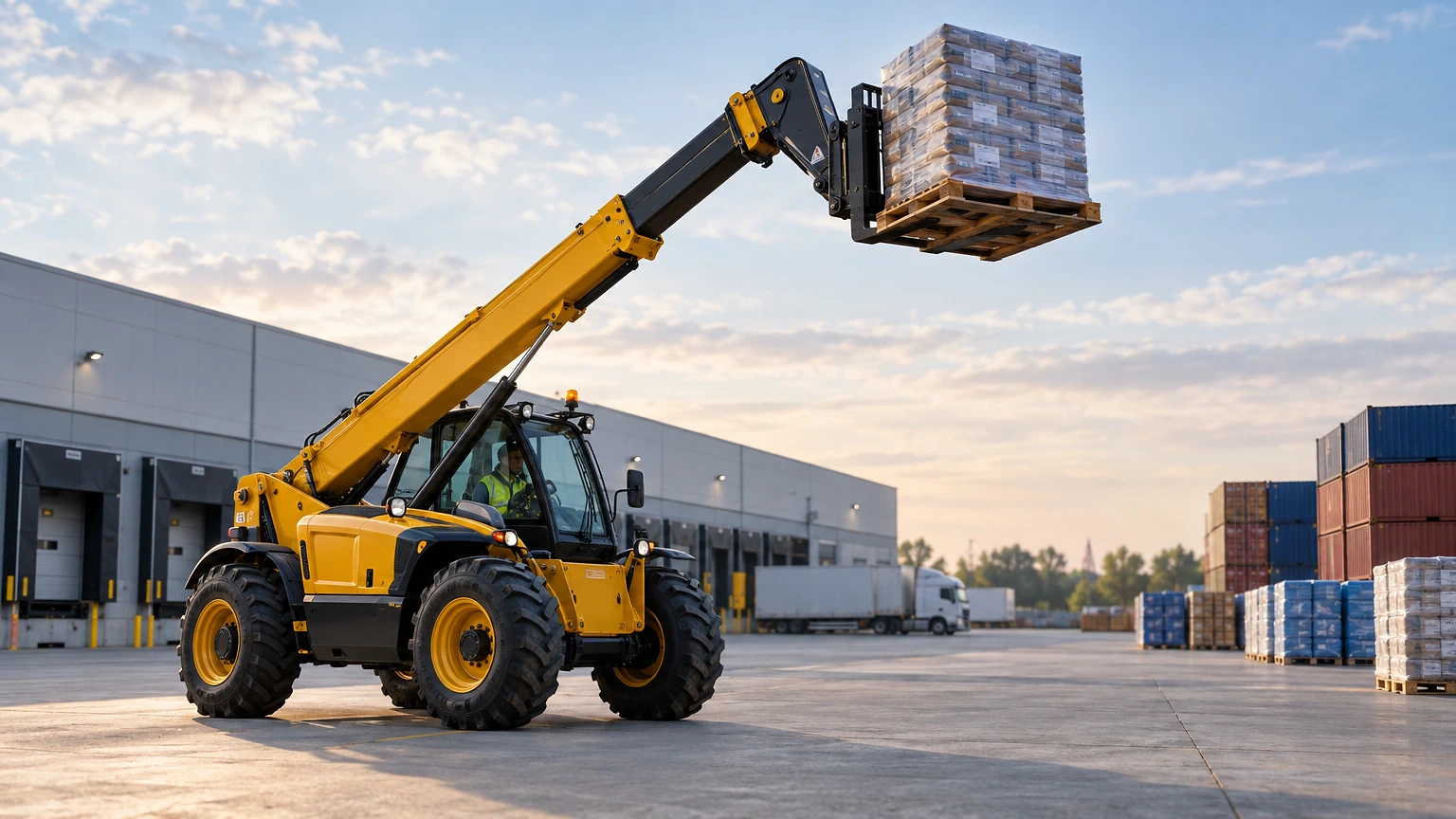
A telehandler forklift can reach 55 feet in the air while carrying 10,000 pounds on the forks, something no counterbalance forklift on your floor can touch. That reach is exactly why so many yards and distribution centers misjudge what they actually need.
This guide breaks down capacities, costs and the real decision points. You will see when a telehandler earns its keep, and when a standard forklift or reach truck does the job cheaper. You’ll get the numbers ops managers actually compare before signing a lease.
What Is a Telehandler Forklift
A telehandler forklift, short for telescopic handler, combines a crane-like extending boom with forks on the end. Unlike a traditional forklift where the mast lifts straight up, the telehandler’s boom extends outward and upward, like a mix between a forklift and a crane.
Definition: A telehandler forklift is a material handling machine with a telescoping boom that extends forks forward and upward, reaching heights and distances a fixed-mast forklift cannot.
Most units lift between 5,000 and 12,000 pounds, with boom reach from 19 feet up to 55 feet on the larger construction-grade models. You’ll see them most on construction sites, moving pallets of block and lumber up to second and third floors. Warehouses with outdoor storage, rail yards and lumber distribution centers use them daily too.
The difference that matters operationally: a telehandler drives on rough, unpaved ground and reaches over obstacles. A warehouse forklift needs a flat, paved surface and lifts straight up through a mast. If your dock has gravel laydown yards or you’re loading flatbed trailers from an angle, the telehandler wins every time.
Telehandler Forklift Capacities and Reach Explained
Capacity and reach work against each other on a telehandler, and that trade-off trips up a lot of first-time buyers.
A compact telehandler rated at 5,500 pounds max capacity usually can’t lift that full load once the boom extends past 10 feet. Check the load chart, not just the headline number. OSHA requires these capacity charts to be posted in the cab, and every operator should read one before the first lift of the shift.
Here’s the pattern across common size classes:
- Compact telehandlers: 5,500-6,000 lb capacity, 19-foot max reach, best for nursery yards and small construction sites
- Mid-size telehandlers: 8,000-9,000 lb capacity, 32-42 foot max reach, the most common rental class
- Heavy-duty telehandlers: 10,000-12,000 lb capacity, 45-55 foot max reach, used for steel erection and high-rack outdoor storage
- Rotating telehandlers: similar capacity to heavy-duty, but the turret rotates 360 degrees, letting one machine do the work of a telehandler and a crane
A loaded pallet at full boom extension can drop the safe capacity by 60% or more compared to the rating at full retraction. Crews that ignore this end up tipping machines, and tip-overs are the single most common telehandler accident reported by equipment insurers.
Telehandler vs Standard Forklift vs Reach Truck
Indoor work is a different problem entirely. If your aisles are tight and the lifting stays inside, our guide to the stand up forklift covers the trade-offs in capacity and turning radius.
Picking the wrong machine for the floor layout costs more in wasted cycles than the equipment lease itself.
A standard counterbalance forklift handles indoor pallet work on flat concrete, lifting 8-16 feet with fork capacities from 3,000 to 15,000 pounds depending on class. It’s cheaper to operate, easier to train on and the right call for 90% of warehouse floor work.
A reach truck goes narrower and taller. It works aisles as tight as 8 feet and reaches 30-36 feet into high-bay racking. Those positions are rated for loads up to 3,000 pounds. If your racking runs that high, nothing beats a reach truck for density.
A telehandler forklift does neither of those jobs well indoors. Its strength is outdoor, uneven terrain and long horizontal reach. Think loading a flatbed from 20 feet away without repositioning the machine, or stacking block three stories up a scaffold. Mixing these up on a bid or a lease request is the most common equipment-planning mistake ops managers make when a yard is attached to a warehouse.
When a Telehandler Forklift Makes Sense for Your Operation
Think about whether your material actually needs lift and reach together, not just lift.
If you’re running a distribution center with an attached outdoor yard, a telehandler handles lumber, roofing material, steel coil or palletized block that arrives on flatbeds. It can unload a 48-foot trailer from one spot, something a counterbalance forklift physically can’t reach.
Rough terrain is the other trigger. Gravel, mud, grass or unpaved laydown areas chew up solid-tire warehouse forklifts and stall them in soft spots. Telehandlers run on pneumatic tires with four-wheel drive and far more ground clearance, built for exactly that terrain.
Height with horizontal offset is the third case. Consider three jobs. Loading a second-story window opening, placing HVAC units on a roof, or stacking pipe racks against a wall. Each needs the boom’s reach, not just a tall mast. If your job only needs vertical lift on flat ground, you’re overpaying for a telehandler.
Telehandler Forklift Rental and Purchase Costs
Monthly rental rates vary by capacity class, and most rental houses price by the week or month rather than the day for anything beyond a one-off job.
A compact telehandler typically rents for less than a mid-size unit. Heavy-duty and rotating models command the highest rates, thanks to demand from steel erectors and bridge crews. United Rentals and Sunbelt Rentals both publish equipment categories online, though actual quotes depend on region, season and length of rental.
Buying new runs considerably more than renting for a short job, which is why most warehouses with occasional outdoor lifting needs rent rather than own. If your yard runs a telehandler daily, year-round, ownership usually beats renting past the 12 to 18 month mark. That holds once you factor maintenance against rental fees.
Used telehandlers hold value reasonably well if hours are under 4,000 and the boom and hydraulics check out clean. Always run a fluid analysis and inspect the boom pins before buying used. A worn boom is the most expensive component to replace and the easiest thing for a seller to hide with fresh paint.
Telehandler Attachments and Equipment Options
The boom and forks are only the start. Attachments turn a telehandler into a half-dozen different machines without buying new equipment.
Fork Carriages and Pallet Forks
Standard pallet forks handle the bulk of material movement, rated to match the machine’s base capacity. Swap-out carriages let you switch fork spacing for odd pallet sizes without changing the whole unit.
Buckets and Grapples
Material buckets move loose aggregate, mulch or debris, common on landscaping and demolition sites. Grapple attachments grab irregular loads like pipe bundles or scrap that forks can’t secure safely.
Jib Booms and Winches
A jib attachment extends reach further and adds a hook point for crane-style lifts, useful for setting trusses or HVAC units. Winch attachments pair with the jib for controlled vertical lifts where a crane isn’t justified for the job size.
Work Platforms
A man-basket attachment turns a telehandler into a temporary aerial lift for short-duration tasks like gutter work or signage installation. OSHA treats this use under aerial lift rules, so operators need separate certification beyond standard telehandler training, and the basket must be rated and secured to the machine’s specifications.
Sweepers and Brooms
Rotary broom attachments clear yards and lots of debris or light snow, giving idle telehandlers a second job during slow lift periods.
Choosing the Right Telehandler Forklift for Your Yard
| Machine Type | Capacity | Max Reach | Best Use Case |
|---|---|---|---|
| Compact telehandler | 5,500-6,000 lb | 19 ft | Nurseries, small job sites |
| Mid-size telehandler | 8,000-9,000 lb | 32-42 ft | General construction, yard work |
| Heavy-duty telehandler | 10,000-12,000 lb | 45-55 ft | Steel erection, high stacking |
| Rotating telehandler | 9,000-11,000 lb | 45-70 ft | Crane-replacement lifts |
| Standard forklift | 3,000-15,000 lb | 8-16 ft | Indoor pallet handling |
| Reach truck | up to 3,000 lb | 30-36 ft | Narrow-aisle high-bay racking |
Match the machine to the job, not the other way around. A yard manager who rents the biggest telehandler “just in case” pays for capacity that sits idle most of the week. Start with your tallest regular lift and your longest regular reach, then size up one class for safety margin.
Telehandler Fleet Decisions That Pay Off
The operations teams that get the most from a telehandler forklift fleet treat it as a specialty tool, not a forklift replacement. They keep counterbalance forklifts and reach trucks for the indoor floor and reserve telehandlers for outdoor, high-reach and rough-terrain work.
Training matters as much as the machine spec. Telehandler operation requires separate certification from standard forklift training under most safety programs, since the extending boom changes the center-of-gravity math completely. Skipping that training is how tip-over incidents happen on job sites every year.
If you’re weighing rental against purchase, track your actual outdoor lift hours for a full quarter before deciding. That number, more than any brochure spec, tells you whether a telehandler forklift belongs in your fleet or on a rental contract.
Frequently asked questions
What is the difference between a telehandler and a forklift?
A telehandler uses a telescoping boom that extends forward and up, reaching farther and higher than a standard forklift’s vertical mast. Standard forklifts work best on flat, paved indoor floors, while telehandlers handle rough terrain and long horizontal reach outdoors.
How much weight can a telehandler forklift lift?
Capacity ranges from about 5,500 pounds on compact models to 12,000 pounds on heavy-duty units, though the real number drops sharply as the boom extends. Always check the load chart posted in the cab rather than relying on the machine’s maximum rated capacity alone.
Do you need a special license to operate a telehandler?
Yes, telehandler operation requires training and certification separate from standard forklift certification, due to the added complexity of boom extension and shifting center of gravity. OSHA requires employers to certify operators on the specific equipment they’ll run, not just forklifts in general.
Is it cheaper to rent or buy a telehandler?
Renting makes sense for occasional or seasonal outdoor lifting needs, while buying typically pays off once a yard runs a telehandler daily for over a year. Used units with low hours and clean boom pins can be a solid middle ground if inspected carefully before purchase.
Can a telehandler replace a crane on a job site?
Rotating telehandlers come close, offering 360-degree turret rotation and reach up to 70 feet with a jib and winch attachment. For heavier picks or extended duration lifts, a dedicated crane still outperforms any telehandler on capacity and stability.