
Your receiving dock is backed up again. Pallets sit three deep waiting for putaway, forklifts are stacked up behind them, and half that freight is already sold and supposed to ship today. Cross docking exists to stop exactly this.
That’s the problem cross docking solves. Instead of storing inbound goods, you move them straight from the receiving door to an outbound trailer, often in under 24 hours. Done right, it cuts handling costs, frees racking space, and gets product moving instead of sitting.
What Is Cross Docking, Exactly
Cross docking is a logistics method where inbound goods are unloaded from a truck or rail car and loaded directly onto outbound transportation, with little or no warehouse storage in between.
Transport planning carries more of the load as a result. Our overview of freight transport compares the main modes on cost and transit time. Cross docking only pays when the inbound schedule holds.
The product touches the dock, maybe a sortation lane, and then goes right back out. No bin location. Nothing to put away. No pick later.
Picture a grocery distribution center receiving a full truckload of bananas. The fruit doesn’t go into reserve racking, it gets broken down by store order and reloaded onto delivery trucks within hours. That’s cross docking in its purest form, and it’s why perishable and retail replenishment networks rely on it so heavily.
The model works best for high-velocity SKUs with predictable demand, pre-sold orders, or short shelf life. It works poorly for slow movers, items needing quality inspection, or anything without a confirmed downstream order waiting.
Why Warehouses Adopt Cross Docking
The appeal comes down to labor and space, not just speed. A standard putaway-then-pick cycle touches a unit twice, sometimes three times. Cross docking touches it once.
That matters on the P&L. Warehouse labor runs 50-65% of total operating cost in most distribution operations, according to Warehousing Education and Research Council benchmarking data cited across the industry. Cutting one full handling cycle per unit is a direct labor line reduction, not a vague efficiency gain.
It also frees racking. A distribution center running pure cross dock for its top 20% of SKUs by velocity can reclaim pallet positions that would otherwise sit full of fast-moving stock. One mid-size apparel 3PL reallocated freed bays to slower overflow inventory instead of leasing an overflow building, a real cost avoidance rather than a paper savings.
There’s a service angle too. Retail replenishment programs like Walmart’s and Target’s vendor compliance guides often demand cross dock capability as a condition of doing business, because it shortens the vendor-to-shelf cycle time that drives in-stock rates.
Pre-Distribution vs Post-Distribution: Picking Your Model
Not all cross docking looks the same on the floor. The two dominant flavors handle allocation at different points, and the choice changes your labor model and your warehouse inventory management software configuration.
Option A: Pre-Distribution Cross Dock
In pre-distribution, the vendor or supplier already knows the final destination before the truck arrives. Cartons arrive pre-labeled by store or customer. Dock staff scan and sort directly to outbound lanes with no repack step.
This model needs tight EDI coordination upstream, usually ASN (advance ship notice) data matched against purchase orders before the truck backs in. When the ASN is accurate, a crew can sort a 26-pallet inbound load to 40 store lanes in a few hours. When it’s wrong, you get exceptions piling up at the dock door, which is the single biggest failure point in pre-distribution programs.
Option B: Post-Distribution Cross Dock
Post-distribution means goods arrive in bulk, undifferentiated, and get allocated to destinations after receipt based on real-time demand. A WMS or distribution module calculates store need, promotional push, or order allocation on the fly.
This gives more flexibility when demand shifts late, think a weather-driven spike in bottled water or a last-minute promo. It costs more in labor because someone has to break down bulk and build new outbound pallets on the spot, usually at a sortation table or conveyor spur. Retailers running seasonal resets lean on this model because allocation isn’t locked in weeks ahead.
Most networks run a blend: core replenishment SKUs go pre-distribution, promotional and seasonal volume goes post-distribution.
Setting Up a Cross Dock Operation: The Core Steps
Getting cross docking running isn’t just rearranging the dock schedule. It needs a sequence, and skipping steps is where most pilots stall out.
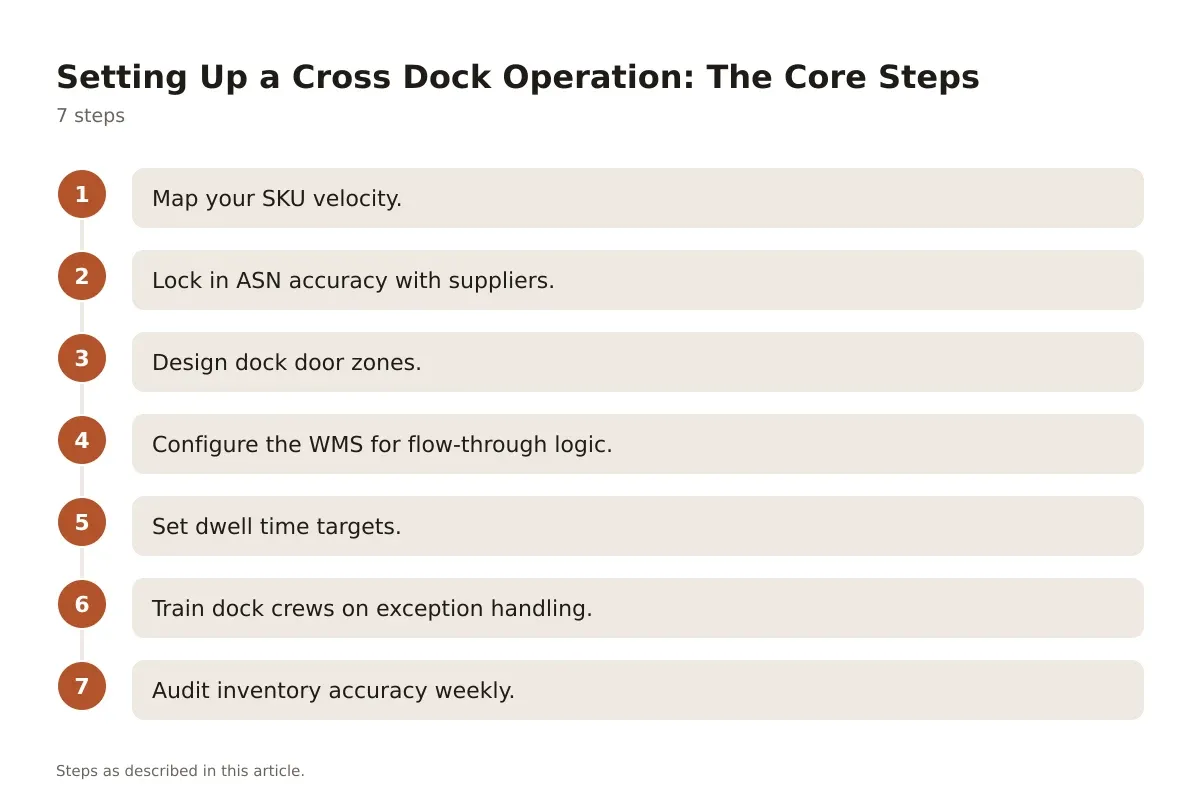
- Map your SKU velocity. Pull 90 days of movement data and flag items with high turn and low variability. These are your cross dock candidates, not your entire catalog.
- Lock in ASN accuracy with suppliers. Require EDI 856 transmissions or a WMS-integrated portal before trucks are scheduled. Anything under 95% ASN accuracy will break a pre-distribution lane.
- Design dock door zones. Separate inbound and outbound doors by flow type, usually a U-shaped or I-shaped dock layout depending on building footprint. Label lanes by destination region, not by arbitrary door number.
- Configure the WMS for flow-through logic. Systems like Manhattan Associates, Blue Yonder, and SAP Extended Warehouse Management all support cross dock task creation that bypasses putaway and generates a direct outbound task instead.
- Set dwell time targets. Most cross dock programs target under 24 hours dock-to-dock, some perishable operations push for under 4 hours. Track actual dwell against target weekly.
- Train dock crews on exception handling. Build a clear process for freight that arrives without a matching ASN or order, usually a short-term holding lane rather than reserve storage, so it doesn’t contaminate the flow-through area.
- Audit inventory accuracy weekly. Cross dock inventory should run above 98% accuracy since there’s no bin location to catch errors later. Cycle counting the staging lanes catches scan errors before they become shortages at the customer.
Skip step two and nothing else matters. Bad ASN data is the root cause behind most failed cross dock launches.
Equipment and Dock Layout Considerations
Cross docking lives or dies on dock door throughput, not racking depth. That changes what you spend money on.
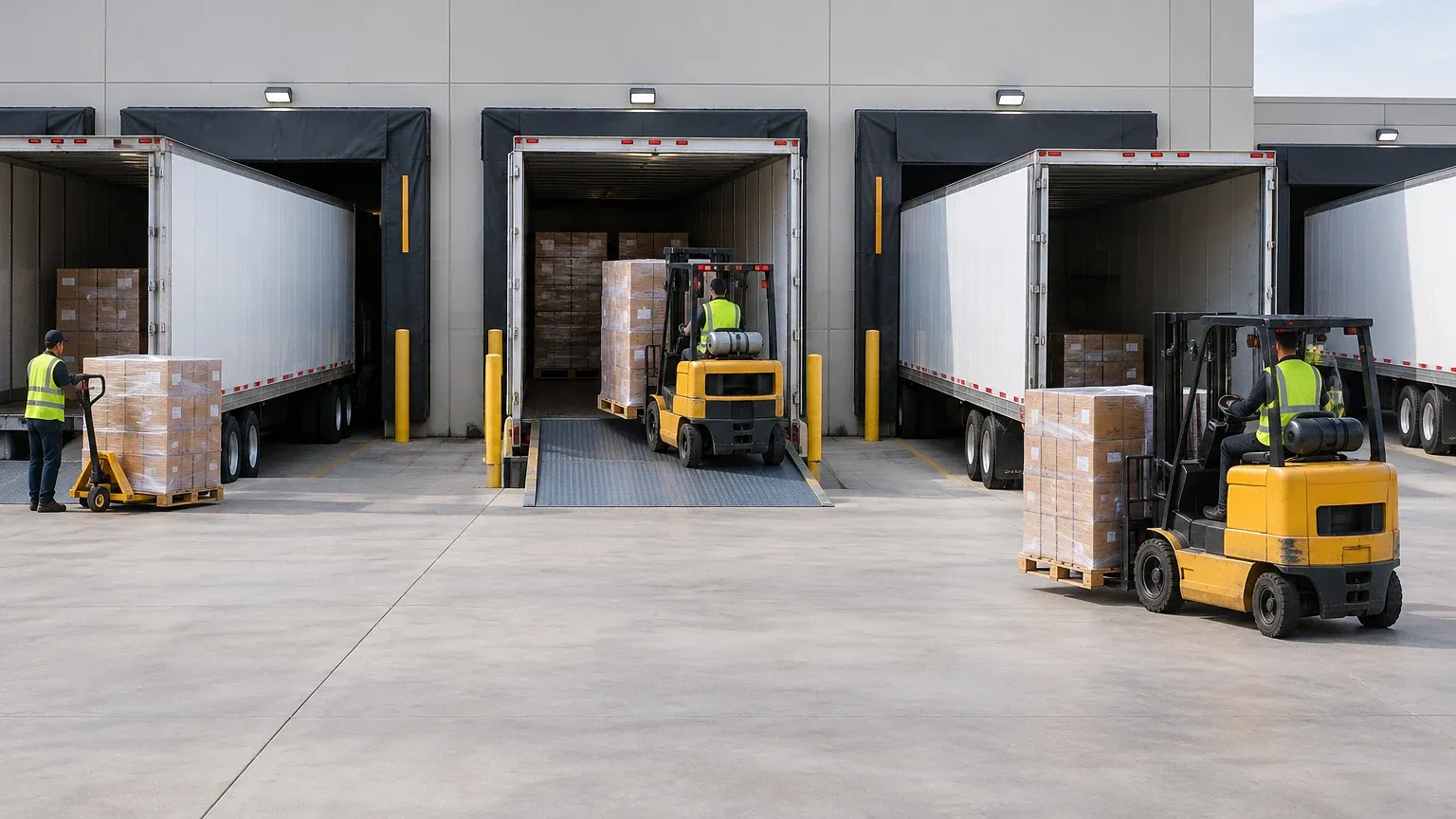
Dock levelers rated for 20,000-30,000 lbs capacity handle standard forklift and pallet jack traffic without flexing under load. Skip the cheaper 15,000 lb units if you’re running double-stacked pallets across the dock plate, they’ll wear out fast under that cycle count.
Conveyor sortation, whether a simple gravity roller spur or a powered tilt-tray sorter, speeds up post-distribution breakdown significantly. A tilt-tray sorter handling 3,000-6,000 cartons per hour makes sense for a high-volume parcel cross dock. A small regional grocery distributor moving a few hundred cases an hour needs only manual sortation tables.
Dock door count matters more than square footage. A facility running 40 doors with minimal reserve racking will out-throughput a 25-door building with deep racking, because cross dock velocity is bottlenecked by door availability, not storage capacity. Door-to-labor ratio, roughly one crew member per active inbound door during peak unload, keeps dwell time down.
Yard management software, like a standalone module or a Manhattan Associates add-on, helps sequence trailers. The right truck then hits the right door at the right time, instead of idling in the yard.
Cross Docking vs Traditional Warehousing: Where Each One Wins
You don’t choose one model for the whole building. You choose by SKU, and sometimes by season.
Traditional putaway-and-pick still wins for slow-moving SKUs, safety stock, and anything needing quality hold or lot segregation before release. It also wins when demand is unpredictable, because reserve inventory gives you a buffer cross dock flow doesn’t have.
Cross docking wins on fast movers with confirmed demand: retail replenishment, grocery perishables, pre-sold ecommerce freight consolidated from multiple vendors into one outbound load. It also wins on cost per unit handled, since labor touches drop from three to one.
A hybrid DC running both models typically segments physical space, a flow-through zone near specific dock doors for cross dock traffic, and standard racking aisles for everything else. Keeping these physically separate, rather than mixing flow-through pallets into racking aisles, prevents staging freight from getting “accidentally” put away by a crew member following habit instead of task instructions.
The WMS has to support both logic paths simultaneously, generating a direct cross dock task for one PO line and a standard putaway task for another line on the same truck. Not every WMS handles that split cleanly, so check this specifically during a software evaluation rather than assuming it’s standard.
Running Cross Docking Without Losing Control
Cross docking isn’t a layout trick, it’s a discipline. The dwell time targets, ASN accuracy thresholds, and door-to-labor ratios only hold if someone owns them daily, not just during the launch week.
The operations that get this right treat cross dock SKUs as a managed subset, not a blanket policy. They track dwell time, audit staging lane accuracy, and keep exception freight out of the main flow path. The ones that struggle usually skipped the ASN discipline step and are now fighting fires at the dock door every morning.
If you’re weighing whether to add cross dock lanes to an existing DC, start small. Pick your top 10-15 SKUs by velocity, build one dedicated flow-through zone, and measure dwell time for 60 days before expanding. That data will tell you faster than any consultant whether your supplier base and order patterns can actually support it.
Frequently asked questions
What is cross docking in simple terms?
Cross docking means freight comes off an inbound truck and goes straight onto an outbound truck, with no storage step in between. The goal is minimal dwell time at the dock, usually under 24 hours, instead of putting product into racking and picking it later.
How is cross docking different from a standard distribution center?
A standard DC receives goods, puts them away into racking, and picks them later when an order comes in. Cross docking skips the putaway and picking steps entirely, since the destination is already known or calculated before the freight arrives.
What inventory accuracy do you need for cross docking to work?
Most successful cross dock programs run inventory accuracy above 98%, since there’s no bin location to catch a scan error later. Weekly cycle counts on staging lanes, not just annual physical inventory, are what keep that number stable.
Does cross docking work for ecommerce fulfillment?
Yes, particularly for consolidation, where freight from multiple vendors arrives and gets combined into single customer or store orders without ever hitting reserve storage. It works less well for ecommerce operations with long tail SKUs and unpredictable single-unit orders, which still need traditional pick-and-pack.
What WMS features are required to run cross docking?
You need flow-through task logic that can generate a direct outbound task instead of a putaway task, ASN matching against purchase orders, and dock door zone configuration. Platforms like Manhattan Associates, Blue Yonder, and SAP Extended Warehouse Management all support this, though configuration depth varies and should be tested against your actual SKU mix before go-live.