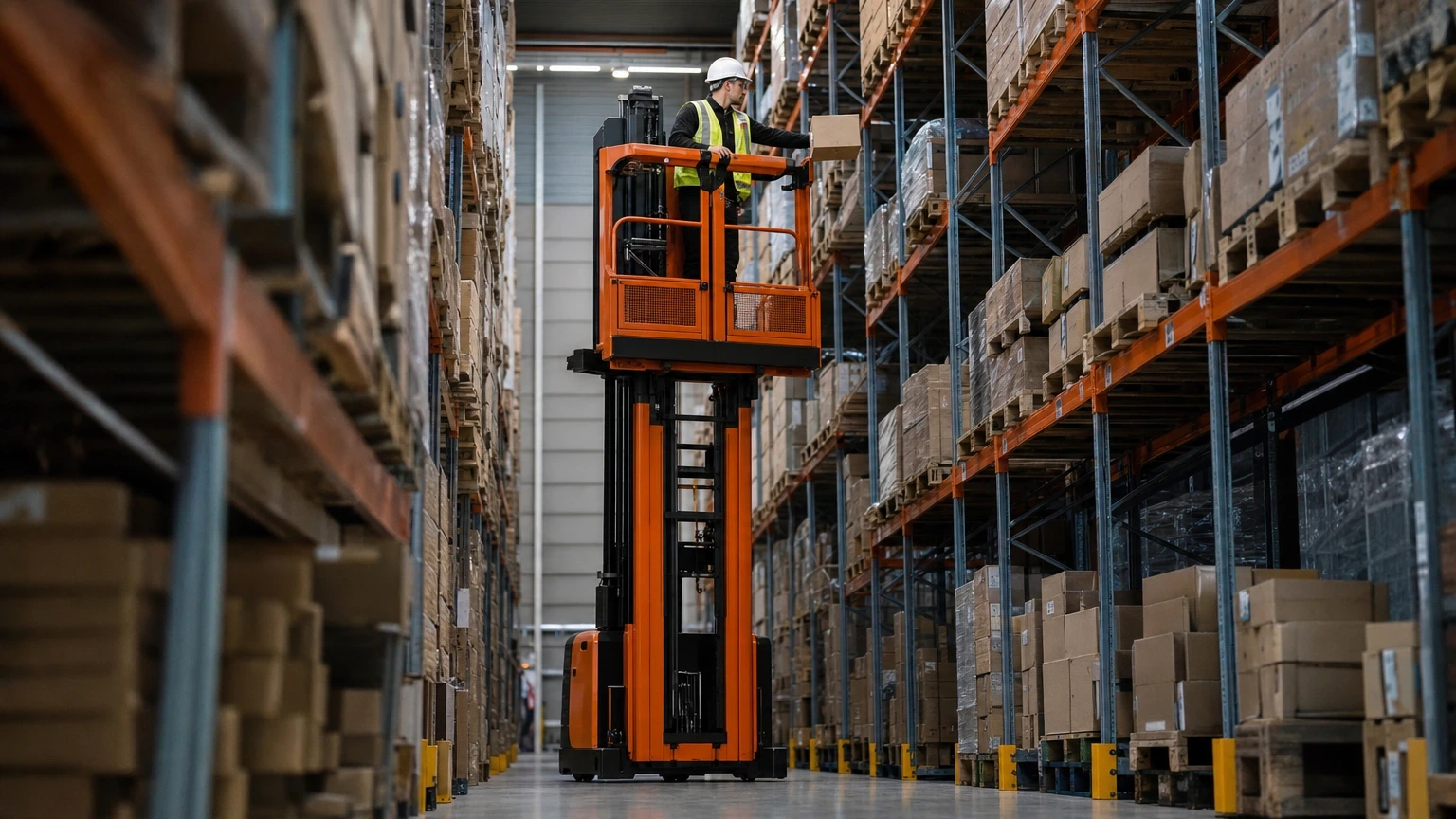
A standard reach truck tops out around 30 feet. A cherry picker forklift, the vertical mast order picker style, puts an operator and load at 40 feet or higher. The controls stay in hand at height. That difference alone reshapes how you plan racking, aisle width and pick paths.
If you are running a distribution center with narrow aisles and high steel, this equipment class deserves a real look. Below is what actually matters when you’re choosing one, spec’ing capacity, or deciding whether to rent or buy.
What Is a Cherry Picker Forklift
A cherry picker forklift is an order-picking machine that lifts the operator, not just the forks, up to the pick face. The platform rises with the mast, so the worker can grab cartons or pallets directly off the beam at height. Nobody climbs a ladder or waits for someone to lower a pallet.
This is different from a man-up reach truck, which lifts forks and driver together but is built more for pallet handling than piece-pick work. It’s also different from a scissor lift, which has no forks and no load-handling attachment at all. On a typical DC floor, you’ll hear all three called “cherry pickers” loosely. Ask which one before you order.
Note: In UK and Australian warehouses, “cherry picker” more often means an aerial work platform (boom lift) used outdoors or in construction. In US logistics, it almost always means the vertical order picker described here.
Most models run on rail-guided or wire-guided systems in very narrow aisle (VNA) layouts, with aisles as tight as 60 inches. That tight footprint is the entire point: you trade turning radius for storage density.
Reach works differently outside the building. Our guide to the telehandler forklift covers the boom machines used on yards and sites. Forward reach, not aisle geometry, decides what those can do.
Capacity Ranges and Lift Heights You Should Spec
Capacity and reach are where buyers get bitten. A machine rated for 3,000 lbs at 20 feet won’t necessarily hold that same rating at 40 feet. Mast deflection and load center shift as you go up.
Entry-level electric order pickers from brands like Crown Equipment, Raymond, and Hyster typically handle 3,000 to 3,500 lbs at lift heights up to 25 feet. Mid-range VNA turret trucks push to 30-42 feet with capacities around 2,200 to 3,000 lbs, derated as height increases. High-reach specialty units for cold storage or aerospace parts racks can go past 45 feet. Capacity drops sharply though, often to 1,500 lbs or less at max height.
Always check the load chart, not just the headline capacity number stamped on the nameplate. A picker rated 3,000 lbs at the base might only carry 1,800 lbs safely at full extension. Your racking has its own limits too. Standard selective pallet racking beams are commonly rated 2,500 to 4,600 lbs per pair, depending on gauge and span. That figure comes from manufacturer engineering data. Match truck capacity, load weight and beam rating together before you finalize a layout.
Choosing Between Man-Up and Man-Down Picking
Every fulfillment operation eventually asks whether to send the person up or keep the person down and bring the product to them. Both models have a real place on the floor.
Option A: Man-Up Order Picking
The operator rides the platform to height and picks directly from the beam. This suits split-case and each-picking operations where SKU variety is high and pallet-level picking would waste time. Warehouses running e-commerce fulfillment with thousands of small SKUs often lean this way because it eliminates double-handling. The tradeoff: operators need certified training under OSHA powered industrial truck rules, and travel time between locations eats into pick rate if your slotting is sloppy.
Option B: Man-Down with Pick-to-Light or Conveyor Feed
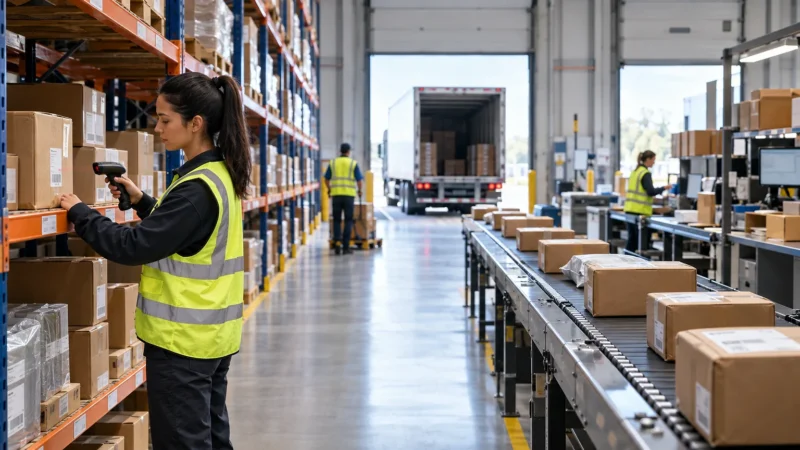
Here the operator stays at ground level and product comes to them via pick modules, flow racks, or a goods-to-person system. This works better for high-velocity SKUs stored in the golden zone, waist to shoulder height. It reduces travel and fatigue. The catch is upfront investment in flow rack or automated storage and retrieval infrastructure, which isn’t cheap to install or reconfigure later.
Most mature DCs run a hybrid: golden-zone fast movers on man-down flow racks, slower movers and reserve stock up high on man-up cherry pickers. That split is usually where the real efficiency gain sits, not in picking one method exclusively.
Pick Rates and Accuracy Numbers That Matter
Pick rate expectations vary a lot by SKU type, but a few benchmarks are worth anchoring to. Case-pick operations using a cherry picker forklift in a VNA layout run 60 to 90 lines per hour per operator. The range depends on travel distance and slotting quality. Each-picking with a handheld scanner tends to run lower, often 40 to 70 lines per hour, because of the extra verification step per item.
Inventory accuracy is the other number ops managers watch closely. Facilities running barcode scanning at the point of pick with a decent WMS typically hold accuracy above 99%, verified through cycle counting. Paper-pick operations without scan verification often sit lower, sometimes 95-97%, because transposition and mis-pick errors go uncaught until a cycle count or customer complaint surfaces them.
If your accuracy numbers are lagging, the fix usually isn’t a faster forklift. It’s tighter license plate labeling, better slotting logic, and scan-confirm at every touch. The equipment is rarely the bottleneck once you dig into the data.
Buying Considerations for Warehouse Operations Managers
Before you sign a PO, walk your actual aisles with a tape measure. Don’t spec off a floor plan drawing. Racking settles, uprights get bent by a decade of near-misses, and “60-inch aisle” on paper sometimes measures 56 inches in reality.
Here is a five-point checklist worth running through with any vendor quote:
- Confirm rail-guided vs. wire-guided vs. free-roaming VNA operation, since each has different floor and racking requirements.
- Match battery voltage and runtime to your shift pattern, an 80V system on a single shift rarely needs opportunity charging, but a 24/7 operation might.
- Verify mast collapse height clears your dock doors and any low steel or sprinkler lines.
- Check whether the fleet needs a fall-arrest harness system integrated into the platform, which OSHA increasingly expects for man-up units.
- Get the actual load chart at your specific rack height, not just the base capacity rating.
Skipping step five is the most common mistake. A buyer specs a 3,000 lb machine. At 38 feet the true rated capacity is closer to 2,000 lbs. That doesn’t match the pallets already sitting in that bay.
New, Used, or Rental: Matching the Machine to the Job
Buying new makes sense when the cherry picker forklift will run daily, multi-shift, for years, in a permanent VNA layout. New units from Toyota Material Handling or Crown come with full warranty coverage and predictable maintenance intervals, which matters when downtime on a 40-foot reach machine means a stalled pick face nobody else can safely access.
Used equipment can work well for seasonal spikes or a secondary shift, provided you get a full inspection. That means mast chain wear, hydraulic seal condition, battery cycle count and platform gate interlock function. A certified technician has to check all four, not eyeball them on the lot.
Rental fits short peak-season surges, a new DC still validating its slotting plan, or a one-off project like a high-bay retrofit. Renting also lets you trial a rail-guided VNA system before committing capital. Retrofitting racking to VNA tolerances after the fact is expensive and disruptive. Whichever route you take, budget for operator certification time. A new hire is not productive on a man-up picker until they’ve logged supervised hours at height.
Matching Equipment to Your Racking Strategy
Racking layout and picking equipment only pay off if your stock data is accurate, which is why most operations pair a cherry picker forklift rollout with a review of their inventory management software before committing to a new slotting plan.
None of this equipment decision happens in isolation from your racking plan. A cherry picker forklift bought without checking beam ratings, aisle tolerances, and pick velocity data is a guess dressed up as a capital purchase.
Start from your actual pick data: line counts per SKU, cube per location, and current accuracy rate. Then work backward to aisle width, lift height, and man-up versus man-down split. That order, data first, equipment second, is the one operations teams skip when a sales rep is standing in the aisle with a demo unit.
Get the sequence right and the machine mostly disappears into the workflow, which is exactly what you want from material handling equipment. It should be invisible on a good day and obvious only when it’s wrong.
Frequently asked questions
What is the difference between a cherry picker forklift and a reach truck?
A cherry picker forklift lifts the operator’s platform up with the load so they can pick directly from the beam at height. A reach truck lifts only the forks, with the operator staying at a fixed cab height. It is generally used for pallet-in, pallet-out work rather than piece-picking.
How high can a cherry picker forklift lift?
Standard electric order pickers commonly reach 20 to 25 feet, while VNA turret and high-reach models go 30 to 45 feet or more. Always check the load chart at your target height since rated capacity typically drops as lift height increases.
Do operators need special certification to run one?
Yes. In the US, OSHA requires powered industrial truck operator training and evaluation specific to the equipment class. Man-up units often require additional fall-protection training tied to the platform’s harness anchor points.
Can a cherry picker forklift work outside a VNA layout?
Some models are free-roaming and don’t need rail or wire guidance, so they can operate in standard or wide-aisle racking too. But you lose the aisle-width savings that make VNA layouts attractive, so most facilities pair the equipment with a purpose-built narrow-aisle rack system.
Is renting or buying better for a seasonal warehouse?
Rental usually wins for short peak windows, typically under three to four months, since you avoid depreciation and storage costs in the off season. Buying makes more sense once utilization is steady across most of the year. Downtime risk on a rented unit gets harder to absorb during your busiest weeks.