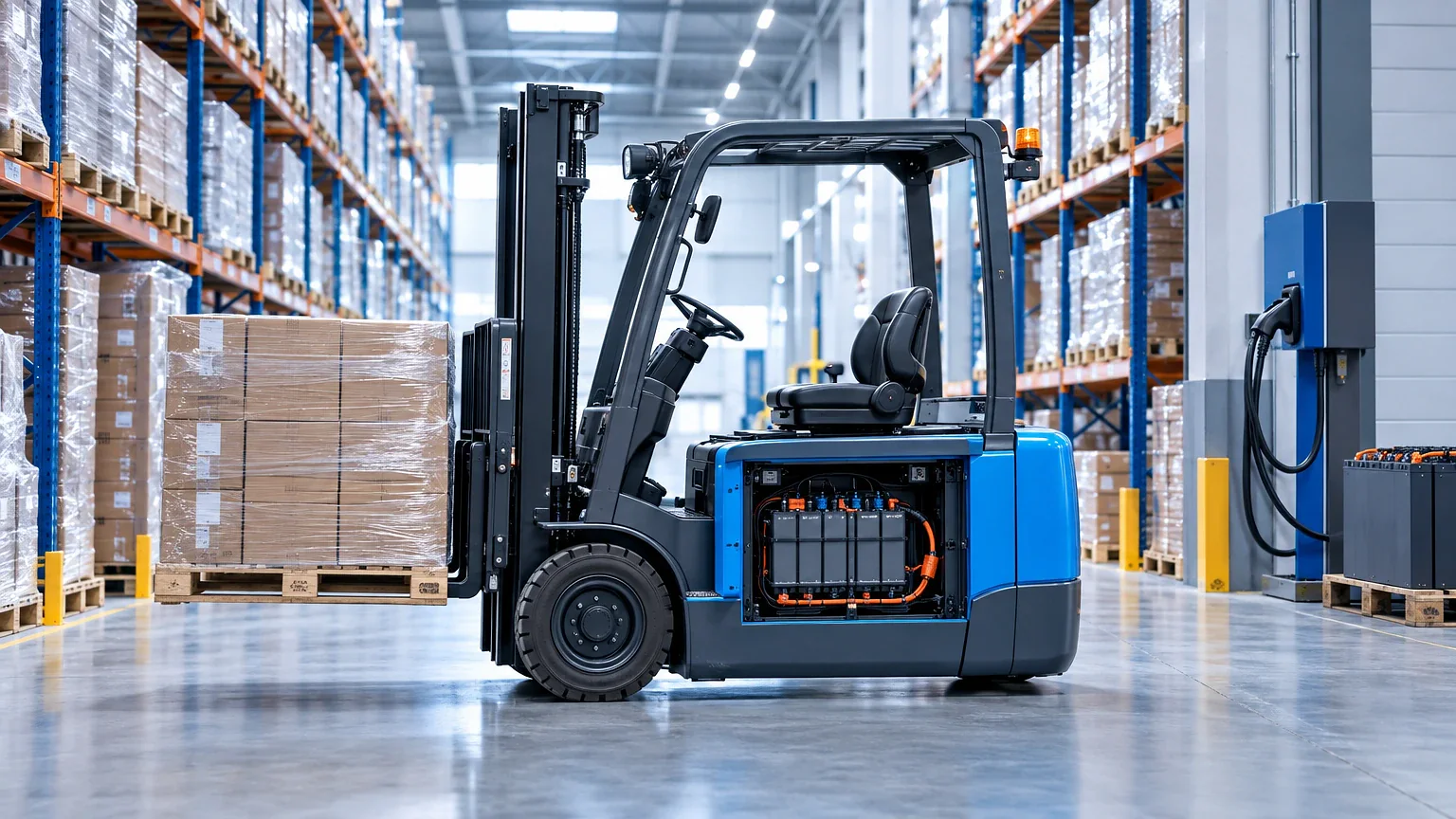
A lead-acid electric forklift battery loses roughly 20% of its runtime once it hits year three, and most warehouses never adjust shift schedules to match. That single oversight kills more pick rates than any racking layout ever will.
Maybe you’re comparing an electric forklift against propane or diesel for the first time. Maybe you’re replacing an aging fleet. Either way, this guide walks through capacity classes, battery choices, and where the real costs hide. No sales pitch. Just what actually happens on the floor.
What Is an Electric Forklift
An electric forklift runs on a battery-powered motor instead of an internal combustion engine, using stored electricity to drive the wheels and lift the mast. Most run on lead-acid or lithium-ion batteries ranging from 24V to 80V depending on class and load capacity.
They fall into three main classes under OSHA’s powered industrial truck standards: Class I (electric rider trucks), Class II (electric narrow-aisle trucks), and Class III (electric motor hand trucks like pallet jacks). Each class covers different capacity ranges and aisle widths, which matters more than horsepower when you’re picking equipment.
The core trade-off versus internal combustion is simple. Electric units cost more upfront but run cheaper per hour, produce zero tailpipe emissions, and work indoors without ventilation concerns. Propane and diesel still win on continuous multi-shift outdoor work where charging windows don’t exist.
Sit-Down Counterbalance vs Narrow-Aisle Reach Trucks
Picking between a counterbalance forklift and a narrow-aisle reach truck usually comes down to aisle width and how high you’re stacking, not brand preference.
Option A: Sit-Down Counterbalance
A Class I sit-down counterbalance electric forklift typically handles 3,000 to 5,000 lb loads and needs 11 to 13 feet of aisle clearance to turn. You’ll see these running dock-to-storage transfers, loading trailers, and handling mixed pallet work in general warehousing.
Toyota’s 8FBCU series and Hyster E series both fall in this bracket, with mast heights up to 240 inches on tall configurations. If your racking tops out around 20 feet and your aisles are wide, this is the default choice. It’s also the easiest unit to cross-train new operators on.
Option B: Narrow-Aisle Reach Truck
A reach truck works aisles as tight as 8.5 to 10 feet and reaches racking 30 to 36 feet high. Counterbalance trucks simply can’t go there without tipping risk. For picking individual cases at those heights, a cherry picker forklift is the other option. Capacity runs lower, usually 2,500 to 4,500 lbs, because the mast design trades some stability for reach.
Crown’s ESR series and Raymond reach trucks dominate this segment. If you’ve ever redesigned a layout to add a fourth pallet position per bay by narrowing aisles, you already know why reach trucks exist. The tighter footprint alone can add 15-20% more storage density to the same square footage.
Choose counterbalance for dock work, mixed freight, and outdoor yard transitions. Choose reach trucks when vertical storage density matters more than raw capacity, which is most modern DCs (distribution centers) running wire-guided or rail-guided aisles.
Battery Types and Charging Infrastructure
This is where most fleet decisions actually get made, not on the forklift spec sheet.
Lead-acid batteries remain the cheapest upfront option and are still common in single-shift operations. They need an 8-hour charge followed by an 8-hour cooldown before reuse, which forces battery swaps if you’re running two or three shifts. A single lead-acid battery for a Class I truck typically weighs 2,000 to 3,000 lbs. It needs a dedicated, ventilated charging room because of hydrogen gas off-gassing during charging.
Lithium-ion changes that math. No cooldown period, opportunity charging during breaks, and roughly double the cycle life of lead-acid, often 3,000+ cycles versus 1,500. Enersys and Hyster-Yale’s lithium packages both target multi-shift fleets where downtime for battery swaps eats into labor hours.
The catch is upfront cost. Lithium packages run higher than equivalent lead-acid. Many ops teams recover that gap within the battery’s lifespan through lower labor and no dedicated charging infrastructure. If you’re running two shifts or more, run the math on lithium before defaulting to lead-acid out of habit.
Five Signs Your Fleet Needs an Electric Forklift Upgrade
Fleet replacement decisions shouldn’t wait until a truck breaks down mid-shift. Here are five signals worth tracking.
- Maintenance costs exceed 15% of the unit’s replacement value annually. Once a propane or aging electric unit crosses this line, you’re funding someone else’s new truck through repair bills.
- Runtime per charge has dropped below 5 hours on an 8-hour shift. This usually means the battery has degraded past 70% of rated capacity and swapping mid-shift is now routine.
- Operators report inconsistent lift speed or drift under load. Worn hydraulic seals or a failing motor controller often show up here before a full breakdown.
- Your indoor air quality logs show CO or NOx spikes near dock doors. That’s a sign propane units are running longer indoor cycles than they should.
- Pick rates have slipped without a change in labor or layout. Slower mast lift and travel speed on an aging unit quietly drags down units-per-hour across a whole shift.
If two or more of these show up together, you’re not looking at a repair decision anymore. You’re looking at a replacement one.
Calculating Total Cost of Ownership
Sticker price is the least useful number when comparing an electric forklift to a propane unit.
Electricity for charging a Class I lithium-ion truck typically runs a few dollars per shift, depending on local utility rates. Propane for equivalent runtime on a comparable IC unit runs $30-$50. Multiply that across a 10-truck fleet running two shifts and the gap becomes real money within a single year.
Maintenance follows the same pattern. Electric motors have far fewer moving parts than combustion engines, no oil changes, no spark plugs, no exhaust system to maintain. Most fleet managers report 30-40% lower annual maintenance spend per unit on electric versus propane once a fleet is fully broken in.
Where electric loses ground is charging infrastructure capital cost and the residual value curve on batteries. A lithium pack that’s five years old still holds real resale value; a lead-acid pack past year four is often scrap. Build both into your TCO model, not just fuel and repairs, or you’ll underestimate the real breakeven point.
Matching Forklift Capacity to Racking and Pallet Load
Every capacity rating on a forklift’s data plate assumes a specific load center, usually 24 inches, at a specific lift height. Push either variable and the truck’s actual safe capacity drops.
A 4,000 lb-rated counterbalance truck lifting a load with a 30-inch load center might only safely handle 3,200 lbs at full mast extension. That’s not a rounding error, it’s the difference between a stable lift and a tip-over. Cross-reference the truck’s load chart, not just the model number stamped on the side, before assuming it matches your pallet weights.
Racking capacity needs the same scrutiny. Standard selective pallet racking is commonly rated for 2,000 to 3,000 lbs per beam level, though heavy-duty configurations go higher. If your electric forklift can lift 5,000 lbs but your beams are rated for 2,500, the truck was never your limiting factor. Run the numbers on both sides of that equation before ordering equipment based on pallet weight alone.
Choosing the Right Fleet for Your Operation
The right electric forklift fleet isn’t about buying the biggest capacity you can afford. It’s about matching truck class, battery chemistry, and aisle configuration to how your floor actually operates during peak hours, not average ones.
Start with your tightest aisle and your heaviest regular pallet, then work outward from there. A fleet built around edge cases handles everything comfortably; one built around averages fails exactly when volume spikes. Battery chemistry decisions should follow shift count, not upfront budget, since the labor cost of battery swaps compounds every week you run multi-shift on lead-acid.
None of this replaces a walk-through with your equipment dealer and a look at your actual racking load charts. But going in with the right questions, aisle widths, shift patterns, load centers, cuts a lot of wasted quoting back and forth.
Frequently asked questions
How long does an electric forklift battery last?
A lead-acid battery typically lasts 1,000 to 1,500 charge cycles, or roughly 4 to 5 years under normal single-shift use. Lithium-ion batteries commonly reach 3,000 or more cycles, often stretching past 8 years, though actual lifespan depends heavily on depth of discharge and charging habits.
Can electric forklifts work outdoors?
Some electric forklifts are rated for outdoor use with sealed components and weatherproofing, but most standard indoor units aren’t built for rain, mud, or rough terrain. If you need regular yard or dock-apron work, look for a model specifically rated for outdoor duty rather than assuming any electric truck will hold up.
Is an electric forklift cheaper than propane long term?
Yes, in most multi-shift operations, once you account for fuel and maintenance savings over the truck’s life. Electricity costs per shift run well below propane, and electric motors need less routine maintenance. The upfront purchase and any charging infrastructure add cost that takes time to recover.
What capacity electric forklift do I need for standard pallets?
A standard 48×40 inch pallet loaded to 2,500 lbs is comfortably handled by most Class I trucks. Those are rated at 3,000 to 5,000 lbs, which covers the bulk of general warehousing. Always check the load center on the data plate against your actual pallet dimensions before finalizing capacity.
How often should electric forklift batteries be charged?
Standard lead-acid batteries should get a full 8-hour charge followed by an 8-hour rest, and shouldn’t be partially charged repeatedly since that shortens battery life. Lithium-ion batteries handle opportunity charging during breaks without the same degradation risk, which is the main operational advantage for multi-shift fleets.