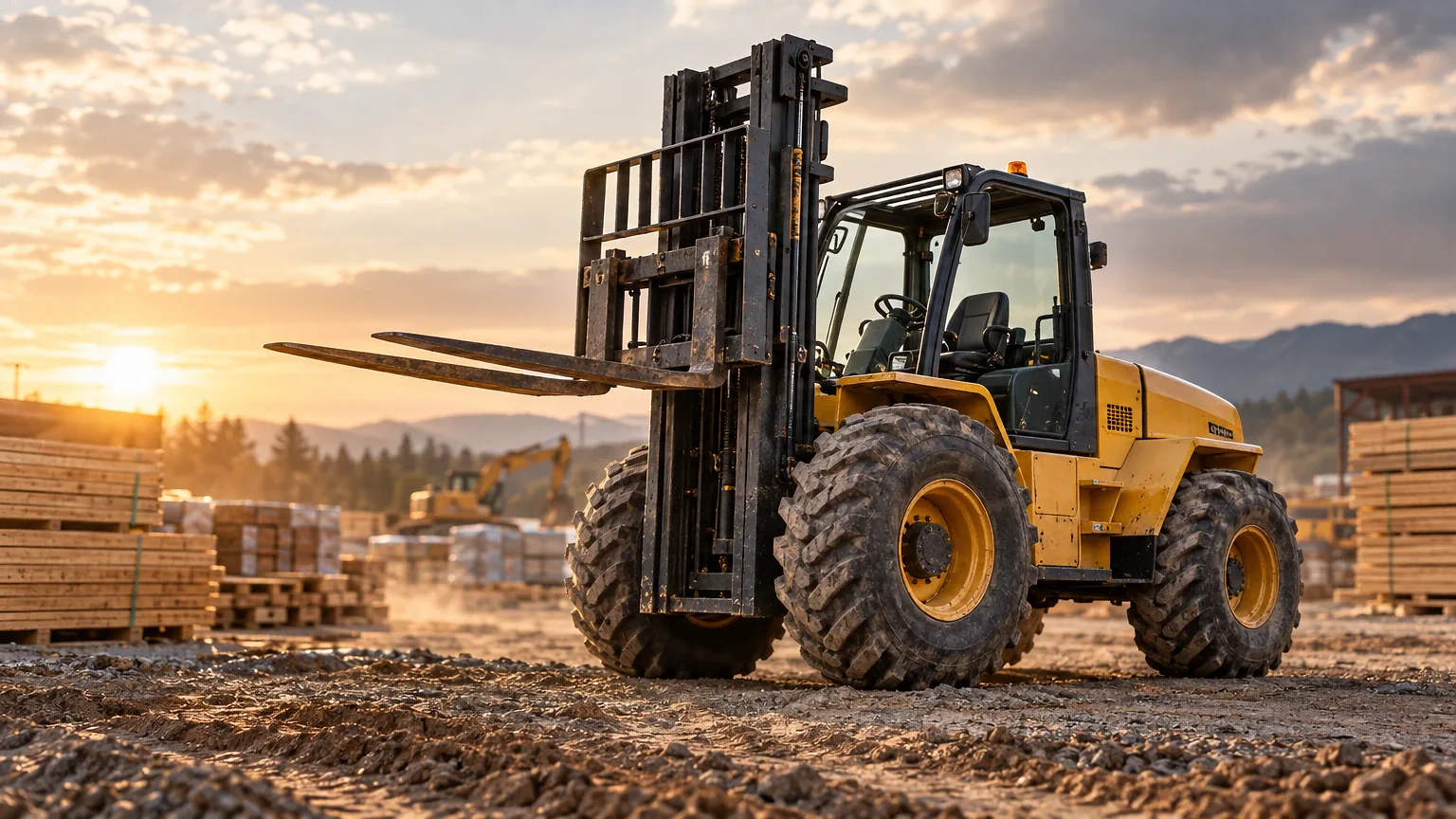
Most yards buy the wrong rough terrain forklift because they size it like a warehouse truck. That’s backward. On uneven ground, tire footprint and mast geometry matter more than raw capacity rating on a spec sheet.
A rough terrain forklift is a pneumatic-tired, off-road lift truck. It handles construction sites, lumber yards, and outdoor work where pavement does not exist. Capacities typically run 6,000 to 10,000 lbs, with specialty units pushing higher. Maybe you are choosing between models, or weighing one against a telehandler. Either way, the details below will save you a bad purchase order.
What Separates a Rough Terrain Forklift From a Standard Forklift
Standard warehouse forklifts, including the common sit down forklift, run on cushion or solid tires. They need a flat, hard floor. Put one on gravel or mud and you’ll snap an axle seal within a week.
Rough terrain forklifts use large, deep-tread pneumatic tires, often foam-filled to resist punctures from rebar and scrap. The mast sits higher off the ground, and the frame has more clearance underneath. Four-wheel drive is standard on most models from JCB and Manitou, which matters when you’re working a staging yard after rain.
The center of gravity is also different. A rough terrain unit carries a wider wheelbase and a counterweight tuned for side-to-side stability. That holds on slopes up to roughly 15 degrees. Warehouse trucks instead use flat-floor tipping math. Picture a crew unloading roofing trusses at a job site where the laydown area is compacted dirt with ruts from delivery trucks. A cushion-tire forklift would bottom out or lose traction. The rough terrain model just climbs over it.
Capacity Ranges and How to Match Load Weight
Capacity ratings on rough terrain forklifts aren’t flat numbers. They drop as load center and lift height increase, same as any forklift, but the curve is steeper because of the taller mast.
A typical 6,000 lb rough terrain forklift is rated at a 24-inch load center. Move that pallet’s center of gravity out to 36 inches, common with long lumber or pipe, and the truck might only handle 4,200 lbs safely. This is where crews get hurt: they read the capacity plate once and never check it again for oversized loads.
For most lumber yards and masonry suppliers, a 6,000 to 8,000 lb unit covers block, brick, and bagged material. Site prep and heavy civil contractors moving precast or steel beams usually step up to 10,000 lb class machines, sometimes with telescoping booms if reach matters more than raw lift.
Always check the data plate for the actual rated load at your load center and lift height, not the headline number on the brochure. OSHA’s powered industrial truck standard requires operators to know this before every lift, and insurers will ask for it after an incident.
Tire Type, Terrain, and Traction Decisions
Pneumatic rubber tires come in two flavors on these machines: air-filled and foam-filled. Air-filled is cheaper and rides smoother, but a single puncture on a demo site can shut down a shift.
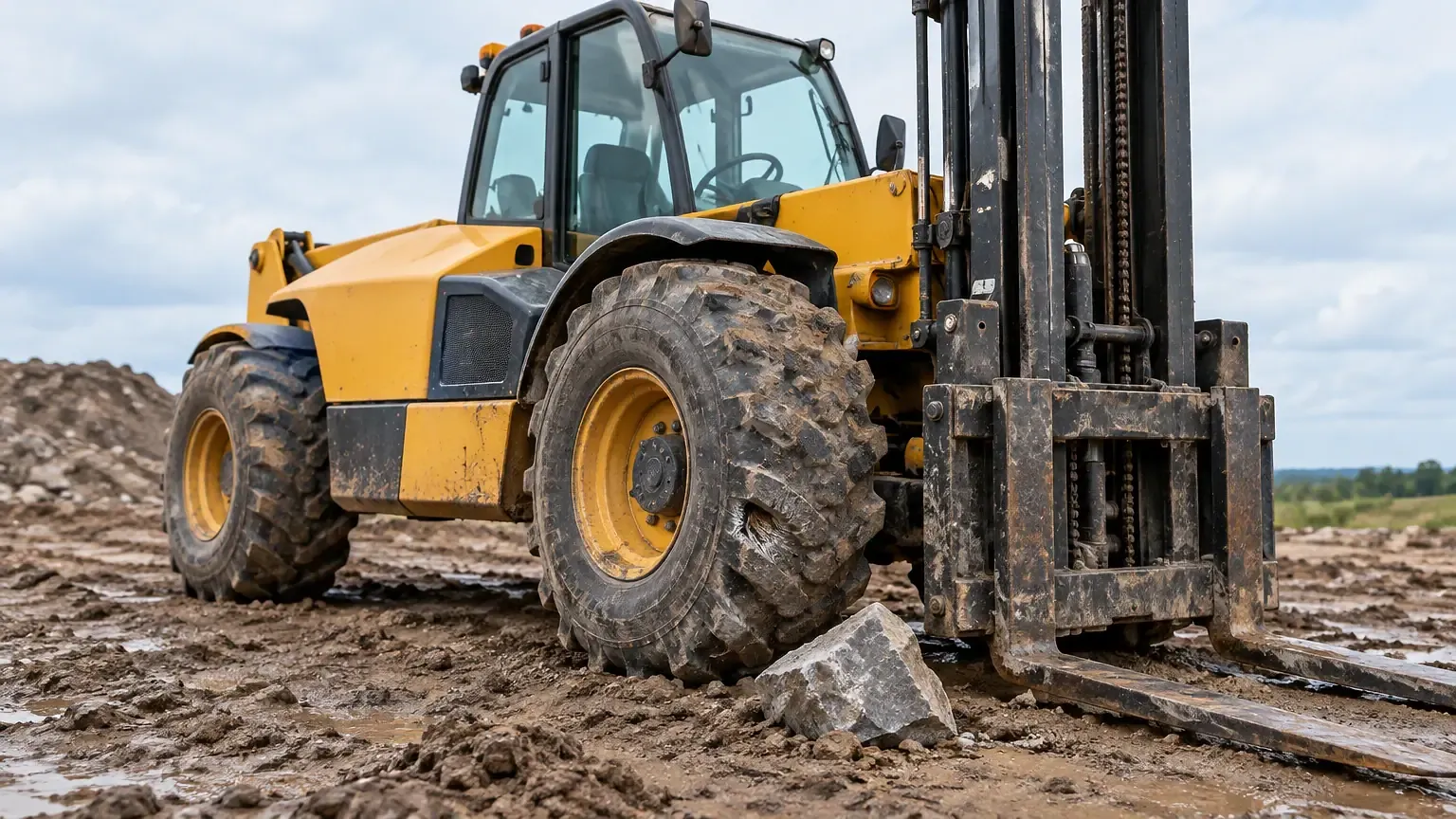
Foam-filled tires solve the flat-tire problem entirely. They cost more upfront, roughly double the price of an air-filled equivalent, but crews working active construction sites with nail-laden debris consider that a fixed cost of doing business, not a luxury.
Tread pattern matters too. An aggressive lug tread grips mud and loose aggregate but wears fast on asphalt. If your rough terrain forklift splits time between a paved yard and an unpaved job site, a general-purpose tread is the better call. Four-wheel drive with a locking differential, offered on most Case Construction and Bobcat rough terrain models, handles washouts and inclines that two-wheel drive units simply can’t climb.
Rough Terrain Forklift vs Telehandler vs Standard Forklift
This is the comparison that actually decides a purchase. Here’s how the three stack up on the factors that matter in the field.
| Factor | Rough Terrain Forklift | Telehandler | Standard Warehouse Forklift |
|---|---|---|---|
| Typical capacity | 6,000-10,000 lbs | 5,000-12,000 lbs | 3,000-5,000 lbs |
| Max lift height | 10-15 ft | Up to 55 ft | 15-20 ft |
| Reach | Vertical mast only | Telescoping boom | Vertical mast only |
| Terrain | Unpaved, uneven | Unpaved, uneven | Flat, paved/smooth concrete |
| Best use case | Heavy, low-lift loads on rough ground | High or extended-reach placement | Indoor pallet handling |
| Typical buyer | Lumber yards, masonry, site prep | General contractors, roofers | Distribution centers, 3PLs |
If you need to set a load on a second-story deck or reach over a foundation wall, a telehandler’s boom does that and a straight-mast rough terrain forklift can’t. But if you’re just muscling pallets of block off a flatbed in a yard with no obstacles, the rough terrain forklift is simpler, cheaper to maintain, and has a tighter turning radius.
Rental Versus Purchase Economics
Buying new makes sense when the machine runs five days a week, year-round. A new 6,000 lb rough terrain forklift from a dealer typically lands in the mid-to-high five figures depending on options, and resale value holds up reasonably well if maintenance records are clean.
Rental makes more sense for short-duration jobs or seasonal spikes. National rental houses like United Rentals and Sunbelt Rentals stock rough terrain forklifts by the day, week, or month, and monthly rates usually beat buying if you need the machine less than four to six months a year.
Used equipment is the middle path. Hour meters matter more than model year here. A machine with 2,500 hours and documented hydraulic service history is a safer bet than a low-hour unit with no paperwork. Always pull maintenance logs before signing, and have a mechanic check mast chains and hydraulic cylinder seals, the two components that fail first on neglected units.
Maintenance and Safety Checks That Actually Matter
Daily inspection isn’t optional paperwork, it’s the difference between catching a cracked lift chain in the yard versus catching it mid-lift.
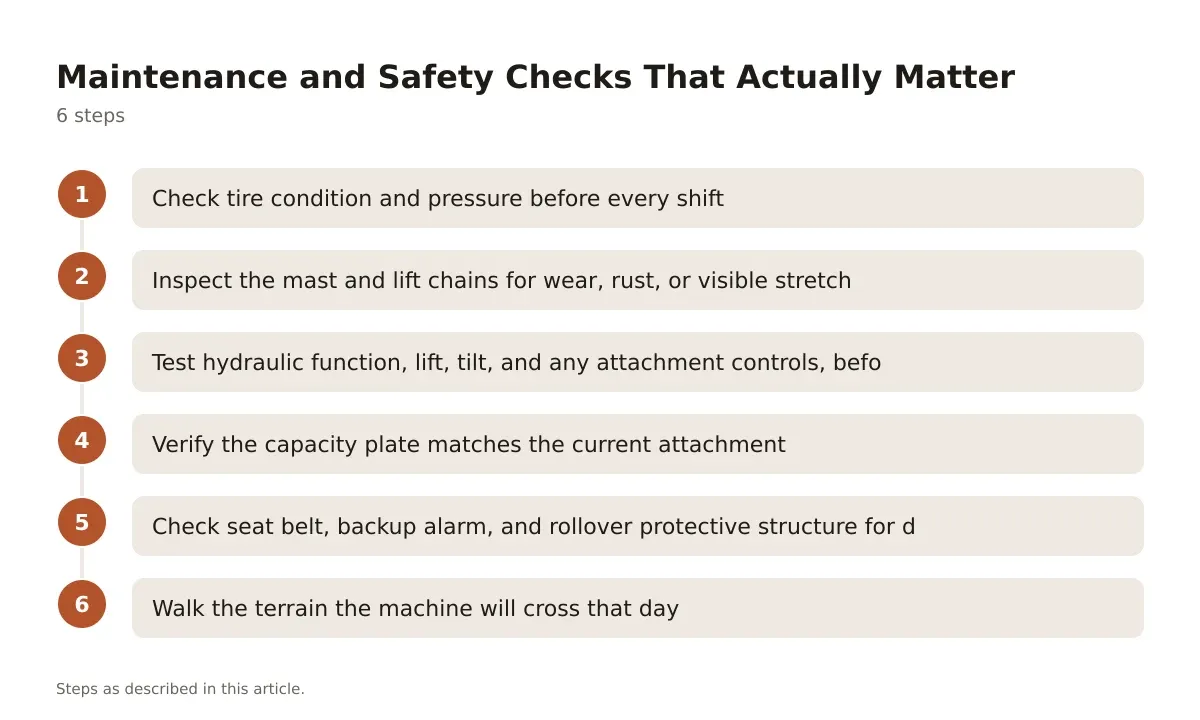
- Check tire condition and pressure before every shift. Foam-filled tires don’t need pressure checks, but inspect for chunking and sidewall damage.
- Inspect the mast and lift chains for wear, rust, or visible stretch. A chain that’s stretched more than 3% needs replacement per manufacturer spec.
- Test hydraulic function, lift, tilt, and any attachment controls, before loading anything.
- Verify the capacity plate matches the current attachment. Swapping to forks with a longer carriage changes the rated load.
- Check seat belt, backup alarm, and rollover protective structure for damage.
- Walk the terrain the machine will cross that day. Soft shoulders and hidden drop-offs cause more rollovers than overloading does.
Operators need certification under OSHA’s powered industrial truck training rules, and rough terrain units often require a separate endorsement beyond standard warehouse forklift certification because the stability triangle and visibility are different. Skipping that training is the single most common root cause investigators find after rough terrain forklift tip-overs.
Choosing the Right Machine for Your Site
The honest answer is that most crews overbuy capacity and underbuy traction. A 10,000 lb machine sitting idle most days costs more in fuel and tires than a well-matched 6,000 lb unit working at 80% of its rated load.
Walk your actual terrain before you shop. Measure the worst slope, the softest ground condition, and the heaviest single load you’ll move regularly. Match the forklift to that reality, not to the biggest number a sales rep quotes you. A rough terrain forklift bought for the job it will actually do, rather than the job you might someday have, is the one that earns its keep.
Frequently asked questions
What is a rough terrain forklift used for?
It’s used for lifting and moving materials on unpaved or uneven ground, common on construction sites, lumber yards, and landscaping supply yards. The pneumatic tires and raised ground clearance let it cross gravel, mud, and rutted dirt that would stop a standard warehouse forklift.
How much weight can a rough terrain forklift lift?
Most models handle 6,000 to 10,000 lbs at a 24-inch load center, though capacity drops as load center distance or lift height increases. Always check the data plate for the rated load at your specific conditions rather than relying on the advertised maximum.
Do I need a separate license to operate a rough terrain forklift?
Operators need training under OSHA’s powered industrial truck standard, and many employers require a rough terrain-specific endorsement because stability and visibility differ from standard forklifts. Certification typically involves classroom instruction plus a hands-on evaluation on the actual terrain the operator will work.
Is a telehandler better than a rough terrain forklift?
Neither is universally better, they solve different problems. A telehandler’s telescoping boom reaches higher and farther, while a rough terrain forklift is simpler, often cheaper to maintain, and better suited to straightforward low-lift loads on rough ground.
Should I rent or buy a rough terrain forklift?
Rent if the job is short-term or seasonal, since monthly rental rates usually beat ownership costs for anything under four to six months of annual use. Buy if the machine will run near full-time, and consider a well-documented used unit as a middle option if upfront cost is a concern.