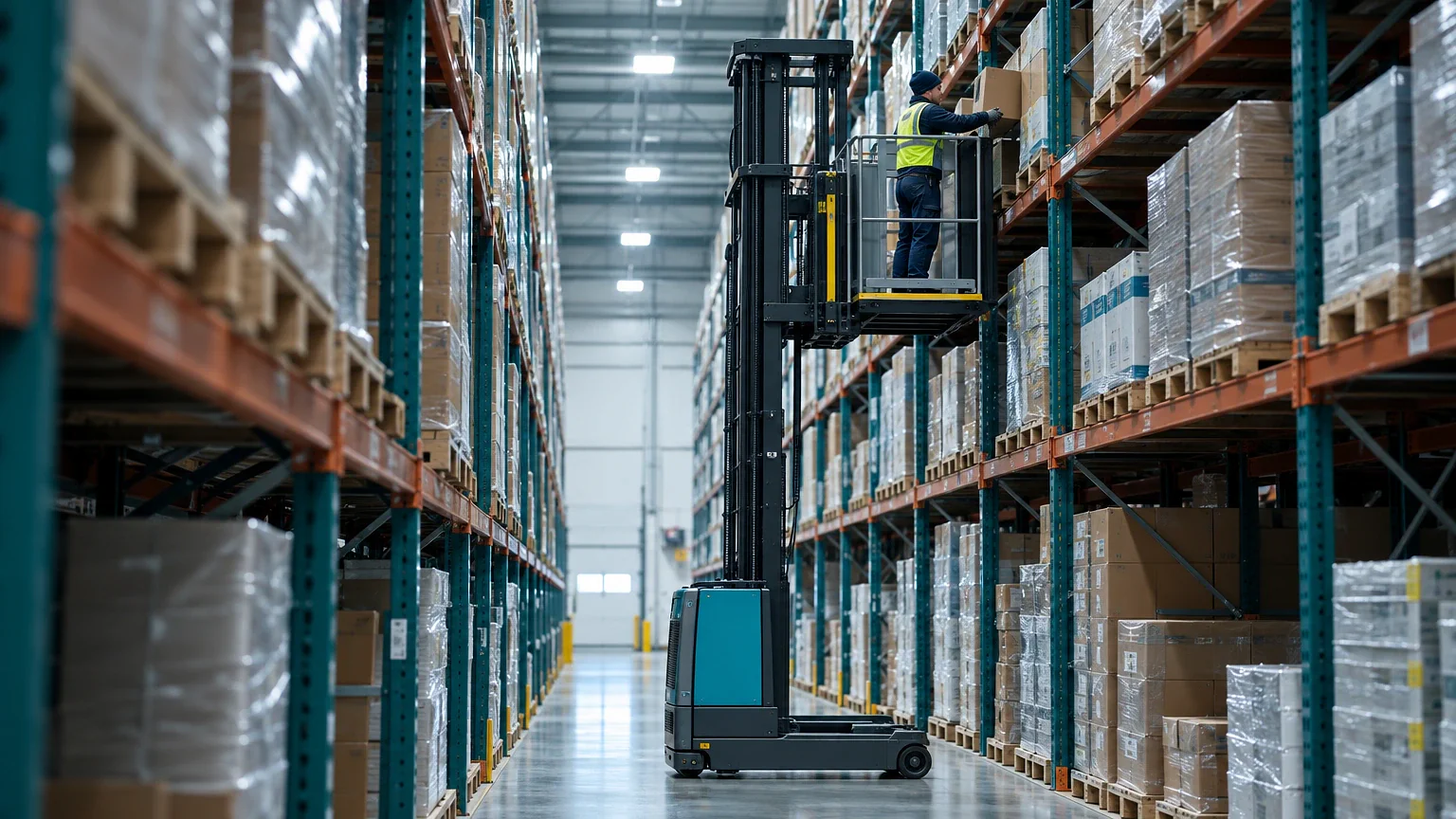
A typical order picker forklift lifts an operator to heights of 20 to 32 feet. From that platform, they pick directly from pallet racking. This cuts horizontal travel. One person now does work that once needed a picker plus a separate lift truck. That single change routinely lifts pick rates by 30 to 50 lines per hour in narrow-aisle operations. This guide breaks down the types, capacities, and where each one actually earns its keep.
If you’re stuck between a stock picker, a swing-reach truck, and a standard reach forklift, the decision usually comes down to aisle width and pick density, not brand preference.
What Is an Order Picker Forklift
An order picker forklift, also called a stock picker, raises the operator on a platform along with the forks. The person rides up with the load instead of staying on the ground and reaching with an attachment.
Definition: An order picker forklift is a warehouse lift truck. It elevates the operator’s platform alongside the forks. The operator then hand-picks individual items or cartons straight from racking at height. It does more than move whole pallets.
This matters because case-pick and each-pick operations don’t move full pallets. They move boxes, sleeves, and single SKUs. A Crown or Raymond order picker gets the person to the product instead of forcing them to guess reach distances from a cage.
Most models run on 36-volt or 48-volt electric systems. Lift heights range from 20 feet on low-level units to over 32 feet on high-level “very narrow aisle” configurations. Load capacities typically sit between 2,500 and 3,500 pounds, though some heavy-duty models push past 4,000.
Low-Level vs High-Level Order Pickers
Not all stock pickers do the same job. The split between low-level and high-level units changes everything about layout, racking, and throughput.
Low-level order pickers lift the operator to roughly 6 to 13 feet. They’re built for split-case picking in the first two or three rack levels, where most fast-moving SKUs live anyway. A grocery distribution center often runs slotted flow racks at ground level. It uses these instead of full-height units. After all, most operators never need to go higher.
High-level order pickers reach 20 to 32 feet and sometimes beyond. You see these trucks gliding down aisles as narrow as 60 inches. Wire guidance or rail guidance keeps them centered. A parts distributor with tall, dense racking leans on these. They multiply cube utilization, and the building never has to expand.
The tradeoff is speed versus reach. Low-level units accelerate and stop faster because there’s less mast to stabilize. High-level units move slower vertically. In return, they open up storage density that a low-level truck simply cannot touch. Get this choice wrong and you either waste vertical cube or bottleneck your fastest pickers on travel time.
5 Order Picker Forklift Types to Know
Here are the five configurations you’ll actually encounter on a warehouse floor, ranked from most common to most specialized.
- Low-level order picker – Platform height under 13 feet, ideal for case picking in the lower rack tiers of a standard distribution center.
- High-level order picker – Reaches 20 to 32+ feet, built for very narrow aisle (VNA) layouts with wire or rail guidance.
- Swing-reach order picker – Combines picking height with a rotating fork carriage, letting one truck both pick and put away pallets in aisles as narrow as 66 inches.
- Turret truck – A specialized VNA machine where the mast rotates 180 degrees instead of the whole truck turning, common in cold storage and automated high-bay warehouses.
- Double-deep order picker – Extended reach forks that access two pallet positions deep, used where footprint is tight but SKU count is high.
Each of these solves a different aisle-width and pick-density problem. Picking the wrong one usually shows up later as wasted rack space or an operator waiting on travel time instead of picking.
Capacity and Lift Height by Application
Matching capacity to load, not just to catalog specs, is where a lot of warehouses get burned. Here’s how the numbers actually play out on the floor.
A standard low-level order picker rated at 3,000 pounds handles most case-pick work without strain. After all, actual carton loads rarely exceed 800 to 1,200 pounds per pick run. High-level units rated at 2,500 to 3,000 pounds show up often in VNA racking systems. There, the racking itself, not the truck, usually sets the real limit.
Racking load capacity varies by manufacturer and configuration, but a standard selective pallet rack beam pair commonly carries 2,000 to 5,000 pounds per level depending on beam gauge and upright spacing. Before you spec a high-capacity order picker, confirm your racking’s rated load matches, because a truck that can lift more than the rack can hold is a liability, not an asset.
Lift height also drives battery and mast selection. A 32-foot reach demands a heavier counterweight. It also needs a wider footprint than a 20-foot unit, even at the same rated capacity. If your building has 28-foot clear height but you buy a 20-foot-max truck, you’ve permanently capped your storage density on day one.
Order Picker vs Reach Truck vs Cherry Picker
People mix these terms up constantly, and it costs them money at the buying stage.
An order picker forklift raises the operator with the load, letting them physically hand-pick items from shelving. A reach truck keeps the operator on the ground and extends the forks forward to place or retrieve whole pallets, it’s built for pallet-in, pallet-out work, not each-picking. A cherry picker, in warehouse terms, usually refers to a boom lift or scissor lift used for maintenance and access work, not routine SKU picking, though the term gets used loosely on some floors to mean an order picker. If your team is comparing options across these categories, our cherry picker forklift guide breaks down that terminology and capacity range in more depth.
The practical test: if your job is picking individual units or cases from a shelf, you need an order picker. If your job is moving full pallets in and out of deep racking, you need a reach truck. Buying a reach truck for an each-pick operation means operators climbing ladders or using clip-on platforms, which is slower and a safety headache.
Buying and Renting: 5 Questions to Answer First
Before you request quotes, work through these five questions. Skipping any one of them tends to show up later as a truck that doesn’t fit the building or the workload.
- What’s your maximum required lift height? Measure your tallest active pick face, not your average, and add clearance for mast collapse height versus your dock door and ceiling.
- What’s your minimum aisle width? VNA trucks need guidance systems, either wire-in-floor or rail, which adds installation cost but lets you run aisles under 6 feet.
- Electric or is propane even an option? Nearly all order pickers run on electric power. Operators work at height, and combustion exhaust in enclosed racking is a nonstarter. Budget for charging infrastructure alongside the truck.
- New, used, or rental? A new high-level order picker from Toyota Material Handling or Crown often runs well into six figures, while rental fits seasonal peak volume or a short-term project without the capital outlay.
- What’s your operator certification plan? OSHA requires powered industrial truck operators to be trained and evaluated per truck type, and order pickers count as their own category under OSHA 29 CFR 1910.178.
⚠️ Warning: Never let an operator use fall protection improvised from pallet wrap or rope. Order picker platforms require OSHA-compliant harnesses and lanyards for the lift height. Auditors cite this gap as one of their most common violations.
Get these five answered honestly, and the quote process gets a lot shorter, because you’ll already know which two or three models are even in contention.
Quick Questions Ops Managers Ask Before Buying
Do order pickers work outdoors? Rarely. Makers build most units for smooth, level indoor concrete floors. The small wheels and a high center of gravity at full extension also make outdoor or uneven surfaces risky.
Can one truck handle both low and high picking? Yes, if you buy a high-level unit, it covers the lower tiers too, just at reduced speed efficiency for those quick low-level grabs. Many operations still run a mixed fleet because a low-level unit is cheaper and faster for the 80% of picks that happen near the ground.
How long does operator training take? Formal classroom and hands-on evaluation for a first-time operator typically runs one to two days. The exact time depends on facility complexity and truck type, per OSHA guidelines.
Getting the Right Fit for Your Warehouse
The order picker forklift you need depends on three things: your rack height, your aisle width, and how many of your picks happen at each tier. Get an honest read on those before you talk to a dealer, not after.
Low-level units win in high-volume, ground-level case picking. High-level and VNA configurations win when land is expensive and cube utilization matters more than pick speed per line. Swing-reach and turret trucks earn their premium price only when you genuinely need both picking and put-away in the same narrow aisle.
If your facility is also weighing electric power options across its broader fleet, it’s worth reviewing an electric forklift buying guide alongside your order picker decision, since battery infrastructure and charging schedules often get planned together. Whatever you land on, match the truck to the racking’s rated capacity first. Everything else is a secondary decision.
Frequently asked questions
What is the difference between an order picker and a stock picker?
There’s no real difference, they’re the same equipment. “Stock picker” is simply the older, more common term in some regions, while “order picker” has become the standard term as ecommerce fulfillment has grown.
What certification does an order picker operator need?
Operators need OSHA-compliant powered industrial truck training specific to order pickers, covering both driving and the fall-protection requirements unique to elevated platforms. OSHA requires recertification after three years, or sooner after an accident or near-miss.
How much does an order picker forklift cost?
Pricing varies widely by lift height, guidance system, and new versus used condition, so get a quote-based estimate from a dealer like Crown, Raymond, or Toyota rather than relying on a rule of thumb. Rental is a common alternative for seasonal spikes without committing to a purchase.
Can an order picker forklift be used outside?
Generally no. Makers build most models for smooth indoor floors. Their small wheelbase and high lift height also make outdoor terrain and weather a real tip-over risk.
What racking works best with a high-level order picker?
Selective pallet racking and VNA (very narrow aisle) racking systems pair best. Both suit the guided, straight-line travel these trucks need. Always confirm the beam load rating matches or exceeds your heaviest expected pick-face load before installing.